- Animals
- ›Arthropods
- ›Hexapods
- ›Insects
- ›Winged and Once-winged Insects
- ›Butterflies and Moths
- ›Eriocranioidea
- ›Sparkling Archaic Sun Moths
- ›Eriocrania
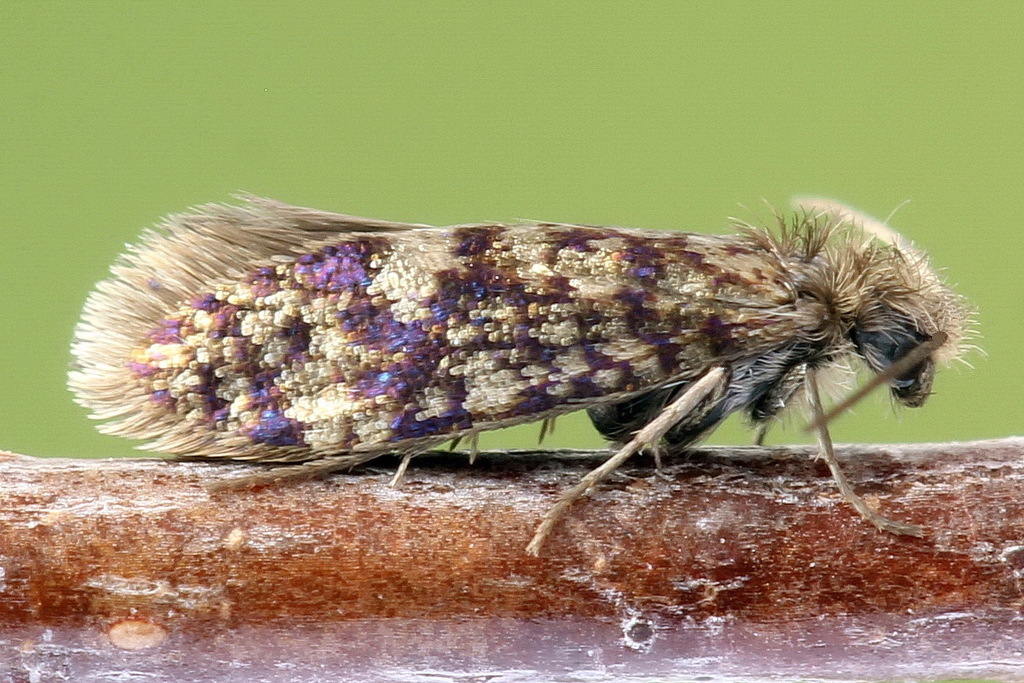
Washed Purple
Eriocrania cicatricella
Eriocrania cicatricella is a moth of the family Eriocraniidae found in Europe. It was first described by Johan Wilhelm Zetterstedt in 1839. The larvae mine the leaves of birch (Betula species).
From the article Eriocrania cicatricella on Wikipedia (CC BY-SA), quoted section by section
Description
The wingspan is about 11 mm. The head is fuscous, somewhat mixed with grey-whitish. The forewings are rather elongate, pale shining golden, strigulated and spotted with purple and the veins posteriorly purple. There is a rather indistinct transverse dorsal spot of ground-colour before the tornus, not reaching half across wing; cilia light grey. Vein 9 is absent. The hindwings are grey, towards apex purplish-tinged.
In human culture
Zetterstedt originally put the moth in the genus Adela, which was raised by the French zoologist, Pierre André Latreille in 1796. The name comes from the Greek adelos, which describes the larval habit of concealing itself in a portable case; although in the case of this moth, the larvae live within the tissue of a leaf! The moth is now in the genus Eriocrania, which was raised by Philipp Christoph Zeller in 1851. Erion means wool and kranion means the upper part of the head, which refers to the hair-scales on the top of the head. The specific name, cicatricella is from cicatrix, a scar – referring to the indistinct transverse dorsal spot.
Wikipedia: “Etymology”
Listen
Looking for field recordings…
Where it lives
Recorded sightings
—
geo-referenced records in GBIF, from museums, herbaria and field observers.
Drag the globe to turn it. Dots are where records exist, not a range map; darker means more records.
In the stacks
Searching the stacks…
Every page naming Eriocrania cicatricella in the Biodiversity Heritage Library →
This page is assembled live from iNaturalist, GBIF, Wikipedia, the Source Library and the Internet Archive. It is not yet part of the hand-edited codex. iNaturalist taxon 173551.