- Fungi Including Lichens
- ›Basidiomycete Fungi
- ›Higher Basidiomycetes
- ›Mushrooms, Bracket Fungi, Puffballs, and Allies
- ›Agaricomycetidae
- ›Common Gilled Mushrooms and Allies
- ›Agaricineae
- ›Galeropsidaceae
- ›Panaeolus
- ›Copelandia
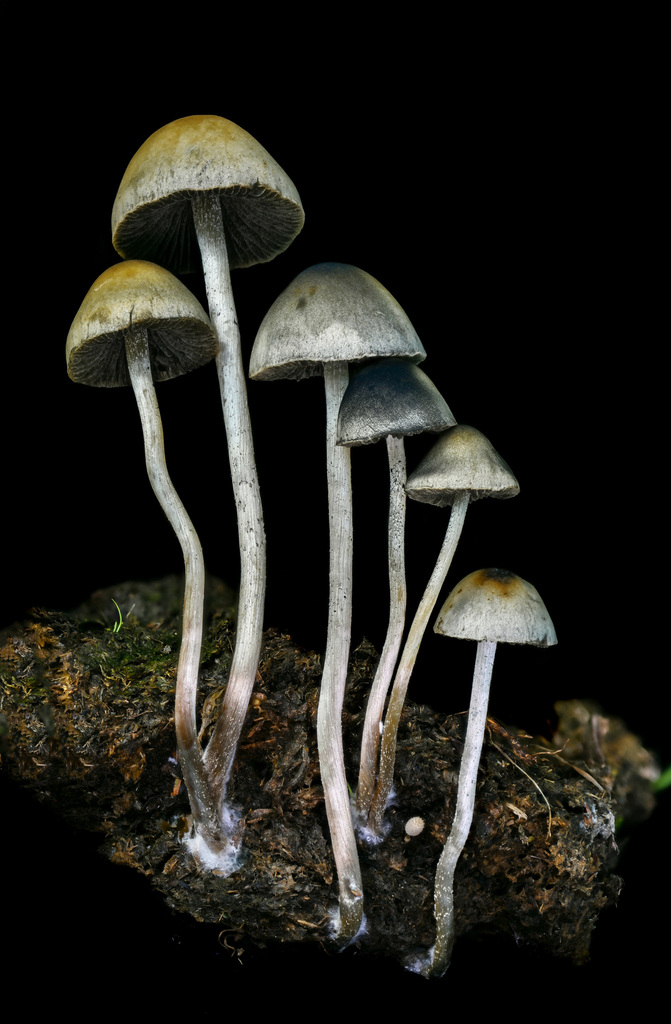
Blue Meanies
Panaeolus cyanescens
Panaeolus cyanescens, also known as Copelandia cyanescens, is a mushroom in the Bolbitiaceae family. Panaeolus cyanescens is a psilocybin mushroom and is similar to Panaeolus tropicalis.
From the article Panaeolus cyanescens on Wikipedia (CC BY-SA), quoted section by section
Description
The cap is 1.5–4 centimetres (1⁄2–1+1⁄2 in) across, dry, at first hemispheric, expanding to campanulate or convex, with an incurved margin when young. Young caps start out light brown and fade to off-white or light gray at maturity, sometimes with yellowish or brownish tones. Often developing cracks in dry weather, slightly hygrophanous, turning greenish or blue where damaged. The gills are broadly adnate to adnexed, close, starting out gray and turning black as the spores mature. The gill faces have a mottled appearance and the edges are white. The spore print is black. The stipe is 6–12 cm long by 2 to 4 mm thick, equal to slightly enlarged at the base, pruinose, colored like the cap, staining somewhat blue where bruised. The taste and odor are farinaceous.
Microscopic features. The spores are jet black, 12–15 x 7–11 μm, smooth, opaque, elliptical. With a germ pore. Basidia 4 spored, pleurocystidia fusoid-ventricose, cheilocystidia 12 x 4 μm.
Range & habitat
Panaeolus cyanescens is a coprophilous (dung-inhabiting) species which occurs in both the Neotropics and Paleotropics. It has been found in Vietnam, Africa (including South Africa, Mauritius, Madagascar and Democratic Republic of the Congo), Australia, Belize, the Caribbean (Bermuda, Grenada, Barbados Jamaica, Trinidad, and Puerto Rico), Costa Rica, India, Malaysia, Indonesia, Sri Lanka, Cambodia, Thailand, Japan, Mexico, Oceania (Fiji and Samoa), the Philippines, South America (Bolivia, Brazil, Paraguay, Colombia, Venezuela, and Ecuador), South Korea, and the United States (California, Hawaii, Louisiana, Mississippi, Alabama, Florida, Tennessee, Texas, Kentucky, Virginia, Georgia, and North Carolina).
Wikipedia: “Distribution and habitat”
Where it lives
Recorded sightings
—
geo-referenced records in GBIF, from museums, herbaria and field observers.
Drag the globe to turn it. Dots are where records exist, not a range map; darker means more records.
In the stacks
Searching the stacks…
Every page naming Panaeolus cyanescens in the Biodiversity Heritage Library →
This page is assembled live from iNaturalist, GBIF, Wikipedia, the Source Library and the Internet Archive. It is not yet part of the hand-edited codex. iNaturalist taxon 179100.