- Plants
- ›Vascular Plants
- ›flowering plants
- ›Dicots
- ›pinks, cactuses, and allies
- ›cacti
- ›Opuntioideae
- ›Cylindropuntieae
- ›Quiabentia
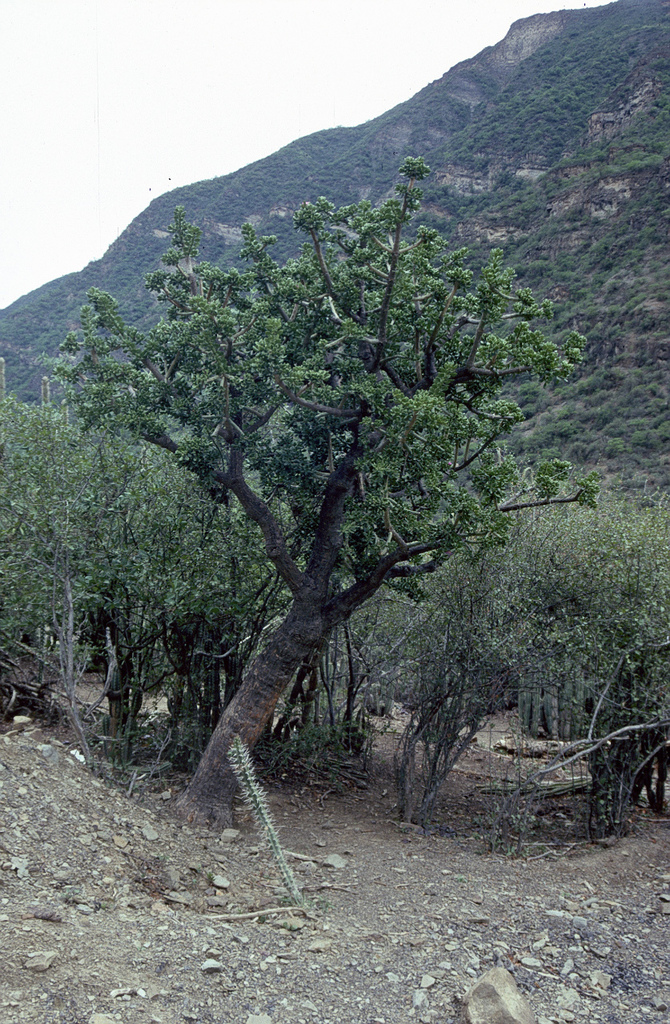
Quiabentia verticillata
Quiabentia verticillata is a species of cactus found in the neotropical forests of the Gran Chaco region (eastern Bolivia, western Paraguay, northern Argentina, and parts of Brazil).
From the article Quiabentia verticillata on Wikipedia (CC BY-SA), quoted section by section
Description
It is an erect woody succulent plant, growing tree-shaped or shrub-like and reaches heights of 2–15 m (7–49 ft). Its leaves, which are approximately 5 cm (2 in) long and up to 2 cm (1 in) wide, are oval to lanceolate (long, wider in the middle, shaped like a lance tip). Like many cacti, it bears leaves which have become specialized as spines. The spines (up to 7 cm (3 in) long) consist of the stipules of the leaves, and protect the plant from browsing by herbivores. It also bears a second type of leaf that is thickened and fleshy, with a somewhat angular cross-section. These leaves and the stems of the plant enable the storage of water. The bright red flowers are 1.5 centimeters long.
Range & habitat
Quiabentia verticillata is found in the neotropical forests of the Gran Chaco region (eastern Bolivia, western Paraguay, northern Argentina, and parts of Brazil). It grows in dry sandy soils, typically found at the edge of fields, in wastelands, at the side of roads, and opportunistically in vineyards and orchards when they are not irrigated.
Wikipedia: “Distribution”
At the table
Like most cacti, it is a xerophyte, capable of growing in areas receiving very little precipitation. It has a laterally extensive, shallow root system.
Wikipedia: “Cultivation and uses”
Where it lives
Recorded sightings
—
geo-referenced records in GBIF, from museums, herbaria and field observers.
Drag the globe to turn it. Dots are where records exist, not a range map; darker means more records.
In the stacks
Searching the stacks…
Every page naming Quiabentia verticillata in the Biodiversity Heritage Library →
This page is assembled live from iNaturalist, GBIF, Wikipedia, the Source Library and the Internet Archive. It is not yet part of the hand-edited codex. iNaturalist taxon 181133.