
cacti
Cactaceae
A cactus (pl.: cacti, cactuses, or less commonly, cactus) is a member of the plant family Cactaceae (), a family of the order Caryophyllales comprising about 131-140 genera with some 1,866 up to 2000+ known species. The word cactus derives, through Latin, from the Ancient Greek word κάκτος (káktos), a name originally used by Theophrastus for a spiny plant whose identity is now not certain. Cacti occur in a wide range of shapes and sizes. They are native to the Americas, ranging from Patagonia in the south to parts of western Canada in the north, with the exception of Rhipsalis baccifera, which is also found in Africa and Sri Lanka. Cacti are adapted to live in very dry environments, including the Atacama Desert, one of the driest places on Earth. Because of this, cacti show many adaptations to conserve water. For example, almost all cacti are succulents, meaning they have thickened, fleshy organs adapted to store water. Unlike many other succulents, the stem is the only part of most cacti where water storage takes place. Most species of cacti have lost true leaves, retaining only spines, which are highly modified leaves. As well as defending against herbivores, spines help prevent water loss by reducing air flow close to the cactus and providing some shade. In the absence of true leaves, cacti's enlarged stems carry out photosynthesis.
Cactus spines are produced from specialized structures called areoles, a kind of highly reduced branch. Areoles are an identifying feature of cacti. As well as spines, areoles give rise to flowers, which are usually tubular and multipetaled.
6 branches of this family, most-observed first

globular cacti, moonlight cacti, torch cacti, and allies
subfamilyCactoideae

Opuntioideae
subfamilyOpuntioideae

Pereskioideae
subfamilyPereskioideae
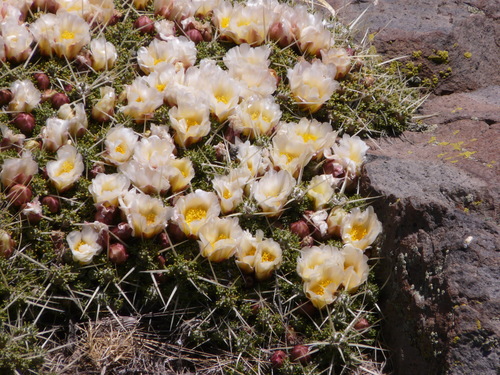
Maihuenioideae
subfamilyMaihuenioideae
Viridicereus
genusViridicereus
Floribunda
genusFloribunda
Where it lives
Recorded sightings
—
geo-referenced records in GBIF, from museums, herbaria and field observers.
Drag the globe to turn it. Dots are where records exist, not a range map; darker means more records.
In the stacks
Searching the stacks…
Every page naming Cactaceae in the Biodiversity Heritage Library →
This page is assembled live from iNaturalist, GBIF, Wikipedia, the Source Library and the Internet Archive. It is not yet part of the hand-edited codex. iNaturalist taxon 47903.