- Plants
- ›Vascular Plants
- ›flowering plants
- ›Dicots
- ›Nances, Willows, and Allies
- ›St. John's wort family
- ›St. John's worts tribe
- ›Hypericum
- ›Androsaemum
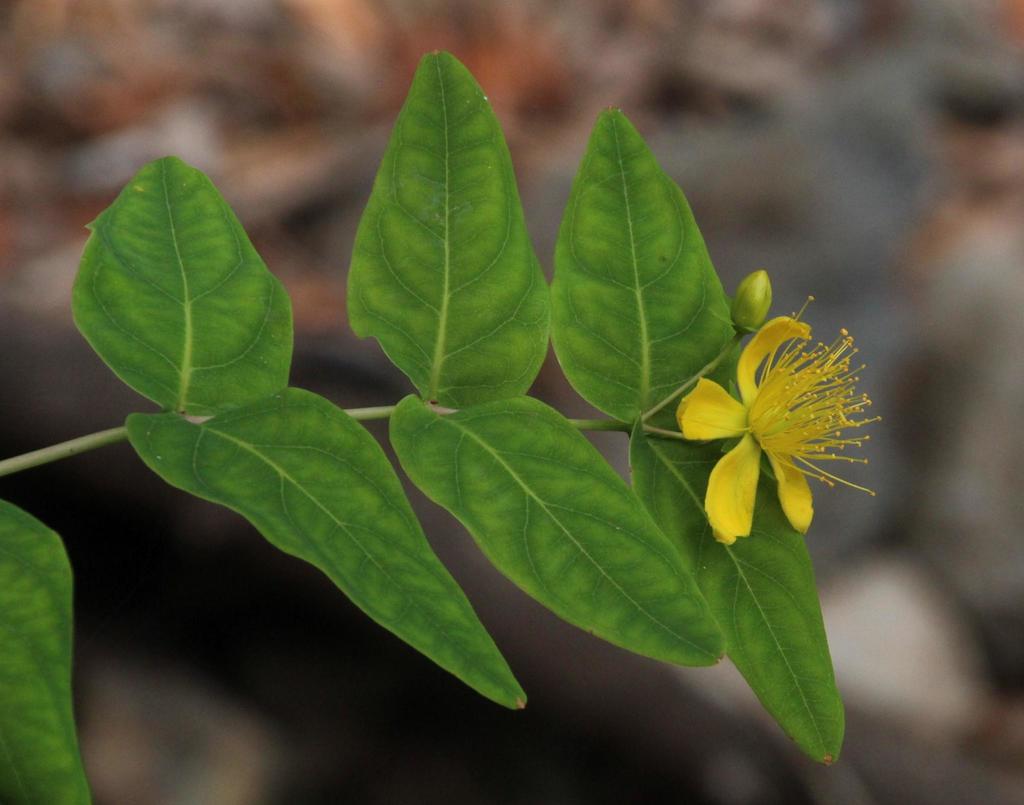
Large-leaved Saint John's Wort
Hypericum grandifolium
Hypericum grandifolium, the large-leaved St John's wort, is a species of flowering plant in the family Hypericaceae. The plant is a bushy shrub that can grow to almost 2 meters tall. It has large leaves, golden yellow petals, and seed capsules that split open. H. grandifolium is native to the Canary Islands and Madeira in Macaronesia, but has become invasive in other regions, including California, after escaping from cultivation as an ornamental plant. It is parasitized by wasps and fungi, and is capable of reproducing through its rhizomes.
First described in 1821 by Jacques Choisy, the ambiguity of its original description meant that the species was often misidentified. Specimens were variously called H. elatum, H. anglicum, Androsaemum webbianum, and others. The species was placed into section Androsaemum of Hypericum by Norman Robson in 1984, and it is most closely related in appearance and classification to the other species in the section, especially H. androsaemum, H. hircinum, and H. × inodorum. The species is not used in modern medical applications, but may have anticancer potential and could be used to treat ear edemas.
From the article Hypericum grandifolium on Wikipedia (CC BY-SA), quoted section by section
Description
Hypericum grandifolium is a bushy shrub that grows 50–180 centimeters tall. Its branches generally grow upright or almost upright. Across its distribution, different populations look almost identical and the species has minimal geographic variation in appearance.
Vegetative structures. When the plant is young, the stems are somewhat flattened and have four lines that run longitudinally up their length. When it matures, they become more cylindrical and have only two lines. There are nodes with leaves every 0.2–0.4 cm along the stem. The bark on the outside of the stem is scaly. The leaf blades are directly connected to the stem, and sometimes partially wrap around it. The blade is roughly 4–9 cm long by 2.5–4.5 cm wide and is a triangular-oval or oblong-oval shape. The end is blunt or rounded, and the base is flat or rounded. It is the same color on top and bottom and has a papery texture. There are four or five pairs of large lateral veins, and the leaf's network of tiny tertiary veins is visible on the top side. The leaf's glands are small, but they are found densely along its edges.
Flowering structures. Each cluster of flowers has anywhere from 1–13 individual flowers. They come from two nodes on the stem that are separated by the same distance as the leaves are from each other. …
Range & habitat
The native distribution of Hypericum grandifolium are the Spanish Canary Islands and the Portuguese island of Madeira. The species is also a garden plant, and has become invasive after escaping from cultivation in non-native areas. For example, it is invasive and spreading in the San Francisco Bay Area, forming dense stands that force out native plants. It was first recorded in California in 2010, and is suspected to be harmful to the native ecology by the California Invasive Plant Council. H. grandifolium has become naturalized in parts of Australia and in Chile, but is listed as a weed in other parts of Australia like South Australia and Victoria. The species can be found at elevations of 200–1,500 meters on the Canary Islands and 400–500 on Madeira. Its habitat is among evergreen forests like those of Laurus trees. It is also present on stony hillsides and cliffsides. In areas that have been deforested by wildfire, Hypericum grandifolium is a colonizing species that grows in the years following the disturbance. It often grows alongside the shrub Ageratina adenophora in California, where both species are invasive. Hypericum grandifolium is a host to several parasites. These include the wasp Euderomphale gomer, the rust fungus Melampsora hypericorum, and rarely the honey fungus Armillaria. H. …
Wikipedia: “Distribution, habitat, and ecology”
In human culture
The genus name Hypericum is possibly derived from the Greek words hyper (above) and eikon (picture), in reference to the tradition of hanging the plant over religious icons in the home. The specific epithet grandifolium is made of the Latin words grandis (large, full) and folium (leaf). As such, it is called the large-leaved St John's wort in English. Hypericum grandifolium is known as malfurada, malfurada grande, and corazoncillo in Spanish, the language used where it is native. The name corazoncillo is a diminutive form of the Spanish word for heart, corazon.
Wikipedia: “Etymology”
Where it lives
Recorded sightings
—
geo-referenced records in GBIF, from museums, herbaria and field observers.
Drag the globe to turn it. Dots are where records exist, not a range map; darker means more records.
In the stacks
Searching the stacks…
Every page naming Hypericum grandifolium in the Biodiversity Heritage Library →
This page is assembled live from iNaturalist, GBIF, Wikipedia, the Source Library and the Internet Archive. It is not yet part of the hand-edited codex. iNaturalist taxon 181908.