 NL·0660
Herbarium of the Nature Library
- Name
- Ramphastos toco
- Family
- Ramphastidae
- Native to
- Guianas, Brazil (excluding most of the Amazon rainforest interior), eastern Bolivia, Paraguay and northern Argentina
- Habitat
- Savanna (Cerrado), Wetland woodland (Pantanal), Gallery forest
On eBird ↗
Toco Toucan
Live sightings near you, the range map, bar charts of when it is seen, and Macaulay Library photos and recordings.
Toco toucan
Ramphastos toco
Also calledTucanuçu (Portuguese, from Tupi) · Tucán toco (Spanish)
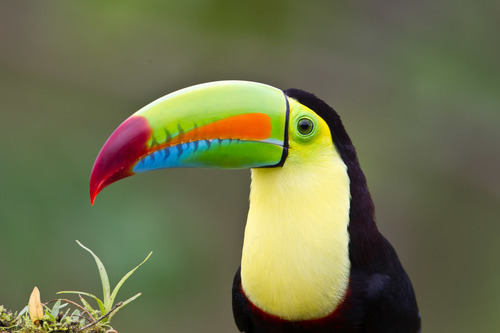
The largest toucan, with an enormous orange bill tipped in black. Unlike most toucans it lives in open savanna and woodland, and uses its bill as a radiator to shed body heat.
The toco toucan is a species of bird in the toucan family Ramphastidae. It is the largest species of toucan and has a distinctive appearance, with a black body, a white throat, chest and uppertail-coverts, and red undertail-coverts. Its most conspicuous feature is its huge beak, which is yellow-orange with a black base and a large spot on the tip. It is endemic to South America, where it has a wide distribution from the Guianas south to northern Argentina and Uruguay, and its range has recently been expanding southwards. Unlike other toucans, which inhabit continuous forests, toco toucans inhabit a variety of semi-open habitats at altitudes of up to 1,750 m (5,740 ft). They are especially common in the Brazilian cerrado, gallery forests, and the wetlands of the Pantanal. Wikipedia
What it can do
- iRegulates blood flow to its bill to dump heat; the bill can account for a large share of total heat loss (Tattersall et al., Science, 2009)
- iiBill about 19–23 cm long yet very light
- iiiRaids nests of other birds for eggs and nestlings
- ivDisperses seeds of Cerrado and Pantanal trees
In the field
Field marks
- aHuge, bright orange bill with a black tip and a black spot at the base
- bBlack body with white throat and bib
- cOrange bare skin around the eye, with a blue eye-ring
- dWhite uppertail and red undertail coverts
- Voice
- A deep, grunting, croaking 'grrr-grrr' or 'groonk', often in series.
- Not to be confused with
- White-throated (Red-billed) Toucan has a dark reddish bill with a yellow ridge and lives in rainforest. Channel-billed Toucan has a black bill with a blue base.
- Where to see it
- The Pantanal (Mato Grosso), Iguaçu Falls, Emas National Park and towns of the Brazilian Cerrado.
- When
- Resident year-round
Listen
Looking for field recordings…
Life & habits
- Diet
- Fruit, insects, eggs, nestlings and small reptiles
- Habitat
- Savanna, open woodland, palm groves, plantations and towns
- Size
- 55–65 cm; 500–860 g
It tucks its bill under its back feathers while sleeping, which reduces heat loss on cool nights.
Where it lives
Recorded sightings
—
geo-referenced records in GBIF, from museums, herbaria and field observers.
Native range
Guianas, Brazil (excluding most of the Amazon rainforest interior), eastern Bolivia, Paraguay and northern Argentina
Drag the globe to turn it. Dots are where records exist, not a range map; darker means more records.
In the old herbals & bestiaries
Woodcuts and engravings matched from the Source Library’s scanned books by name. Plates marked “relative” show a close kin rather than this exact species. Click a plate to read the page it came from, with translation.

In the stacks
Searching the stacks…
Every page naming Ramphastos toco in the Biodiversity Heritage Library →
Marginalia
The word 'toucan' comes through Portuguese from the Tupi name for the bird; early European naturalists in Brazil, including Georg Marcgrave in the 1640s, described and drew toucans.
Curiosity
In the Pantanal it is both the main seed disperser of the manduvi tree — the Hyacinth Macaw's main nest tree — and a major predator of Hyacinth Macaw eggs.
Kinship




Fact-checked: 1 correction made to this sheet. Photographs: iNaturalist contributors under the licences shown. Records: GBIF.org. Historical plates: Source Library (CC BY-SA 4.0; originals public domain). Summary text: Nature Library editors and Wikipedia (CC BY-SA). Medicinal and edibility notes are historical and educational, not advice. iNaturalist taxon 18793.