 NL·0650
Herbarium of the Nature Library
- Name
- Ara macao
- Family
- Psittacidae
- Native to
- Southern Mexico through Central America to the Amazon basin
- Habitat
- Tropical rainforest, Gallery forest, Savanna woodland
On eBird ↗
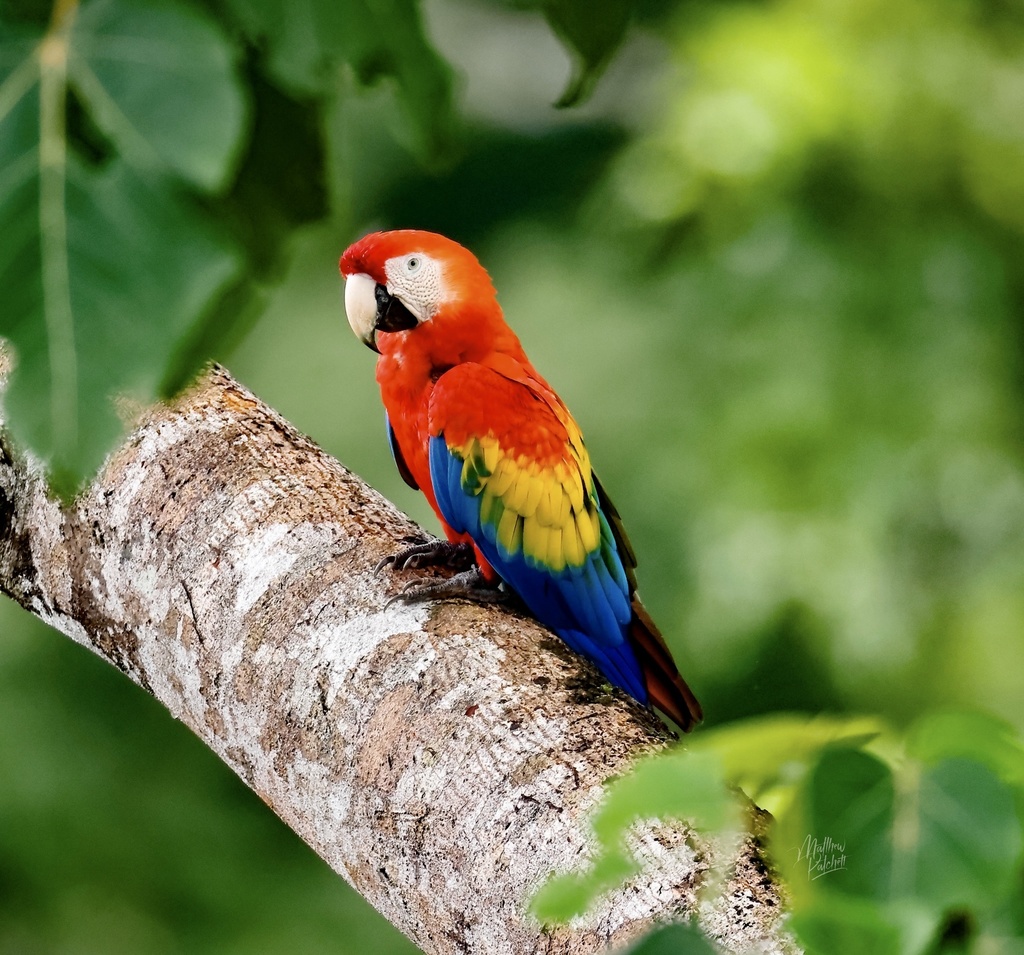
Scarlet Macaw
Live sightings near you, the range map, bar charts of when it is seen, and Macaulay Library photos and recordings.
Scarlet macaw
Ara macao
Also calledGuacamaya roja (Spanish) · Arara-vermelha (Portuguese) · Mo' (Yucatec Maya) · Alo (Nahuatl, macaw)
A large red, yellow and blue parrot of tropical American forests. It gathers on riverbank clay licks in the Amazon to eat soil.
The scarlet macaw also called the red-and-yellow macaw, red-and-blue macaw or red-breasted macaw, is a large yellow, green, red and blue Neotropical parrot native to humid evergreen forests of the Americas. Its range extends from southeastern Mexico to Peru, Ecuador, Colombia, Bolivia, Venezuela, Honduras, and Brazil in lowlands of 500 m (1,600 ft) up to 1,000 m (3,300 ft), the Caribbean island of Trinidad, as well as the Pacific island of Coiba. Formerly, the northern extent of its range included southern Tamaulipas. In some areas, it has suffered local extinction because of habitat destruction, or capture for the parrot trade, but in other areas, it remains fairly common. It is the national bird of Honduras. Like its relative the blue-and-yellow macaw, the scarlet macaw is a popular bird in aviculture as a result of its striking plumage. It is the third most common macaw species in captivity after the blue-and-yellow and red-and-green macaw respectively. In recent years it has become much rarer in captivity and much more expensive due to stricter laws, its price being higher than even red-and-green macaws. Wikipedia
What it can do
- iBeak cracks extremely hard nuts and seeds
- iiEats clay from riverbanks, possibly for sodium and to neutralise plant toxins
- iiiFlies at around 55 km/h
- ivCan live for over 40 years and forms lifelong pair bonds
In the field
Field marks
- aLarge scarlet parrot with a very long pointed tail
- bYellow band across the upperwing, blue flight feathers
- cBare white facial skin
- dPale upper bill
- Voice
- Loud, harsh, far-carrying screeches, often given in flight
- Not to be confused with
- Red-and-green macaw has green wing coverts instead of yellow and lines of tiny red feathers on its white face.
- Where to see it
- Clay licks of Tambopata, Peru; Carara National Park and the Osa Peninsula, Costa Rica
- When
- Resident
Listen
Looking for field recordings…
Life & habits
- Diet
- Seeds, nuts, fruit, flowers and nectar
- Habitat
- Humid lowland forest, especially near rivers
- Size
- 81–96 cm including tail; ~1 kg
- Lifespan
- 40–50 years; longer in captivity
Pairs fly wingtip to wingtip and gather in noisy flocks at dawn at clay licks.
Where it lives
Recorded sightings
—
geo-referenced records in GBIF, from museums, herbaria and field observers.
Native range
Southern Mexico through Central America to the Amazon basin
Drag the globe to turn it. Dots are where records exist, not a range map; darker means more records.
In the old herbals & bestiaries
Woodcuts and engravings matched from the Source Library’s scanned books by name. Plates marked “relative” show a close kin rather than this exact species. Click a plate to read the page it came from, with translation.

François Bouchard — Recueil de cent-trente-trois oiseaux des plus belles especes (1775)
François Bouchard · 1775 · p.137

Ornithology
Ulisse Aldrovandi · 1599 · p.699

Ornithology: The History of Birds
Ulisse Aldrovandi · 1599 · p.696

Ornithology: The History of Birds
Ulisse Aldrovandi · 1599 · p.698

François Bouchard — Recueil de cent-trente-trois oiseaux des plus belles especes (1775)
François Bouchard · 1775 · p.141
In the stacks
Searching the stacks…
Every page naming Ara macao in the Biodiversity Heritage Library →
Marginalia
Live scarlet macaws were traded north from Mexico to the ancestral Puebloans of Chaco Canyon around 900–1150 CE for their feathers. It is the national bird of Honduras.
Curiosity
Macaw skeletons at Pueblo Bonito suggest the birds were kept far from their native range a thousand years ago.
Kinship
Photographs: iNaturalist contributors under the licences shown. Records: GBIF.org. Historical plates: Source Library (CC BY-SA 4.0; originals public domain). Summary text: Nature Library editors and Wikipedia (CC BY-SA). Medicinal and edibility notes are historical and educational, not advice. iNaturalist taxon 19022.