- Animals
- ›Arthropods
- ›Chelicerates
- ›Arachnids
- ›Scorpions
- ›Neoscorpionina
- ›Orthosterni
- ›Buthida
- ›Flat-tailed and Bark Scorpions
- ›Arrowbreasted Scorpions
- ›Androctonus
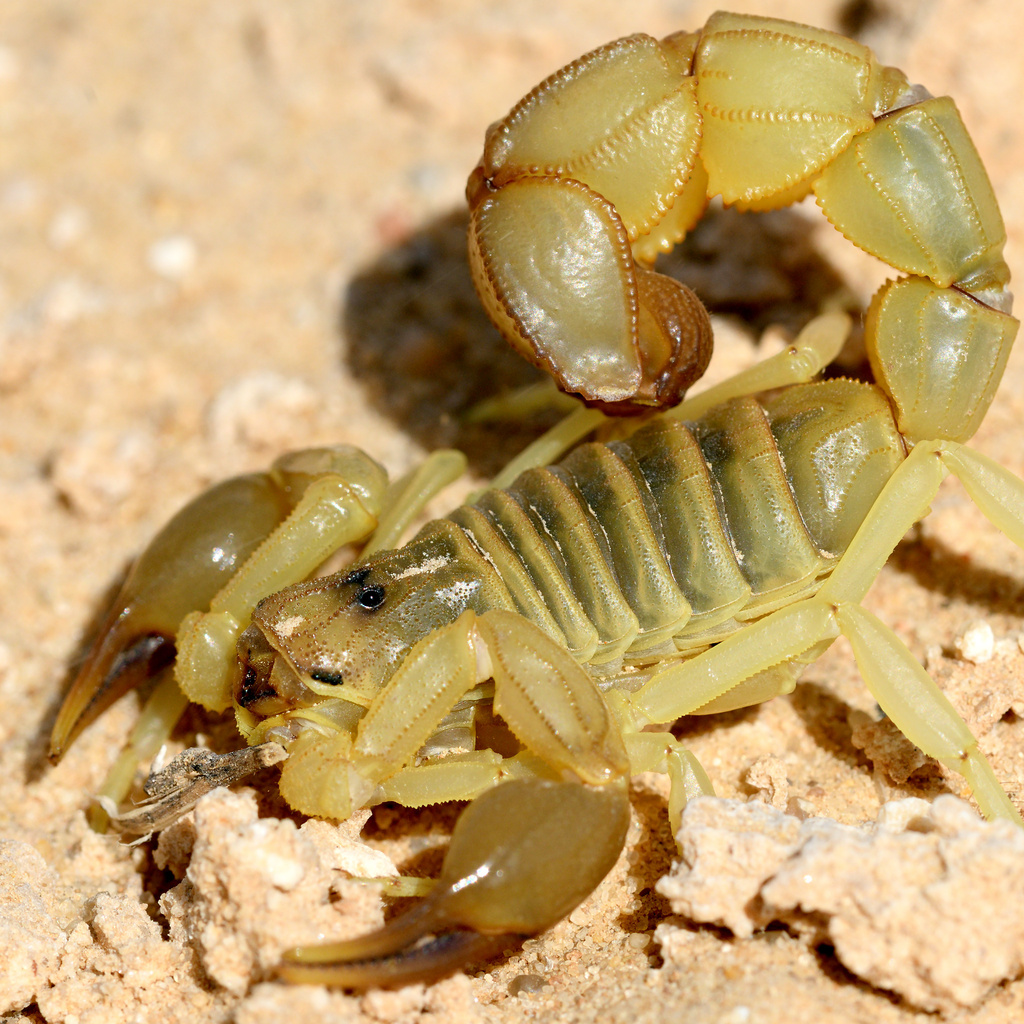
Androctonus australis
Androctonus australis, the yellow fat-tailed scorpion, is a hardy desert scorpion from North Africa. Older data indicated the species may have a broader distribution throughout the Middle East to India, but discredited in more recent studies which revise many generally similar allies from those regions as different species.
From the article Androctonus australis on Wikipedia (CC BY-SA), quoted section by section
Description
Androctonus australis is a medium-sized scorpion which can grow up to 10 centimeters in length. It has a very thick and powerful tail, and stripes on the sides of its dome for better vision while attacking another animal or for the use of self-defense. It is an animal of nocturnal habit, during the day it hides in humid and dark places, while the night goes out to hunt, it feeds on insects, small lizards and even small mammals. Cannibalism has been reported in this species. It is found mainly in deserts and arid places.
Wikipedia: “Description and behavior”
Toxicity
Androctonus australis has very potent venom and is one of the world's most dangerous scorpions due to its relative toxicity and temperament. It claims several lives each year. It has the most potent venom of its kind, it is mainly composed of neurotoxins, cardiotoxins and myotoxins and additional hemotoxins, deaths in humans usually occur by heart and respiratory failure, sometimes by cerebral hemorrhage, organ dysfunction and shock. The LD50 for this species is 0.32 mg / kg subcutaneously. The AaTX1 toxin was originally found in the venom of Androctonus australis.
In human culture
The name Androctonus australis is derived from the Greek word Androctonus (roughly translated as "man-killer") and the Latin word australis (translated as "south") which together translate as "southern man-killer".
Wikipedia: “Etymology”
Where it lives
Recorded sightings
—
geo-referenced records in GBIF, from museums, herbaria and field observers.
Drag the globe to turn it. Dots are where records exist, not a range map; darker means more records.
In the stacks
Searching the stacks…
Every page naming Androctonus australis in the Biodiversity Heritage Library →
This page is assembled live from iNaturalist, GBIF, Wikipedia, the Source Library and the Internet Archive. It is not yet part of the hand-edited codex. iNaturalist taxon 197001.