- Animals
- ›Arthropods
- ›Hexapods
- ›Insects
- ›Winged and Once-winged Insects
- ›Ants, Bees, Wasps, and Sawflies
- ›Narrow-waisted Wasps, Ants, and Bees
- ›Ants, Bees, and Stinging Wasps
- ›Bees and Apoid Wasps
- ›Bees
- ›Sweat Bees
- ›Sweat and Furrow bees
- ›Halictini
- ›Halictina
- ›Lasioglossum
- ›Dialictus
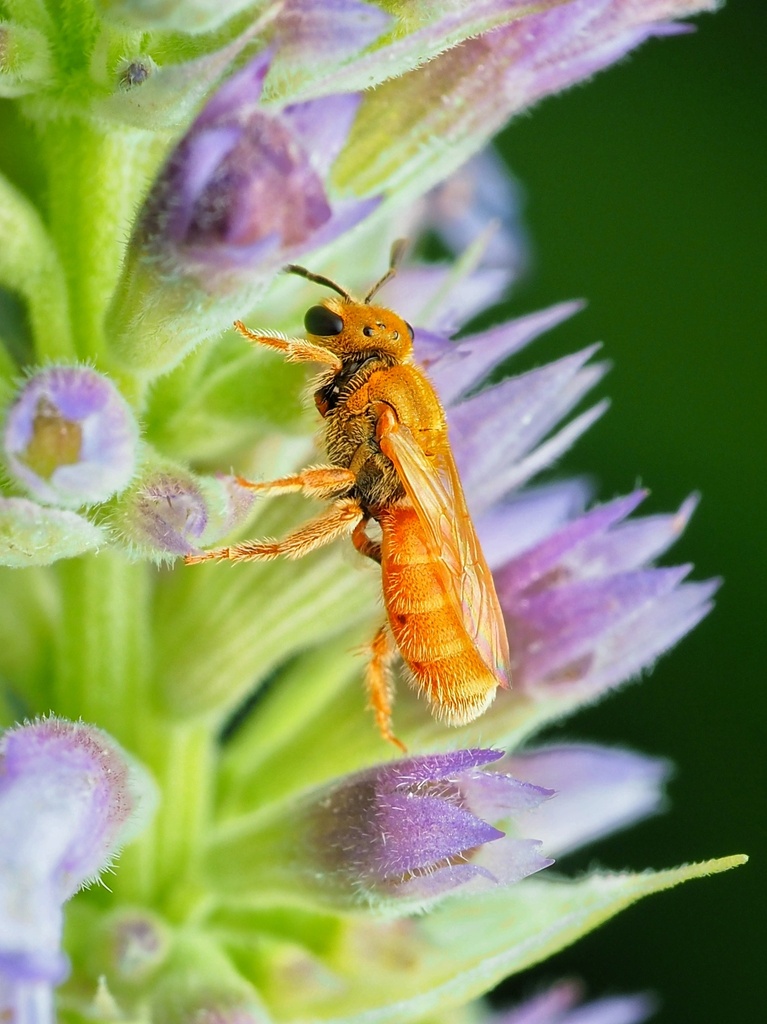
Viereck's Sweat Bee
Lasioglossum vierecki
Lasioglossum vierecki, also known as Dialictus vierecki and Halictus vierecki, is a sand sweat bee and is part of the family Halictidae of the order Hymenoptera. It is found in the eastern half of North America from Minnesota to the New England States down to Georgia and Louisiana and up in Manitoba and Ontario. Commonly found in sandy areas, it pollinates various flowers such as grass-leaved goldenrod (Euthamia graminifolia) and rattlesnake master (Eryngium yuccifolium).
From the article Lasioglossum vierecki on Wikipedia (CC BY-SA), quoted section by section
Description
L. vierecki can be distinguished by its extremely hairy, orange-yellow abdomen with clear golden yellow hair on its scutellum, and pits touching the scutellum. There are several other differences from bees that have similar colored abdomen. Its antennae is darker on the bottom half, and the rugae reaches the top of the metathorax, which has narrowly spaced punctures. Though the abdomen has punctures as well, it does not have a bronze-colored reflection and is not smooth and shiny. The mesonotum, which is the same color as the abdomen, is not smooth and polished in the middle and has small punctures. The first abdominal segment differs from other segments due to its bluer color and punctures. The legs are lighter but not polished.
Females. Female L. vierecki are distinguished by extensively yellow legs with a brown tint on the top half of the clypeus, a pale yellow-brown metasoma, and a very dense, slightly yellow tomentum on the mesosoma, metasomal terga, and head.
Males. Male L. vierecki are recognized by their smaller size and many punctures on the scutum of their middle thoracic segment.
Wikipedia: “Description and identification”
Range & habitat
L. vierecki is found in eastern North America from Minnesota to the New England states and south to Louisiana and Georgia as well as in Canada in Manitoba and Ontario. They are known as sand specialist bees, which means that they only nest in sand or only visit plants restricted to sand.
Flowers visited. L. vierecki pollinates several flowers throughout the eastern part of North America. In New Jersey they have been found on Ceanothus, Hydrangea, Rubus, Specularia, Helianthus, Monarda, and Solidago. In Illinois, they have been found on:
Wikipedia: “Distribution and habitat”
What it does
L. vierecki is considered a solitary bee. These types of bees exhibit solitary behavior, where a female raises the entire brood by herself and lives alone in her own nest. This behavior could have evolved from eusociality. L. vierecki is active between April and September.
Wikipedia: “Behavior and ecology”
Listen
Looking for field recordings…
Where it lives
Recorded sightings
—
geo-referenced records in GBIF, from museums, herbaria and field observers.
Drag the globe to turn it. Dots are where records exist, not a range map; darker means more records.
In the stacks
Searching the stacks…
Every page naming Lasioglossum vierecki in the Biodiversity Heritage Library →
This page is assembled live from iNaturalist, GBIF, Wikipedia, the Source Library and the Internet Archive. It is not yet part of the hand-edited codex. iNaturalist taxon 199077.