 NL·0707
Herbarium of the Nature Library
- Name
- Sphenodon punctatus
- Family
- Sphenodontidae
- Native to
- Offshore islands of New Zealand; reintroduced to fenced sanctuaries on the mainland
- Habitat
- Coastal forest, Island scrub, Seabird colonies
Tuatara
Sphenodon punctatus
Also calledTuatara (Māori, 'peaks on the back') · Ngārara (Māori, reptiles generally)
Not a lizard but the sole survivor of an order of reptiles, the Rhynchocephalia, which flourished in the age of the dinosaurs. It lives on cool islands off New Zealand, grows slowly, breeds rarely and can live for more than a century.
The tuatara is a species of reptile endemic to New Zealand. Despite its close resemblance to lizards, it is the only extant member of a distinct lineage, the previously highly diverse order Rhynchocephalia. The name tuatara is derived from the Māori language and means "peaks on the back". Wikipedia
What it can do
- iThe only living member of the reptile order Rhynchocephalia
- iiHas a 'third eye' (parietal eye) with a lens and retina on top of its head, visible in hatchlings
- iiiActive at temperatures as low as ~5 °C, colder than most reptiles tolerate
- ivSex of hatchlings depends on nest temperature; warmer nests produce more males
In the field
Field marks
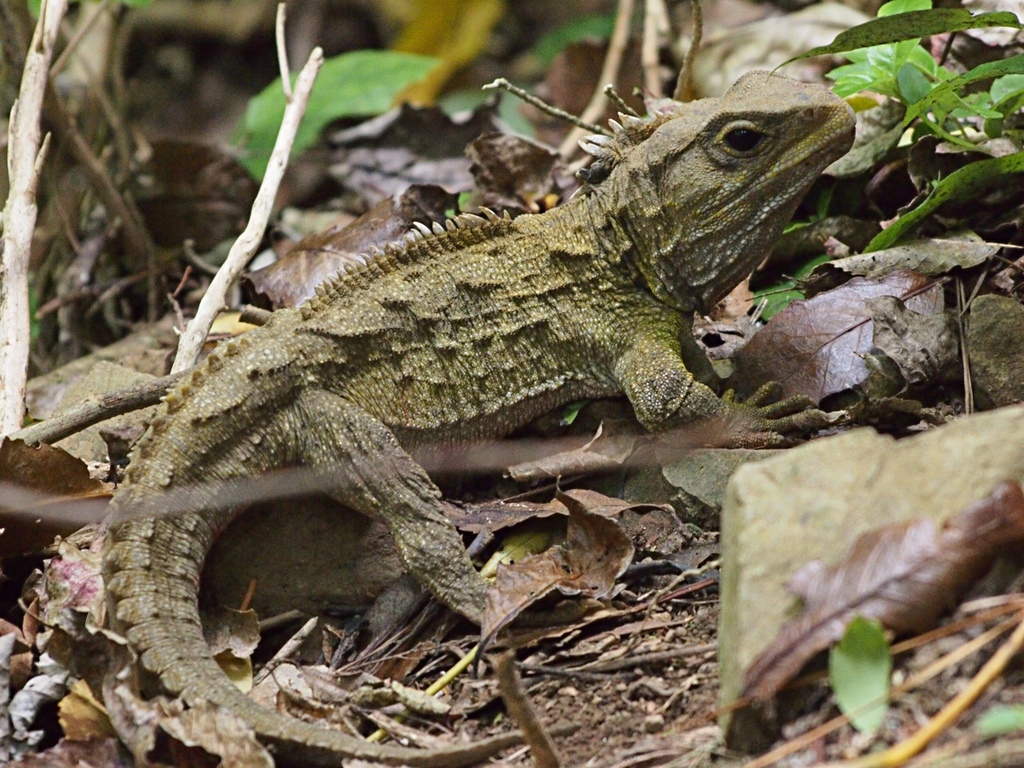
- aLizard-like body, olive-green to grey or reddish
- bSpiny crest along the neck and back, larger in males
- cNo external ear openings
- dSaw-like teeth fused to the jaw bone
- Not to be confused with
- Superficially like a large lizard, but no lizard in New Zealand has a spiny crest like this. It has no external ear opening and a beak-like upper jaw.
- Where to see it
- Zealandia Ecosanctuary (Wellington), Orokonui (Dunedin), Tiritiri Matangi Island; Stephens Island (Takapourewa) has the largest population but is closed to the public
- When
- Resident; most active on warm, humid nights
Life & habits
- Diet
- Beetles, wētā, spiders, worms, seabird eggs and chicks, lizards
- Habitat
- Coastal forest and scrub on islands, often sharing burrows with seabirds such as petrels
- Size
- Males up to ~60 cm and 1 kg; females smaller
- Lifespan
- Can exceed 100 years
Nocturnal. It shares burrows with nesting seabirds. Females breed only every 2–5 years, and eggs take 11–16 months to hatch.
Where it lives
Recorded sightings
—
geo-referenced records in GBIF, from museums, herbaria and field observers.
Native range
Offshore islands of New Zealand; reintroduced to fenced sanctuaries on the mainland
Drag the globe to turn it. Dots are where records exist, not a range map; darker means more records.
In the stacks
Searching the stacks…
Every page naming Sphenodon punctatus in the Biodiversity Heritage Library →
Marginalia
To many Māori tuatara are taonga (treasures) and kaitiaki (guardians) of knowledge. Albert Günther showed in 1867 that it was not a lizard but the last of an ancient reptile lineage.
Curiosity
'Henry', a tuatara at the Southland Museum in Invercargill, became a father in 2009 at the age of about 111.
Kinship



Photographs: iNaturalist contributors under the licences shown. Records: GBIF.org. Historical plates: Source Library (CC BY-SA 4.0; originals public domain). Summary text: Nature Library editors and Wikipedia (CC BY-SA). Medicinal and edibility notes are historical and educational, not advice. iNaturalist taxon 200834.