- Plants
- ›Vascular Plants
- ›flowering plants
- ›Dicots
- ›beeches, oaks, walnuts, and allies
- ›beech family
- ›Quercus
- ›Quercus
- ›Quercus
- ›Quercus
- ›Quercus petraea
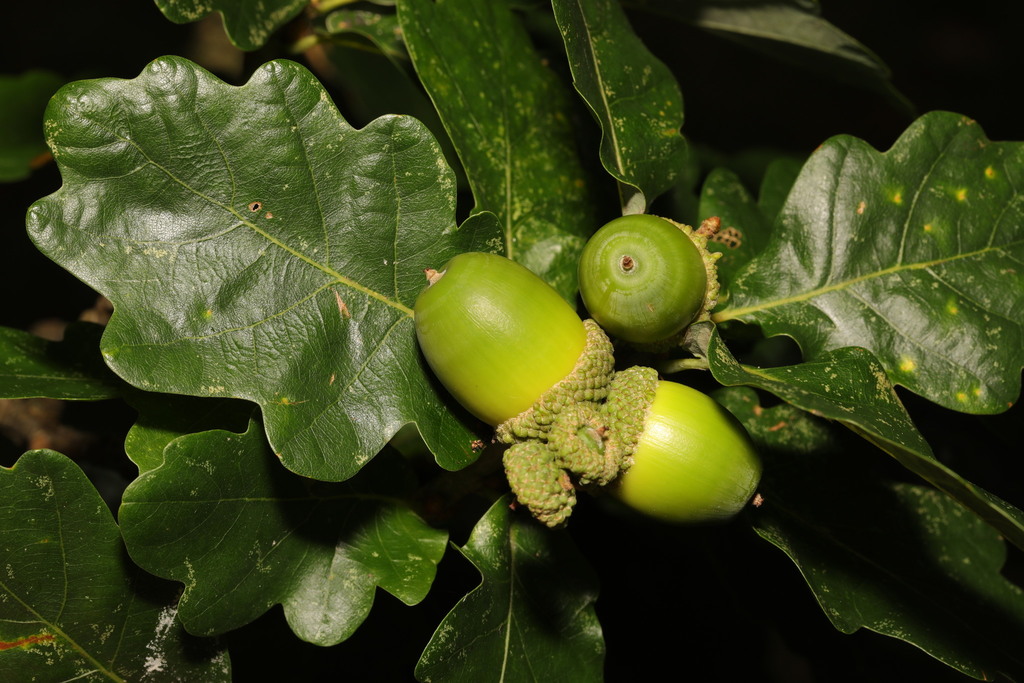
sessile oak
Quercus petraea
Quercus petraea, commonly known as the sessile oak, Welsh oak, Cornish oak, Irish oak or durmast oak, is a species of deciduous oak tree in the flowering plant family Fagaceae. It is native to most of Europe and into Anatolia and Iran. The sessile oak is the national tree of Ireland, and an unofficial emblem in Wales and Cornwall.
Sessile oak is a significant source of Timber in Europe, and historically was important in ship construction. Most trees reach a height of 20-40 m, and can live for several centuries.
From the article Quercus petraea on Wikipedia (CC BY-SA), quoted section by section
Description
The sessile oak is a large deciduous tree up to 40 metres (130 feet) tall, in the white oak section of the genus (Quercus sect. Quercus) and similar to the pedunculate oak (Q. robur), with which it overlaps extensively in range. The leaves are 7–14 centimetres (2+3⁄4–5+1⁄2 inches) long and 4–8 cm (1+1⁄2–3 in) broad, evenly lobed with five to six lobes on each side and a 1 cm-long (1⁄2 in) petiole. Sessile oak is monoecious, with both male and female flowers found on the same tree. The female flowers are found on bracts. The male flowers are grouped into catkins, produced in the spring. The fruit is an acorn 2–3 cm (3⁄4–1+1⁄4 in) long and 1–2 cm (1⁄2–3⁄4 in) broad, which matures in about six months.
Comparison with pedunculate oak. Significant botanical differences from pedunculate oak (Q. robur) include the stalked leaves, and the stalkless (sessile) acorns from which one of its common names is derived. (With the pedunculate oak, it is the acorns which are pedunculate, i.e. on stalks, while the leaves are not.) It occurs in upland areas of altitudes over 300 m (984 ft) with higher rainfall and shallow, acidic, sandy soils. Its specific epithet petraea means "of rocky places". Q. robur, on the other hand, prefers finer, richer, and deeper soils at lower altitude. …
Range & habitat
Sessile oak is found throughout Europe, and is most common in upland areas with heavy soils (rocky and well draining) that is neutral to slightly acidic.
Wikipedia: “Distribution”
At the table
Sessile oak is one of the most important species in Europe both economically and ecologically. Oak timber is traditionally used for building, ships and furniture. Today the best woods are used for quality cabinetmaking, veneers and barrel staves. Rougher material is used for fence construction, roof beams and specialist building work. The wood also has antimicrobial properties. It is also a good fuel wood. During autumns with good acorn crops (the mast years), animals are traditionally grazed under the trees to fatten them.
Wikipedia: “Uses”
Where it lives
Recorded sightings
—
geo-referenced records in GBIF, from museums, herbaria and field observers.
Drag the globe to turn it. Dots are where records exist, not a range map; darker means more records.
In the stacks
Searching the stacks…
Every page naming Quercus petraea in the Biodiversity Heritage Library →
This page is assembled live from iNaturalist, GBIF, Wikipedia, the Source Library and the Internet Archive. It is not yet part of the hand-edited codex. iNaturalist taxon 200942.