- Plants
- ›Vascular Plants
- ›flowering plants
- ›Dicots
- ›Nances, Willows, and Allies
- ›Passionfruit Family
- ›Passifloroideae
- ›Passifloreae
- ›Passiflora
- ›Decaloba
- ›Disemma
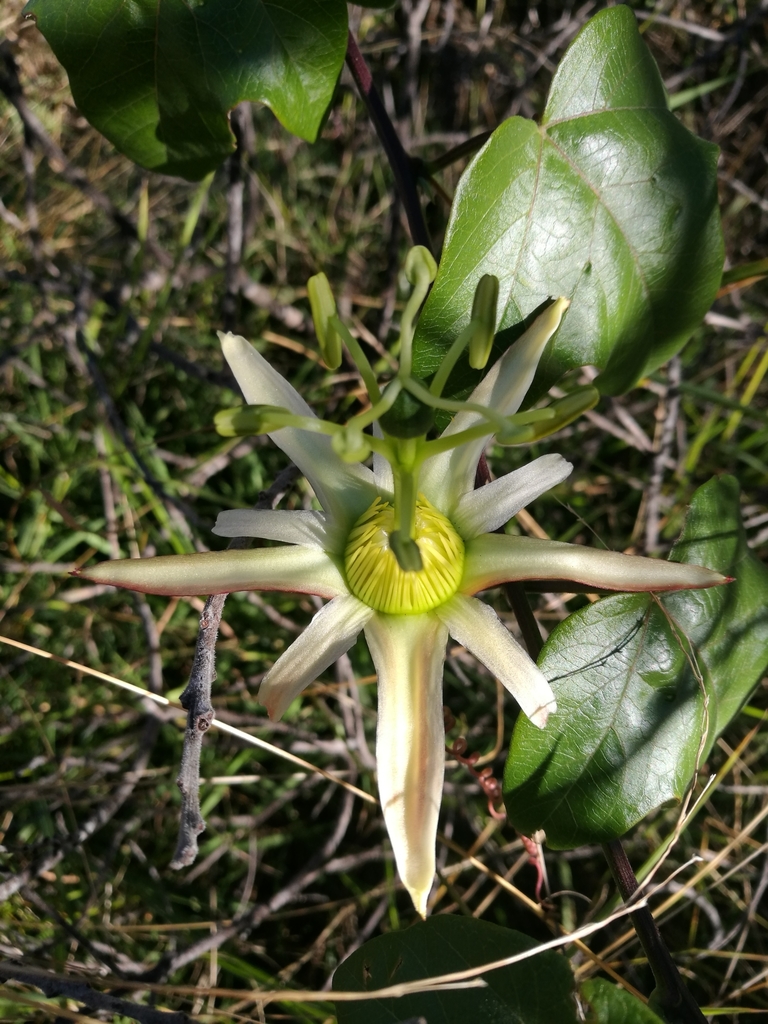
Herbert's Passionfruit
Passiflora herbertiana
Passiflora herbertiana, or native passionfruit, is a widespread climbing twiner native to moist forests on the coast and ranges of eastern Australia. The subspecies P. h. insulae-howei P.S.Green is endemic to Lord Howe Island in the Tasman Sea.
From the article Passiflora herbertiana on Wikipedia (CC BY-SA), quoted section by section
Description
The leaves are usually 3-lobed usually with a slightly hairy undersurface; 6–12 cm long; with petioles mostly 1.5–4 cm long, with 2 glands at the apex. Stipules are linear, mostly 1–3 mm long. The flowers are 6 cm wide and yellow to orange. The following green berry is 50 mm long with pale spots. The insulae-howei subspecies is similar: the leaves are usually 4–8 cm long and 5–8 cm wide. The solitary, orange-yellow to greenish flowers, 60 mm across, appear from October to March. The oval green fruits are 40–50 mm long; they are edible but sickly-sweet.
Range & habitat
The insulae-howei subspecies is endemic to Australia’s subtropical Lord Howe Island in the Tasman Sea, where it is widespread.
Wikipedia: “Distribution and habitat”
Where it lives
Recorded sightings
—
geo-referenced records in GBIF, from museums, herbaria and field observers.
Drag the globe to turn it. Dots are where records exist, not a range map; darker means more records.
In the stacks
Searching the stacks…
Every page naming Passiflora herbertiana in the Biodiversity Heritage Library →
This page is assembled live from iNaturalist, GBIF, Wikipedia, the Source Library and the Internet Archive. It is not yet part of the hand-edited codex. iNaturalist taxon 201649.