- Animals
- ›Arthropods
- ›Chelicerates
- ›Arachnids
- ›Spiders
- ›Typical Spiders
- ›Entelegyne Spiders
- ›Thomisoidea Spiders
- ›Crab Spiders
- ›Thomisinae
- ›Thomisini
- ›Thomisus
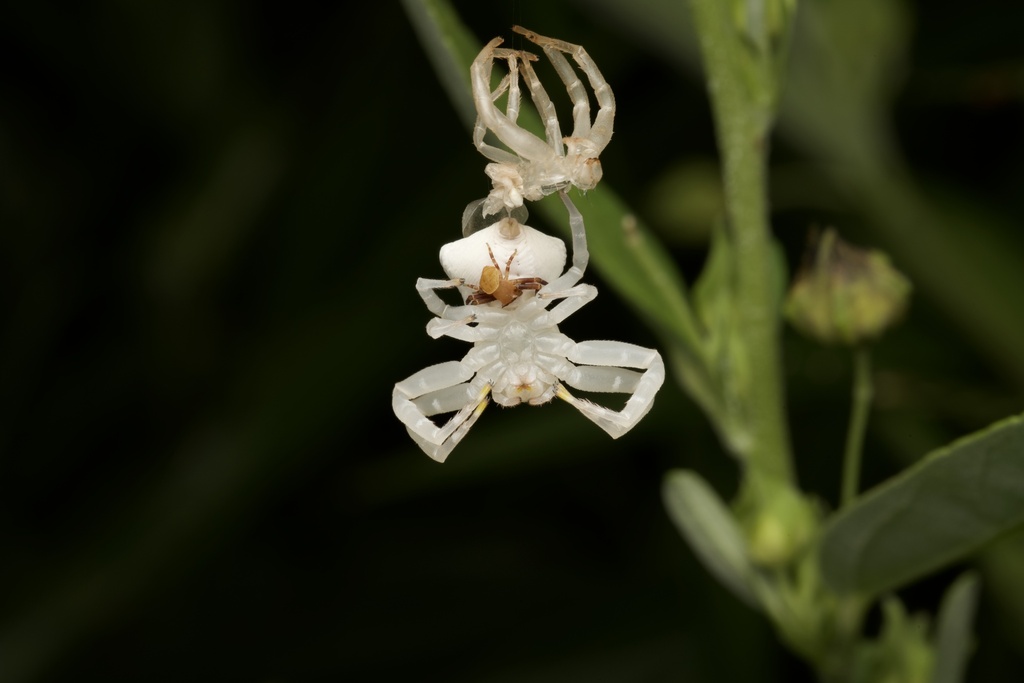
Spectacular Crab Spider
Thomisus spectabilis
Thomisus spectabilis, also known as the white crab spider or Australian crab spider, is a small spider found in Australia and far east Asia.
The body length of the female is up to 10 mm, the male 6.2 mm. Including legs, the spider is around 3 cm across. This spider is usually white, though sometimes may appear yellow. The legs and head appear almost translucent. Thomisus spectabilis is an ambush predator, often seen resting in flowers of its same color. Its egg sacs are laid in a folded leaf, and the cream colored eggs, typically 1 mm in diameter, range between 200 and 370 in number.
From the article Thomisus spectabilis on Wikipedia (CC BY-SA), quoted section by section
Description
T. spectabilis undergo a unique color transformation from yellow to white. The color change helps them not only hide from predators, but stalk prey in similarly colored daisies as well. This transformation allows them to switch between appearing conspicuous and cryptic to their prey. The colorful bodies allow spiders to reflect UV-light in a manner that attracts bees to their flower. When the spider changes to a specific color, the color is displayed uniformly across its head, legs, and abdomen. The legs of this spider span up to 30 mm. They have small black eyes that are organized into a white band across the head resembling a mask. The abdomen of the spider has a pentagon shape and two small bumps across it. They have stout legs arranged similarly to a crab. The spider has pinching fangs, but no claw tufts, so it is not able to climb across smooth surfaces.
Range & habitat
Australian crab spiders choose habitats that increase their chances of catching prey. Since this involves creating contrast between itself and the flower, it will pick flower colors and flower positions that maximize the contrast. Due to the importance of contrast with flowers, these spiders cannot simply choose habitats with large numbers of its prey. Instead, they must think about both flower type and prey number while choosing habitats in a way that maximizes capture. T. spectabilis is mostly attracted to staying in flowers that are newer, and is drawn to them through olfactory cues. It is most commonly found in tropical or subtropical areas, but some also prefer white clothing lines.
Wikipedia: “Habitat”
What it does
These spiders are a predatory species, and they feed mainly on insects. They mainly eat live or recently killed insects. Some examples of these insects are crickets, drosophila flies, and pollinators such as honey bees and butterflies. The spiders are an important form of pest control as they protect the flowers they inhabit from attack by insects. The energy obtained from consuming these insects allows the adult female Australian crab spider to produce a clutch of eggs.
Wikipedia: “Diet”
Where it lives
Recorded sightings
—
geo-referenced records in GBIF, from museums, herbaria and field observers.
Drag the globe to turn it. Dots are where records exist, not a range map; darker means more records.
In the stacks
Searching the stacks…
Every page naming Thomisus spectabilis in the Biodiversity Heritage Library →
This page is assembled live from iNaturalist, GBIF, Wikipedia, the Source Library and the Internet Archive. It is not yet part of the hand-edited codex. iNaturalist taxon 202059.