- Animals
- ›Arthropods
- ›Hexapods
- ›Insects
- ›Winged and Once-winged Insects
- ›Butterflies and Moths
- ›Teak Moths
- ›Hyblaeidae
- ›Hyblaea
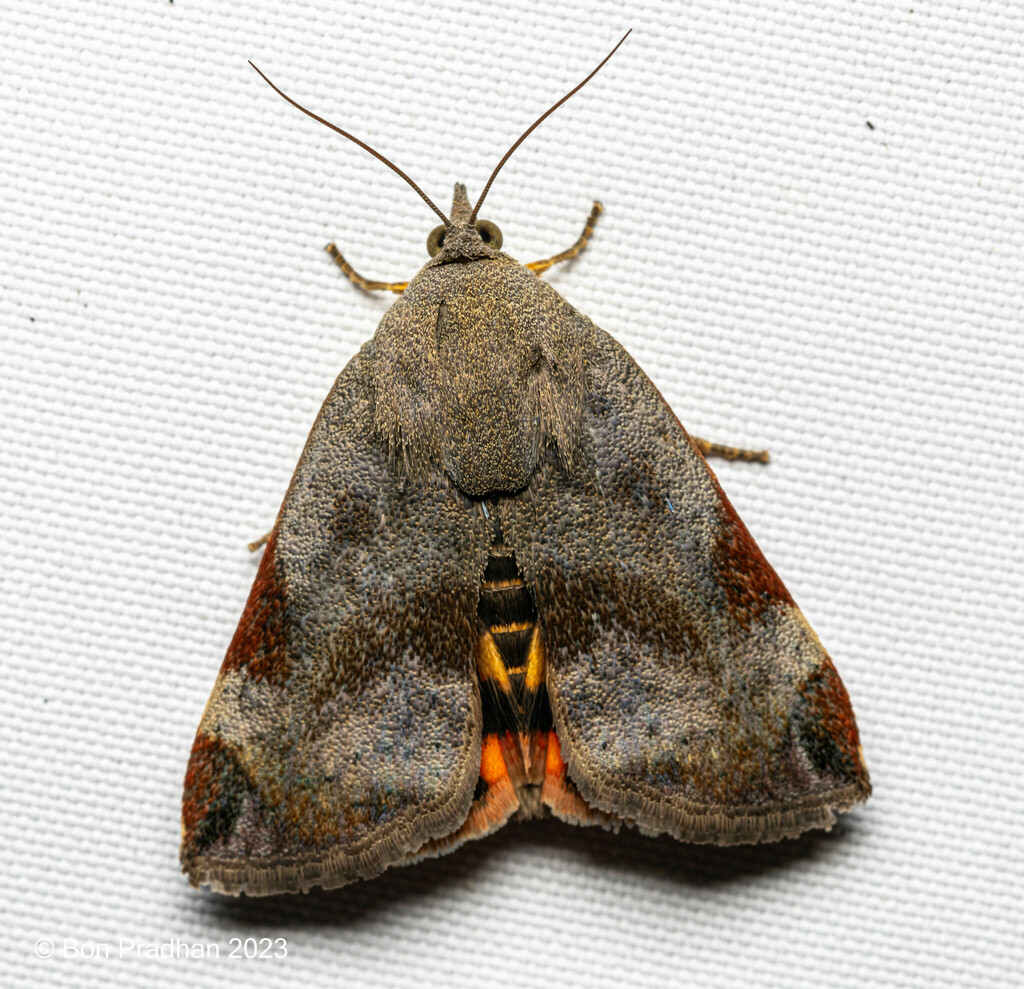
Teak Defoliator
Hyblaea puera
Hyblaea puera, the teak defoliator, is a moth and cryptic species complex native to South Asia and Southeast Asia, though also reported from Central America and Africa. It was first described by Pieter Cramer in 1777. The caterpillar feeds on teak and other trees, and considered to be one of the major teak pests around the world.
From the article Hyblaea puera on Wikipedia (CC BY-SA), quoted section by section
Description
The adult moths are comparatively small, with a wingspan of 3–4 cm (1.2–1.6 in), and have a characteristic resting posture that conceals the black and orange-yellow hindwings under the greyish-brown forewings. There are five larval instars, with the last instar measuring about 3.5–4.5 cm (1.4–1.8 in), and there is considerable colour variation in the fourth and fifth instars; the body may be either wholly black or dark greyish to black, with longitudinal coloured bands which may include a dorsal orange or ocherous band and lateral white lines. The instars have characteristic feeding methods: the first and second instars mainly feed on the leaf's surface, while in subsequent instars, the larvae cuts out a leaf flap, usually at the edge of the leaf, folds it over, fastens it with silk, and feeds from within. The entire leaf, excluding the major veins of tender leaves, is eaten, but more veins are left in older leaves.
Range & habitat
Hyblaea puera occurs in forests across southern Asia from India, Sri Lanka and Bangladesh, and southeast Asia from Thailand to New Guinea, and north Queensland in Australia. The species has been reported from Guadeloupe, and Suriname.
Wikipedia: “Distribution and habitat”
What it does
The teak defoliator is present year round in teak plantations, but in varying population densities. During the period of natural defoliation of teak (November, December, and January), the pest density is very low (endemic). Every year high-intensity outbreaks of teak defoliator occur immediately after the premonsoon showers in late February or early march in Kerala. These centres are highly localized outbreaks which represent the transitional stage between very sparse endemic population and high density outbreak population. These centres will be 5,000 to 15,000 m2 (54,000 to 161,000 sq ft) in area and are characterized by heavy tree top infestation. The months of April, May, June, and July witness a series of large outbreaks. During late July or September, the population declines to the endemic level. In some years, there will be fresh outbreaks during October. From then on until the next year, the population remains at the endemic level.
Life cycle. Males and females emerge more or less simultaneously and mating takes place within a couple of days. Eggs are laid on tender new leaves, placed singly near the veins, and usually on the undersurface. They are oval, flat, and white and measure about 1 mm in length. About 500 eggs are laid per female with a recorded maximum of 1000. Larvae hatch in about two days. Under the optimal conditions, the larval period lasts 10 to 12 days. …
Wikipedia: “Ecology”
Listen
Looking for field recordings…
Where it lives
Recorded sightings
—
geo-referenced records in GBIF, from museums, herbaria and field observers.
Drag the globe to turn it. Dots are where records exist, not a range map; darker means more records.
In the stacks
Searching the stacks…
Every page naming Hyblaea puera in the Biodiversity Heritage Library →
This page is assembled live from iNaturalist, GBIF, Wikipedia, the Source Library and the Internet Archive. It is not yet part of the hand-edited codex. iNaturalist taxon 202649.