- Animals
- ›Arthropods
- ›Hexapods
- ›Insects
- ›Winged and Once-winged Insects
- ›Butterflies and Moths
- ›Owlet Moths and Allies
- ›Cutworm Moths and Allies
- ›Plusiine Looper Moths
- ›Argyrogrammatini
- ›Trichoplusia
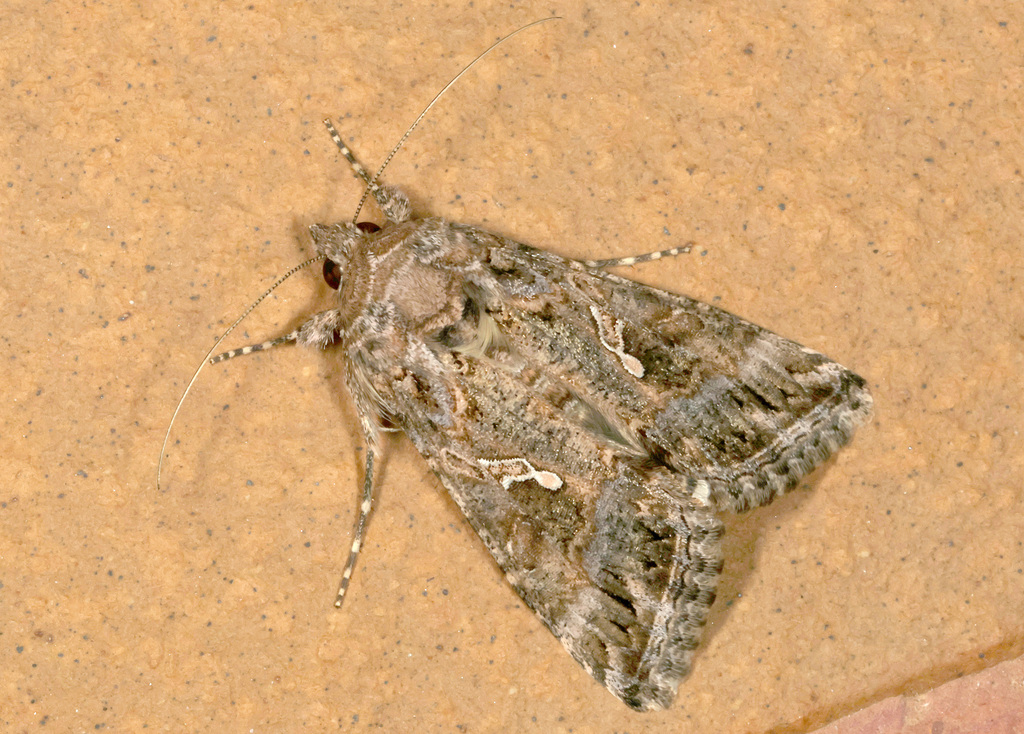
Cabbage Looper Moth
Trichoplusia ni
The cabbage looper (Trichoplusia ni) is a medium-sized moth in the family Noctuidae, a family commonly referred to as owlet moths. Its common name comes from its preferred host plants and distinctive crawling behavior. Cruciferous vegetables, such as cabbage, bok choy, and broccoli, are its main host plant; hence, the reference to cabbage in its common name. The larva is called a looper because it arches its back into a loop when it crawls.
While crucifers are preferred, over 160 plants can serve as hosts for the cabbage looper larvae. The adult cabbage looper is a migratory moth that can be found across North America and Eurasia, as far south as Florida and as far north as British Columbia. Its migratory behavior and wide range of host plants contribute to its broad distribution.
From the article Cabbage looper on Wikipedia (CC BY-SA), quoted section by section
Range & habitat
The cabbage looper can be found across North America and Eurasia, as far south as Florida and as far north as British Columbia. Cabbage looper populations in North America migrate from Mexico to Canada, depending on the seasons. It generally overwinters in Mexico or southern California, where temperatures are above 16 °C (61 °F) even during winter. It used to be frequently found in Florida, but this has lessened due to fewer cabbage crops. As northern regions of North America grow warmer, the cabbage looper gradually moves upward, only migrating if the region is above 16 °C (61 °F). During summer, it is less commonly found in southern regions, due to high temperatures. Similar to the monarch butterfly, populations presumably migrate in groups, as there is little genetic difference between source and migrating populations. Similar seasonal distributions were found in Europe. There, the cabbage looper can be found from England to southeastern Europe.
Wikipedia: “Distribution and migration”
Listen
Looking for field recordings…
Where it lives
Recorded sightings
—
geo-referenced records in GBIF, from museums, herbaria and field observers.
Drag the globe to turn it. Dots are where records exist, not a range map; darker means more records.
In the stacks
Searching the stacks…
Every page naming Trichoplusia ni in the Biodiversity Heritage Library →
This page is assembled live from iNaturalist, GBIF, Wikipedia, the Source Library and the Internet Archive. It is not yet part of the hand-edited codex. iNaturalist taxon 202789.