- Animals
- ›Arthropods
- ›Hexapods
- ›Insects
- ›Winged and Once-winged Insects
- ›Butterflies and Moths
- ›Owlet Moths and Allies
- ›Cutworm Moths and Allies
- ›Cutworms and Dart Moths
- ›Noctuini
- ›Noctuina
- ›Xestia
- ›Megasema
- ›Xestia c-nigrum
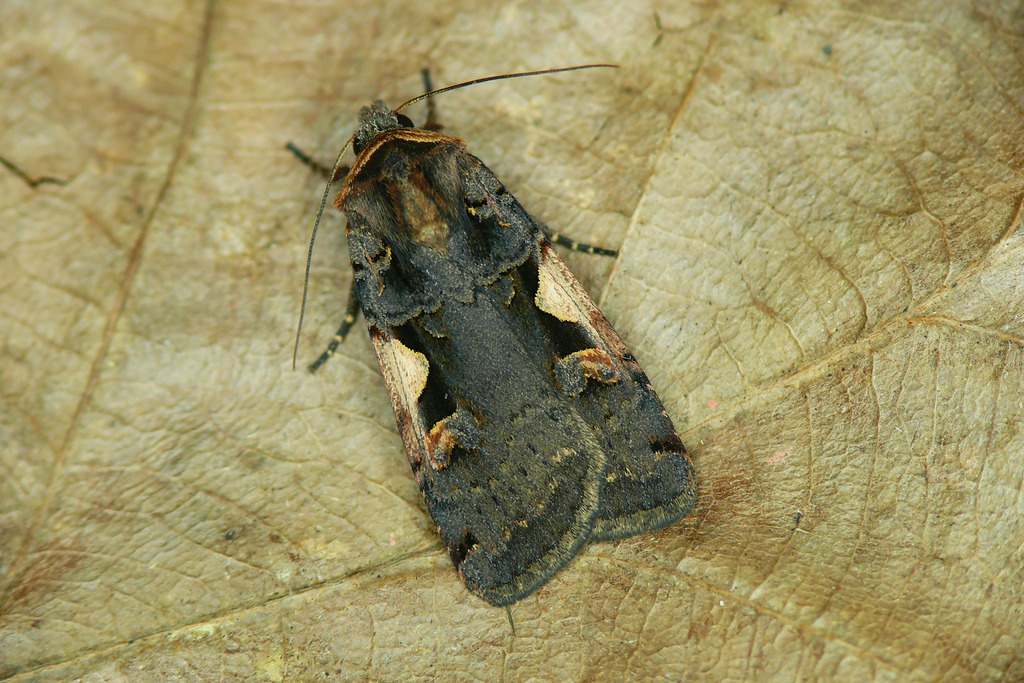
Setaceous Hebrew Character
Xestia c-nigrum
The setaceous Hebrew character (Xestia c-nigrum) is a moth of the family Noctuidae. The species was first described by Carl Linnaeus in his 1758 10th edition of Systema Naturae. It is found in the Palearctic realm. It is a common species throughout Europe and North Asia and Central Asia, South Asia, China, Japan and Korea. It is also found in North America, from coast to coast across Canada and the northern United States to western Alaska. It occurs in the Rocky Mountains from Montana to southern Arizona and New Mexico. In the east, it ranges from Maine to North Carolina. It has recently been recorded in Tennessee.
The forewings of this species are reddish brown with distinctive patterning towards the base: a black mark resembling the Hebrew letter nun (נ), thus inspiring the common name, with a pale cream-coloured area adjacent to this mark. The hindwings are cream coloured. "Setaceous", meaning "having bristles", refers to the hairs on the top of the thorax and fringing the wings.
From the article Setaceous Hebrew character on Wikipedia (CC BY-SA), quoted section by section
Description
The wingspan is 35–45 mm. Forewing purplish grey or purplish fuscous with a leaden gloss; costal area at middle ochreous, merged with the bluntly triangular orbicular stigma: cell, a submedian basal blotch, and costal spot before apex purplish black; claviform stigma minute; reniform large, the lower lobe purplish; hindwing ochreous whitish, in female with the termen broadly fuscous. Larva pink with a broad dark brown subdorsal band. A lateral yellow band with a brown spot on it. Head reddish brown in color.
Listen
Looking for field recordings…
Where it lives
Recorded sightings
—
geo-referenced records in GBIF, from museums, herbaria and field observers.
Drag the globe to turn it. Dots are where records exist, not a range map; darker means more records.
In the stacks
Searching the stacks…
Every page naming Xestia c-nigrum in the Biodiversity Heritage Library →
This page is assembled live from iNaturalist, GBIF, Wikipedia, the Source Library and the Internet Archive. It is not yet part of the hand-edited codex. iNaturalist taxon 203342.