- Animals
- ›Arthropods
- ›Hexapods
- ›Insects
- ›Winged and Once-winged Insects
- ›Butterflies and Moths
- ›Gracillarioidea
- ›Ribbed Cocoon-Making Moths
- ›Bucculatrix
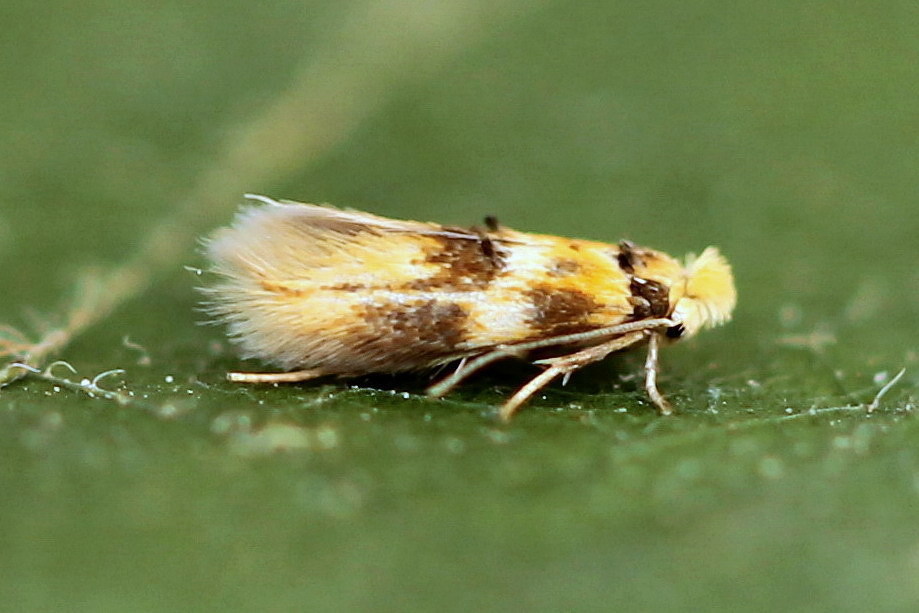
Lime Bent-wing
Bucculatrix thoracella
Bucculatrix thoracella, the lime bent-wing, is species of moth in the family Bucculatricidae, and was first described in 1794 by Carl Peter Thunberg as Tinea thoracella. It is found throughout Europe with exception of Ireland and the Balkan Peninsula, and in Japan, where it occurs on the islands of Hokkaido and Honshu.
From the article Bucculatrix thoracella on Wikipedia (CC BY-SA), quoted section by section
Description
Adult specimens of Bucculatrix thoracella are small, with a wingspan of 6–8 mm, and have a wing pattern of dark brown blotches on a yellow base, with a brown line extending to the wing's edge. Larvae have a pale, greenish yellow body and a pale yellow head. Pupae are a dark, cloudy brown, and are covered by a strongly ribbed white, yellowish or greyish brown cocoon.
Wikipedia: “Appearance”
What it does
In continental Europe, Bucculatrix thoracella occurs in two generations per year, whereas it is generally univoltine in most of Britain. It overwinters as a pupa, either on the host plant's trunk or in leaf litter. Adults are on wing in June and sometimes August in Britain, while in continental Europe they are on wing from April to May and from July to August. Eggs are left on the underside of leaves, often at a vein angle.
Larvae. Larvae feed mainly on species of lime tree (Tilia spp.) and less commonly on maple species (Acer spp.), but infrequent records of a variety of other host plants exist. During the first larval stadium, they mine their host plant's leaves, resulting in a small, hook-like mine. The mine starts with a small blotch at the angle of leaf veins, then follows in a straight line along the vein, eventually turning away and forming a hook-like shape. When the larva emerges from its mine, it moults in a smooth cocoonet. Afterwards, it feeds externally from the leaf's underside, eating out windows in the leaf.
Wikipedia: “Behaviour”
Listen
Looking for field recordings…
Where it lives
Recorded sightings
—
geo-referenced records in GBIF, from museums, herbaria and field observers.
Drag the globe to turn it. Dots are where records exist, not a range map; darker means more records.
In the stacks
Searching the stacks…
Every page naming Bucculatrix thoracella in the Biodiversity Heritage Library →
This page is assembled live from iNaturalist, GBIF, Wikipedia, the Source Library and the Internet Archive. It is not yet part of the hand-edited codex. iNaturalist taxon 207526.