- Plants
- ›Vascular Plants
- ›flowering plants
- ›Dicots
- ›Nances, Willows, and Allies
- ›Spurge Family
- ›Acalyphoideae
- ›Acalypheae
- ›Acalyphinae
- ›Acalypha
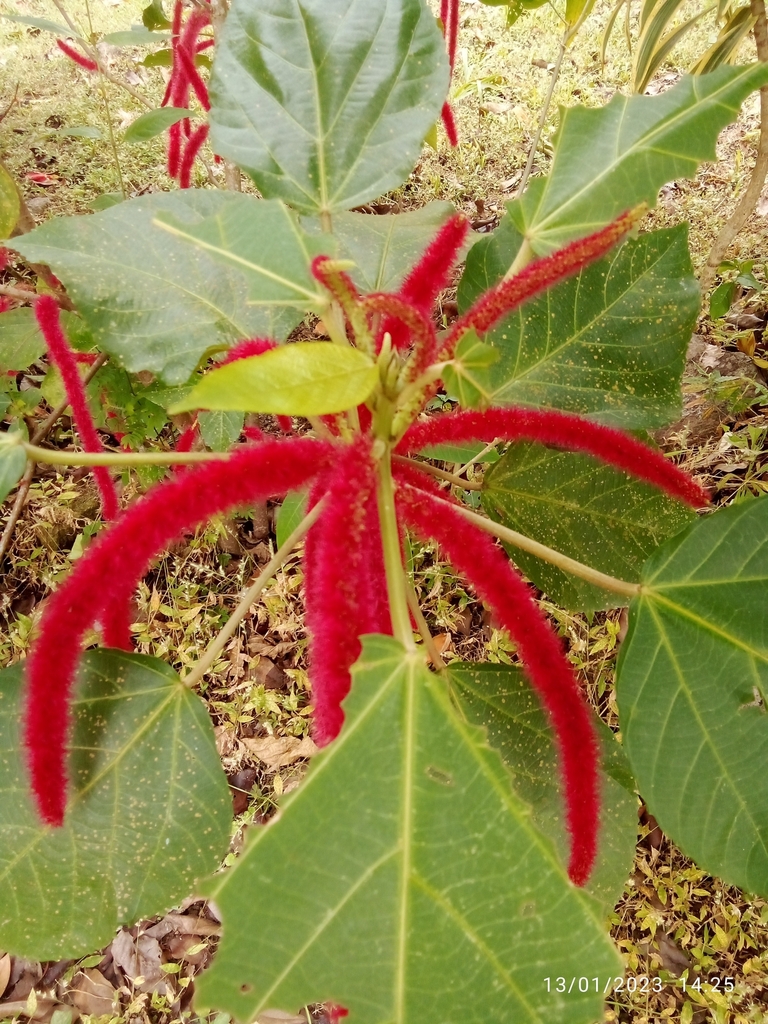
Chenille-plant
Acalypha hispida
Acalypha hispida, the chenille plant, is a flowering shrub which belongs to the family Euphorbiaceae, the subfamily Acalyphinae, and the genus Acalypha. Acalypha is the fourth largest genus of the Euphorbiaceae family, and contains many plants native to Hawaii and Oceania. This plant is also known as the Philippines Medusa, red hot cat's tail and fox tail in English, pokok ekor kucing in Malay, Rabo de Gato in Portuguese, Tai tượng đuôi chồn in Vietnamese and...
From the article Acalypha hispida on Wikipedia (CC BY-SA), quoted section by section
Description
It can grow to be 5–12 feet (1.5–3.7 m) tall, and have a spread of 3–6 feet (0.91–1.83 m), with potted plants being the smallest in growth. The plant has become somewhat domesticated, due to the nature and color of its flowers. It can be grown from seeds as well as from cuttings. It can be kept either as an outdoor plant or as a houseplant. The plant is dioecious, and therefore there are distinct male and female members of the species. The female plant bears pistillate flowers which are 0.7 millimeters long and range in color from purple to bright red, and grow in clusters along catkins that can grow up to fifty centimeters (19.5 inches) or more in length. This feature is the primary reason the plant bears the nickname “red-hot cat tail”. The pistillates will grow all year long as long as the temperatures are favorable. The leaves are large, oval and bright green to reddish copper.
How it is grown
When grown as a house plant, it needs bright light but not direct sunlight, and requires high humidity and a temperature of at least 61 °F (16 °C). It should be grown in a loose potting soil, rich in organic matter and sand, and must be kept well-watered during the spring and summer. Watering should be reduced somewhat in fall and winter. It is typically propagated from cuttings.
Wikipedia: “Cultivation”
Where it lives
Recorded sightings
—
geo-referenced records in GBIF, from museums, herbaria and field observers.
Drag the globe to turn it. Dots are where records exist, not a range map; darker means more records.
In the stacks
Searching the stacks…
Every page naming Acalypha hispida in the Biodiversity Heritage Library →
This page is assembled live from iNaturalist, GBIF, Wikipedia, the Source Library and the Internet Archive. It is not yet part of the hand-edited codex. iNaturalist taxon 208742.