- Animals
- ›Arthropods
- ›Chelicerates
- ›Arachnids
- ›Spiders
- ›Typical Spiders
- ›Entelegyne Spiders
- ›Orbweavers and Allies
- ›Dwarf, Sheetweb, and Hammock-web Spiders
- ›Sheetweb and Dwarf Weavers
- ›Sheet-weavers
- ›Frontinella
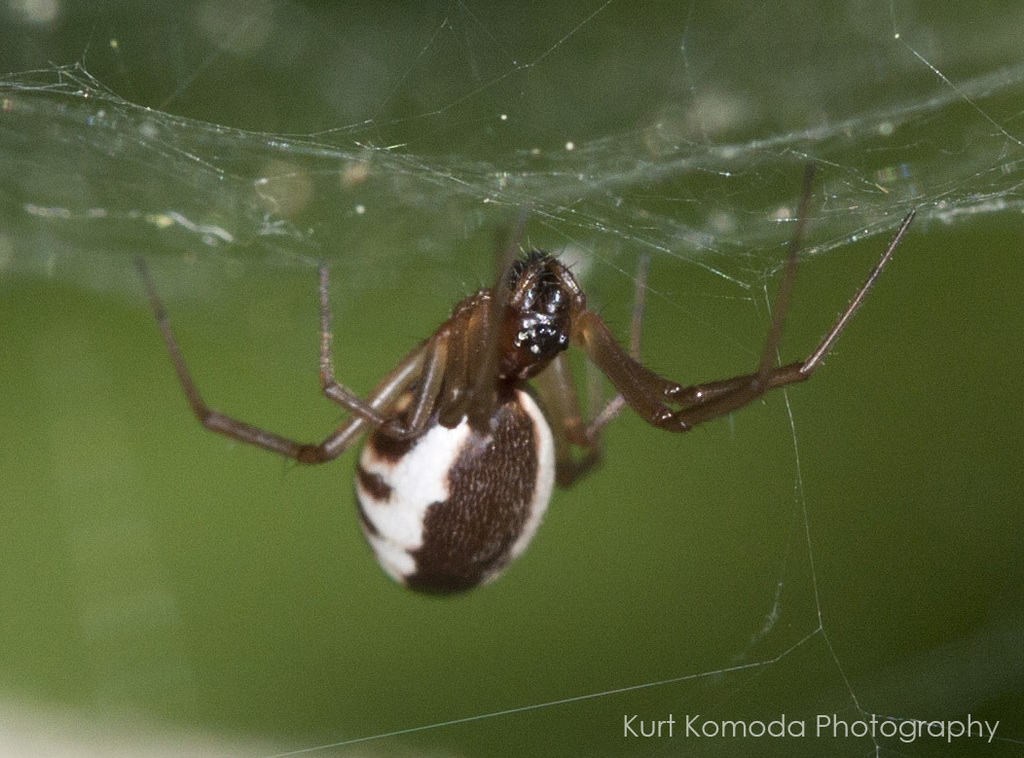
Bowl-and-doily Spider
Frontinella pyramitela
The bowl and doily spider (Frontinella pyramitela) is a species of sheet weaver found in North and Central America. It is a small spider, about 4 mm (0.16 in) long, that weaves a fairly complex and unique sheet web system consisting of an inverted dome shaped web, or "bowl," suspended above a horizontal sheet web, or "doily", hence its common name. The spider hangs from the underside of the "bowl", and bites through the web small flies, gnats and other small insects that fall down into the non-sticky webbing. The webs are commonly seen in weedy fields and in shrubs, and may often contain both a male and a female spider in late summer—like many linyphiids, Frontinella males and females may cohabitate for some time. Males exhibit competition for female mates both by fighting and sperm competition. Uniquely, these spiders exhibit behavioral thermoregulation and have lengthened circadian rhythms.
From the article Bowl and doily spider on Wikipedia (CC BY-SA), quoted section by section
Description
F. pyramitela are small (4 mm, or 0.15 in) and are typically a reddish-brown color, with more yellowish colored legs. Their abdomen displays decorative white dots along the sides and has short hairs.
Range & habitat
These spiders are found in a large variety of habitats and climates. Some of their more common habitat sites include temperate woods and alpine forests, though they can also be found in more tropical, humid areas. They are most commonly found in North America, often in the United States. The spiders are most active from May through June, and then again in September.
Wikipedia: “Habitat and distribution”
What it does
Female F. pyramitela spiders tend to live longer lives when they have a more restricted food diet. Despite this, when the spiders have more restricted diets, they also have decreased overall fecundity and delay their egg laying.
Wikipedia: “Life extension by dietary restriction”
Where it lives
Recorded sightings
—
geo-referenced records in GBIF, from museums, herbaria and field observers.
Drag the globe to turn it. Dots are where records exist, not a range map; darker means more records.
In the stacks
Searching the stacks…
Every page naming Frontinella pyramitela in the Biodiversity Heritage Library →
This page is assembled live from iNaturalist, GBIF, Wikipedia, the Source Library and the Internet Archive. It is not yet part of the hand-edited codex. iNaturalist taxon 209810.