- Animals
- ›Arthropods
- ›Hexapods
- ›Insects
- ›Winged and Once-winged Insects
- ›Butterflies and Moths
- ›Owlet Moths and Allies
- ›Cutworm Moths and Allies
- ›Cutworms and Dart Moths
- ›Prodeniini
- ›Spodoptera
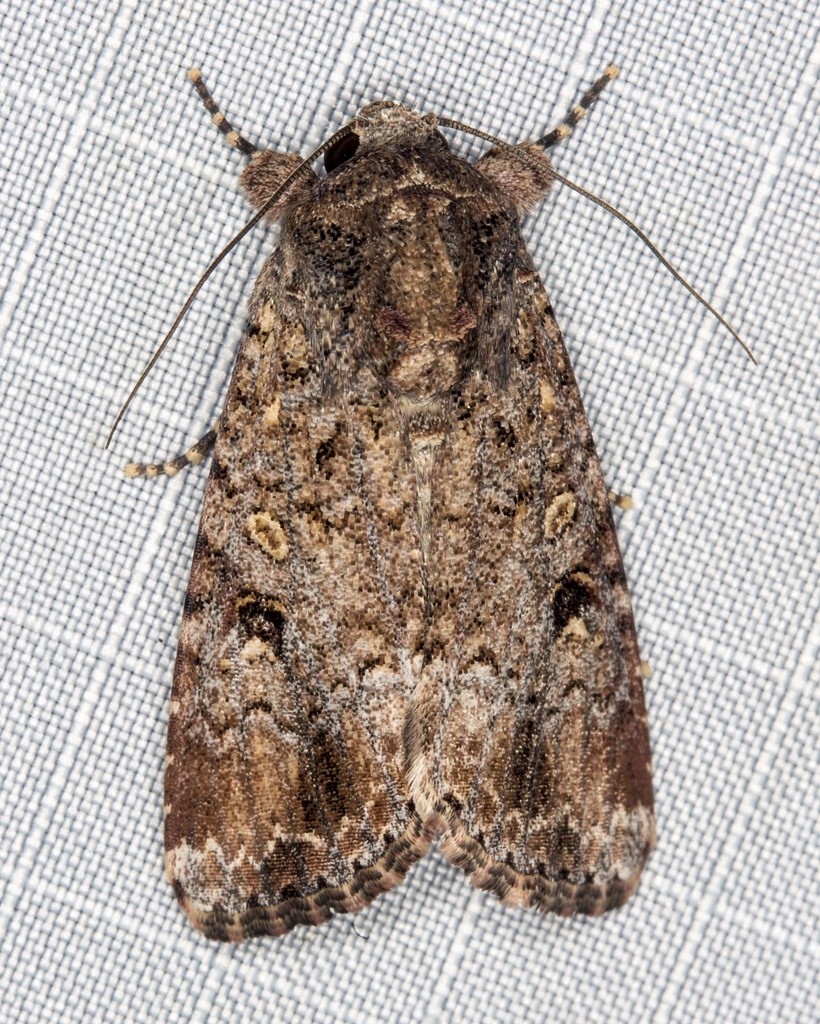
Lawn Armyworm Moth
Spodoptera mauritia
Spodoptera mauritia, the lawn armyworm or paddy swarming caterpillar, is a moth of the family Noctuidae. The species was first described by Jean Baptiste Boisduval in 1833. Able to eat many types of food, it is a major pest throughout the world.
From the article Spodoptera mauritia on Wikipedia (CC BY-SA), quoted section by section
Description
The wingspan is about 40 mm. It is dark grey brown with a rusty tinge on its body. The abdomen is fuscous. Forewings with sub-basal, antemedial and postmedial double waved lines indistinct. The orbicular small and ochreous, whereas reniform blackish. Submarginal line whitish and irregularly waved. There is a white patch often can be seen between orbicular and reniform and a dark patch on the central marginal area. Hindwings opalescent and semi-hyaline white, with a dark marginal line.
Range & habitat
It is widespread from the Red Sea to India, Myanmar, Sri Lanka, Malaya to Australia and widespread in the Pacific Islands, including the Solomons, New Hebrides, Fiji, Samoa, Hawaii, the Society Islands, Austral Islands, Marquesas and the Marshall Islands.
Wikipedia: “Distribution”
What it does
The larvae feed on various grasses, including rice, wheat, Cynodon, Pennisetum clandestinum, Sorghum bicolor, Oryza sativa, and trees such as Casuarina equisetifolia. They are considered one of the major international agricultural pests on crops and pastures. Unlike other insects, armyworm caterpillars of their sixth instar do not excrete uric acid, instead they excrete urea as nitrogenous wastes. Spodoptera mauritia has been found in the feces of the Greater tube-nosed bat.
Wikipedia: “Ecology”
Listen
Looking for field recordings…
Where it lives
Recorded sightings
—
geo-referenced records in GBIF, from museums, herbaria and field observers.
Drag the globe to turn it. Dots are where records exist, not a range map; darker means more records.
In the stacks
Searching the stacks…
Every page naming Spodoptera mauritia in the Biodiversity Heritage Library →
This page is assembled live from iNaturalist, GBIF, Wikipedia, the Source Library and the Internet Archive. It is not yet part of the hand-edited codex. iNaturalist taxon 211020.