- Fungi Including Lichens
- ›Ascomycete Fungi
- ›Sac Fungi and Lichens
- ›Common Lichens
- ›Shield Lichens, Sunburst Lichens, Rosette Lichens, and Allies
- ›shield lichens, rim lichens, and allies
- ›shield lichens and allies
- ›typical shield lichens
- ›Cornicularia
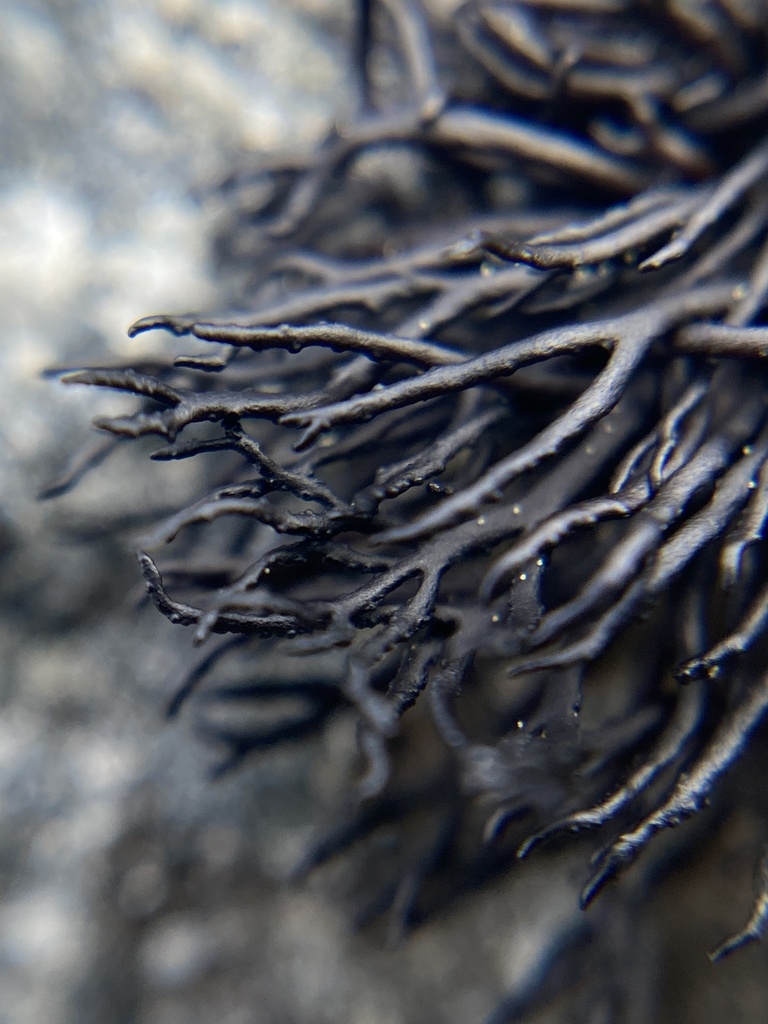
Mountain Bootstrap Lichen
Cornicularia normoerica
Cornicularia is a genus of lichenised ascomycetes in the large family Parmeliaceae. It is a monotypic genus, with a single currently accepted species, the saxicolous lichen Cornicularia normoerica, and is sometimes referred to as the bootstrap lichen. The lichen forms small, dark tufts rarely exceeding 2 cm in height that are anchored so firmly to rocks, with narrow, stiff branches topped by shiny black reproductive discs. It grows on high-elevation, sun-exposed rocks and boulders, where its compact, shrub-like appearance and glossy black-brown surface make it distinctive among mountain lichens.
From the article Cornicularia on Wikipedia (CC BY-SA), quoted section by section
Description
Cornicularia is represented by a single species, Cornicularia normoerica, which forms neat, dark tufts that rarely exceed 2 cm in height. The lichen body (thallus) stands erect and is anchored so firmly that it must be cut or scraped away from rock or bark. Its main branches are narrow—about 0.3–0.6 mm across—stiff, and slightly flattened, with few side-branches. Each branch tapers abruptly near the tip and arises from a repeatedly dividing holdfast, giving the tuft a shrub-like outline. The surface is a glossy black-brown and is protected by an unusually thick outer skin (cortex) made of densely packed, parallel hyphae. Inside, the fungal partner shelters rounded green algal cells of the genus Trebouxia, which supply photosynthetic sugars. Reproduction in C. normoerica is mainly sexual: most branch tips carry black, shiny discs (apothecia) one to five millimetres wide. These discs may sprout a few short, rod-like extensions and gradually overtop the branch apex. Each spore sac (ascus) is club-shaped with a thickened tip and releases eight smooth, colourless ascospores measuring about 5–6 × 3–4 μm. Asexual propagules also occur: half-sunken, spherical pycnidia dot the branch ends and secrete thread-like conidia roughly 6.5–7.5 μm long. …
What it does
Cornicularia normoerica is a saxicolous (rock-dwelling) species, growing on high-elevation, sun-exposed rocks and boulders.
Wikipedia: “Ecology”
Where it lives
Recorded sightings
—
geo-referenced records in GBIF, from museums, herbaria and field observers.
Drag the globe to turn it. Dots are where records exist, not a range map; darker means more records.
In the stacks
Searching the stacks…
Every page naming Cornicularia normoerica in the Biodiversity Heritage Library →
This page is assembled live from iNaturalist, GBIF, Wikipedia, the Source Library and the Internet Archive. It is not yet part of the hand-edited codex. iNaturalist taxon 217598.