- Animals
- ›Arthropods
- ›Hexapods
- ›Insects
- ›Winged and Once-winged Insects
- ›Butterflies and Moths
- ›Butterflies
- ›Brush-footed Butterflies
- ›Satyrs, Morphos, and Allies
- ›Alpines, Arctics, Nymphs and Satyrs
- ›Erebiina
- ›Erebia
- ›Magda
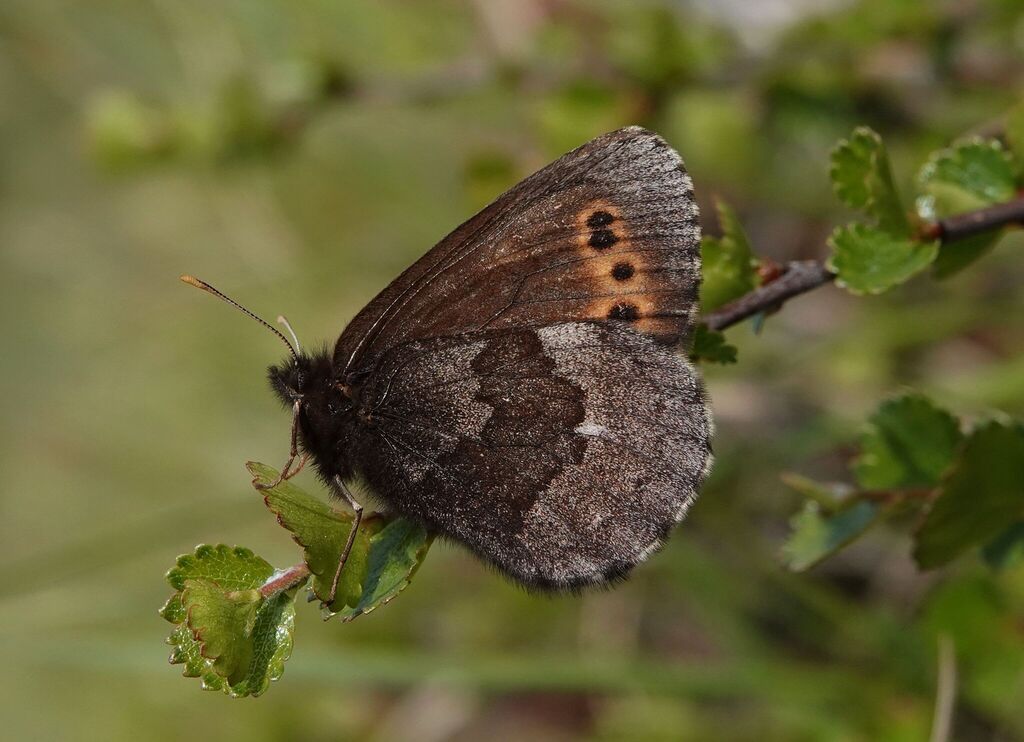
Arctic Ringlet
Erebia disa
The Arctic ringlet or Disa alpine (Erebia disa) is a member of the subfamily Satyrinae of family Nymphalidae. It is associated with wet muskeg and bogs in subarctic and Arctic climates, and is often found near the tree-line. The larva overwinters twice before undergoing metamorphosis into an adult. It is found in Arctic Europe, Arctic European Russia (Kanin Peninsula), Sajan, Irkutsk, Yakutsk, Yablonoi and Arctic North America.
From the article Arctic ringlet on Wikipedia (CC BY-SA), quoted section by section
Description
The upperside of the wings are dark brown with a fine black and white hashed line along the hind margins. The forewing has a red or orange strip fairly near the edge on which are four black blotches with white-centred eyespots. The hindwing is plain brown. The underside of the forewing is similar to the upperside while the underside of the hindwing is greyish brown with a broad dark brown lateral band and a hashed black and white margin. The wingspan is 40 to 50 mm (1.6 to 2.0 in). Species with which this butterfly could be confused include the Lapland ringlet (Erebia embla) and the Arran brown (Erebia ligea), but these both have white markings on the undersides of their hindwings.
Range & habitat
The Arctic ringlet has a Holarctic distribution. It is found in Arctic Europe, Arctic European Russia (Kanin Peninsula), Sajan, Irkutsk, Yakutsk, Yablonoi and Arctic North America. Its typical habitat is bogs and damp forests.
Wikipedia: “Distribution and habitat”
What it does
The food plants of the larvae are various species of grasses (Poaceae), cottongrasses (Eriophorum) and sedges (Carex). The larva overwinters twice as a caterpillar and the adult generally flies in July.
Wikipedia: “Life cycle”
Listen
Looking for field recordings…
Where it lives
Recorded sightings
—
geo-referenced records in GBIF, from museums, herbaria and field observers.
Drag the globe to turn it. Dots are where records exist, not a range map; darker means more records.
In the stacks
Searching the stacks…
Every page naming Erebia disa in the Biodiversity Heritage Library →
This page is assembled live from iNaturalist, GBIF, Wikipedia, the Source Library and the Internet Archive. It is not yet part of the hand-edited codex. iNaturalist taxon 219415.