- Animals
- ›Arthropods
- ›Hexapods
- ›Insects
- ›Winged and Once-winged Insects
- ›Butterflies and Moths
- ›Geometrid and Swallowtail Moths
- ›Geometer Moths
- ›Carpet Moths
- ›Lampropterygini
- ›Lampropteryx
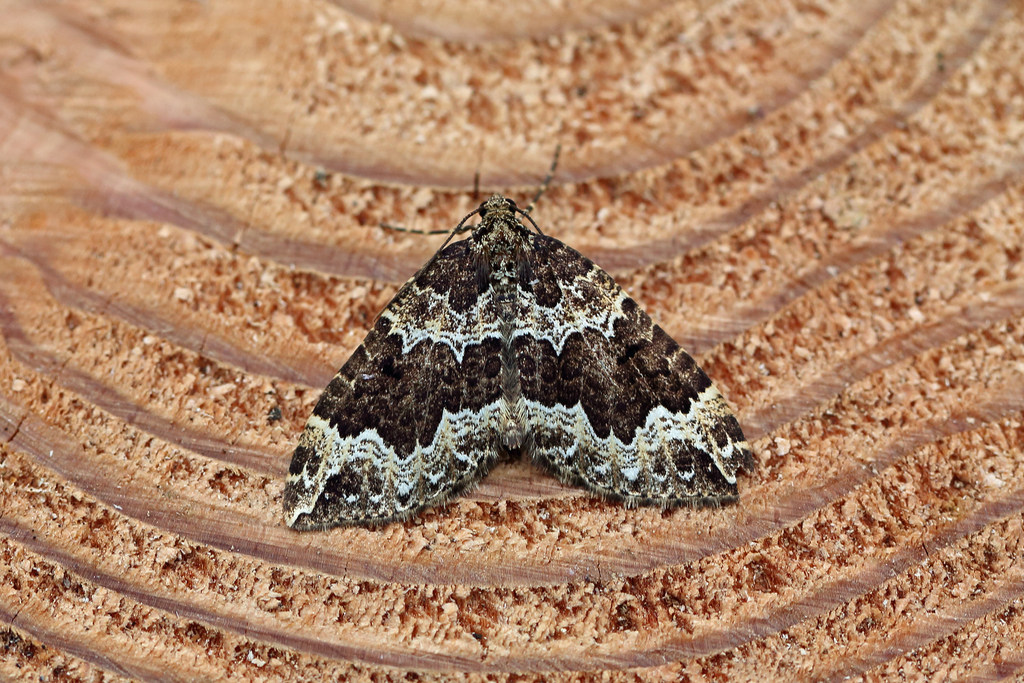
Water Carpet Moth
Lampropteryx suffumata
Lampropteryx suffumata, the water carpet, is a moth of the family Geometridae. It is found from Europe to the Altai Mountains, Khabarovsk Krai and the Kamchatka Peninsula in the far east of Russia, and Hokkaido, Japan. In 2000, the species was discovered in Alaska, United States, and then in 2008 DNA-barcoding analysis of museum specimens identified several Canadian specimens, thereby extending the geographical range from Ireland in the west, across Eurasia, to the west of North America. The habitat consists of damp woodland, grassy areas, chalk downland and scrubland.
From the article Lampropteryx suffumata on Wikipedia (CC BY-SA), quoted section by section
Description
The wingspan is 25–32 mm. The ground colour is brownish. Between the wingbase and the midfield, as well as between the central and margin field is a whitish lateral band. The dark midfield is serrated on both sides. The outer cross-line limiting the midfield and shows a clearly protruding double wave. The margin field is heavily obscured below the apex. The hind wings are pale grey and have a strongly curved dark cross line. In northern Europe, adults are in the wing from March to June in one generation.
Larvae Adult caterpillars have a brown basic coloration. On the dorsum, there is reddish-brown to black-brown angled spots. The rear segments are lighter brown. The larvae feed on Galium species (often known as bedstraws) and can be found in May and June.
Pupa It overwinters in the pupal stage, in a substantial, silken cocoon spun among the foodplant.
In human culture
The genus Lampropteryx was raised by the English entomologist, James Francis Stephens in 1831. The name is from the Greek (lampros, a wing) and (pteryx, bright); referring to the ″strong gloss on the forewings …″. The specific name suffumata is from the Latin (sub, somewhat) and (fumatus, smoky or smoked) and the authors Denis and Schiffermüller may have had ab. piceata Stephens before them. Ab. piceata (piceus, pitch-black) also has very glossy forewings.
Wikipedia: “Etymology”
Listen
Looking for field recordings…
Where it lives
Recorded sightings
—
geo-referenced records in GBIF, from museums, herbaria and field observers.
Drag the globe to turn it. Dots are where records exist, not a range map; darker means more records.
In the stacks
Searching the stacks…
Every page naming Lampropteryx suffumata in the Biodiversity Heritage Library →
This page is assembled live from iNaturalist, GBIF, Wikipedia, the Source Library and the Internet Archive. It is not yet part of the hand-edited codex. iNaturalist taxon 222645.