- Animals
- ›Arthropods
- ›Hexapods
- ›Insects
- ›Winged and Once-winged Insects
- ›Butterflies and Moths
- ›Geometrid and Swallowtail Moths
- ›Geometer Moths
- ›Ennominae
- ›Boarmiini
- ›Neoalcis
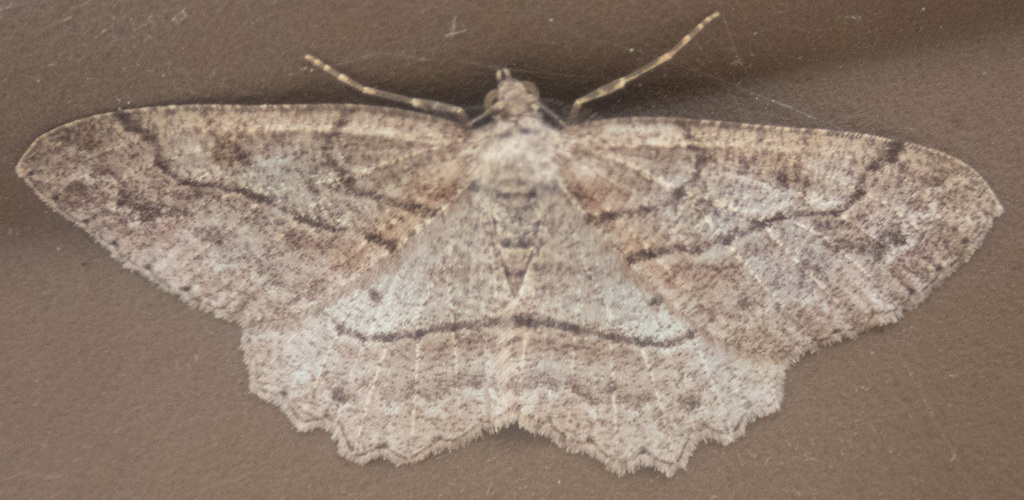
Brown-lined Looper
Neoalcis californiaria
Neoalcis californiaria, the Brown-lined looper, is a common North American moth, with a range along the west coast from British Columbia to California. Its larva is a looper (inchworm) caterpillar that feeds on Douglas Fir and other conifers trees. It is identified by the position of three dark lines on each wing and scalloped edges of the hindwing.
Neoalcis is a monotypic genus of moths in the family Geometridae erected by James Halliday McDunnough in 1920. It is the only species in the genus, and was first described by Packard in 1871.
From the article Neoalcis on Wikipedia (CC BY-SA), quoted section by section
Description
The wingspan is about 34 mm. The Brown-lined Looper's ground color ranges from ashy gray, to light brown to dark brown, with numerous brown speckles and variable patches of darker shading between crosslines. Wing edges are scalloped. It has three dark transverse lines on both forewing and hindwing, however the middle line may be obscure. When in a resting posture, with wings spread, the darkest crossline (the PM line) of the hindwing is set lower and dose not line up with the darkest line of the forewing. On the forewing, the basal line is curved convexly and ends on the costa at the basal third. The middle line is broader towards the costa and may be truncated, faded or missing. The third (Postmedial) line has a gentle wave, one point at the lower submedian venule and the third on the median venule.There are discal spots on the hindwing that can be seen when the forewings are open and from the ventral (underside) view. Males have wide, two-sided, pectinate (feathery) antennae. Packard notes of the specimens he studied that the female was "paler ash, less ochreous and the hind wing more deeply scalloped."
What it does
The caterpillar is a twig-mimicing looper growing up to 35 mm long. "Head, tan with rust mottling, vertex moderately cleft. Body, elongate, colour highly variable from rusty brown (most common) to light tan to dark grey. Prominent subspiracular tubercles on the second abdominal segment. Raised pairs of dark tubercles on the dorsum near posterior margin of abdominal segments 2-8." (Natural Resources Canada ) Adults are observed from June to November (depending on the climate), peaking in late summer. The first instar is born and begins feeding by the fall. It overwinters as a mid-instar larva and resumes feeding in the spring. Pupation occurs in June or July.
Wikipedia: “Life cycle”
Listen
Looking for field recordings…
Where it lives
Recorded sightings
—
geo-referenced records in GBIF, from museums, herbaria and field observers.
Drag the globe to turn it. Dots are where records exist, not a range map; darker means more records.
In the stacks
Searching the stacks…
Every page naming Neoalcis californiaria in the Biodiversity Heritage Library →
This page is assembled live from iNaturalist, GBIF, Wikipedia, the Source Library and the Internet Archive. It is not yet part of the hand-edited codex. iNaturalist taxon 225567.