- Fungi Including Lichens
- ›Ascomycete Fungi
- ›Sac Fungi and Lichens
- ›Common Lichens
- ›Shield Lichens, Sunburst Lichens, Rosette Lichens, and Allies
- ›shield lichens, rim lichens, and allies
- ›shield lichens and allies
- ›typical shield lichens
- ›Punctelia
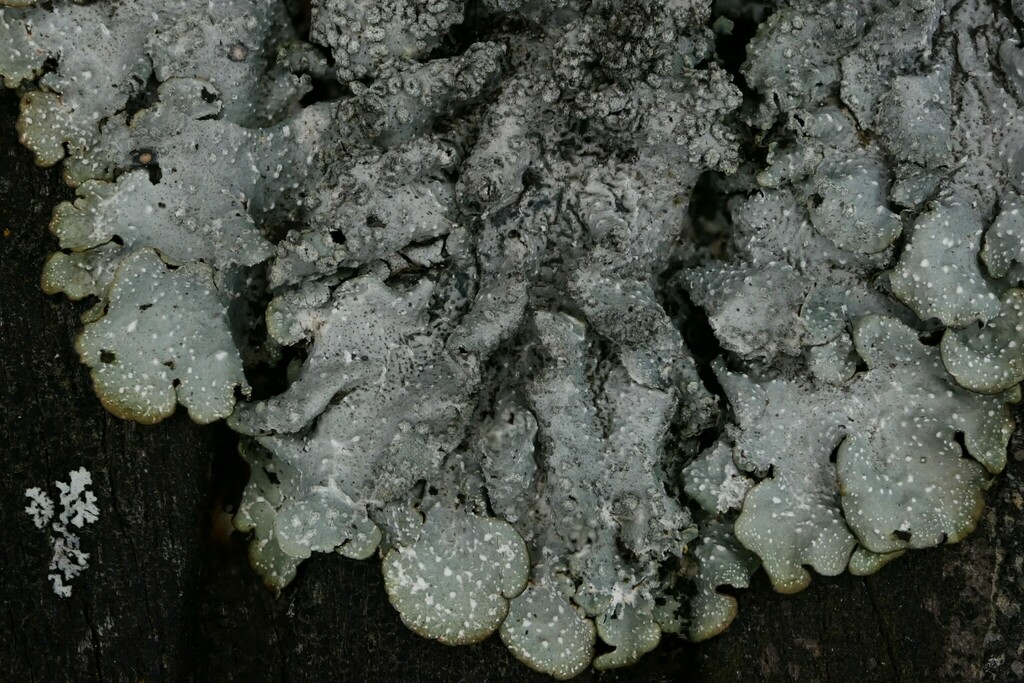
Borrer's Speckled Shield Lichen
Punctelia borreri
Punctelia borreri is a species of foliose lichen in the family Parmeliaceae. It is a common and widely distributed species, occurring in tropical, subtropical, and temperate regions of Africa, Asia, Europe, North America, Oceania, and South America. The lichen typically grows on bark of deciduous trees, and less commonly on rock. Some European countries have reported increases in the geographic range or regional frequency of the lichen in recent decades, attributed alternatively to a reduction of atmospheric sulphur dioxide levels or an increase in temperatures resulting from climate change.
The lichen is characterised by a greenish-grey to bluish-grey upper thallus surface, a black lower surface, pseudocyphellae on the surface of the thallus (tiny pores that facilitate gas exchange), and chemically, by the presence of gyrophoric acid in the medulla. There are several lookalike Punctelia species, including P. subrudecta, P. perreticulata, and P. reddenda. These can be distinguished from P. borreri by differences in chemistry, in the nature of the vegetative reproductive structures present on the thallus, or the colour of the thallus underside.
From the article Punctelia borreri on Wikipedia (CC BY-SA), quoted section by section
Description
The thallus of Punctelia borreri is foliose (leafy), forming rosettes that are closely attached to their substrate, measuring up to 10 cm (4 in) in diameter. The colour of the upper thallus surface ranges from grey to bluish-grey, greenish-grey, or yellowish-grey. Old herbarium specimens turn buff. Sometimes, the margins of the thallus are whitish from pruina (a powdery coating); at other times they have a brownish tinge. The pruina is often abundant, but not present on all the lobes. In fresh specimens, the pruina gives the lobes a glaucous colour (dull bluish-green). Pruina consists of crystals of calcium oxalate, an insoluble organic calcium salt that is excreted on the thallus surface. The surface has a smooth and shiny texture, with some wrinkling near the centre of the thallus. Lobes comprising the thallus are flat or concave, measuring 4–8 mm (0.2–0.3 in) wide. Pseudocyphellae are small (up to 300 μm wide), roughly circular, and point-like (punctate); they are more prominent towards the periphery of the thallus. Closer to the centre of the thallus they aggregate in regions with powdery propagules called soralia. The soralia are dot-like, whitish, and distinctly rounded. They arise from pseudocyphellae that are small and punctiform, which often become confluent in age. The soredia are farinose (powdery) to more or less granular on older thalli. …
Range & habitat
Punctelia borreri usually grows on bark, but is occasionally found growing on rock. The lichen has a cosmopolitan distribution, having been recorded from Africa, Asia, Europe, North America, Oceania, Macaronesia, and South America. Its distribution in North America is largely limited to the west coast from California to Canada. Although some occurrences have been reported in Ohio and West Virginia, it is rare in eastern North America. In Mexico, it only occurs in Veracruz. In Australasia, Punctelia borreri is widely distributed, having been reported throughout eastern Australia and New Zealand. It is fairly common in eastern Australia (including Queensland, New South Wales, and Victoria) but is rare in New Zealand. In India it occurs in subtropical and lower temperate regions at altitudes of 1,500–2,200 m (4,900–7,200 ft). A 2017 record from the Hunza Valley in Pakistan was the first documented occurrence for that country.
Before its range expansion in Europe, Punctelia borreri was noted to have a strongly oceanic distribution with scattered occurrences in the central part of the continent. In a 2008 checklist of all parmelioid lichens in Europe (updated in 2011), P. borreri was noted to have been recorded from 21 countries and island groups. …
Wikipedia: “Habitat and distribution”
What it does
Several endophytic fungi (fungi that live within the tissue of plants or lichens) have been isolated from the thalli of Punctelia borreri. These include Chaetomium globosum, Hypoxylon fuscum (conidial stage), Nodulisporium hyalosporum, Spirographa ciliata (conidial stage), as well as taxa not identified to species from the genera Chaetomium, Nodulisporium, Phoma, Thielavia, and Scopulariopsis. Two species of lichenicolous fungi that have been recorded parasitizing Punctelia borreri are Nesolechia oxyspora and Pronectria subimperspicua. Infection by the latter of these fungal parasites creates discoloured areas on the host thallus.
Wikipedia: “Ecology”
At the table
Punctelia borreri has been used in traditional Chinese medicine as an alleged remedy for a variety of ailments, including chronic dermatitis, blurred vision, bleeding from the uterus or from external injuries, and for sores and swelling. To use, a decoction was drunk, or the dried and powdered lichen applied directly to the affected area. Laboratory tests using the disk diffusion test method have shown that ethanol-based extracts of P. borreri have antimicrobial effects against the bacteria Xanthomonas campestris and Staphylococcus aureus. In a study exploring the potential of several lichens as antidiabetic agents, P. borreri was noted for its in vitro ability to inhibit α-amylase, a key enzyme of carbohydrate digestion.
Wikipedia: “Human uses and research”
Where it lives
Recorded sightings
—
geo-referenced records in GBIF, from museums, herbaria and field observers.
Drag the globe to turn it. Dots are where records exist, not a range map; darker means more records.
In the stacks
Searching the stacks…
Every page naming Punctelia borreri in the Biodiversity Heritage Library →
This page is assembled live from iNaturalist, GBIF, Wikipedia, the Source Library and the Internet Archive. It is not yet part of the hand-edited codex. iNaturalist taxon 229442.