- Animals
- ›Arthropods
- ›Hexapods
- ›Insects
- ›Winged and Once-winged Insects
- ›Butterflies and Moths
- ›Curved-horn Moths
- ›Twirler Moths
- ›Apatetrinae
- ›Pexicopiini
- ›Sitotroga
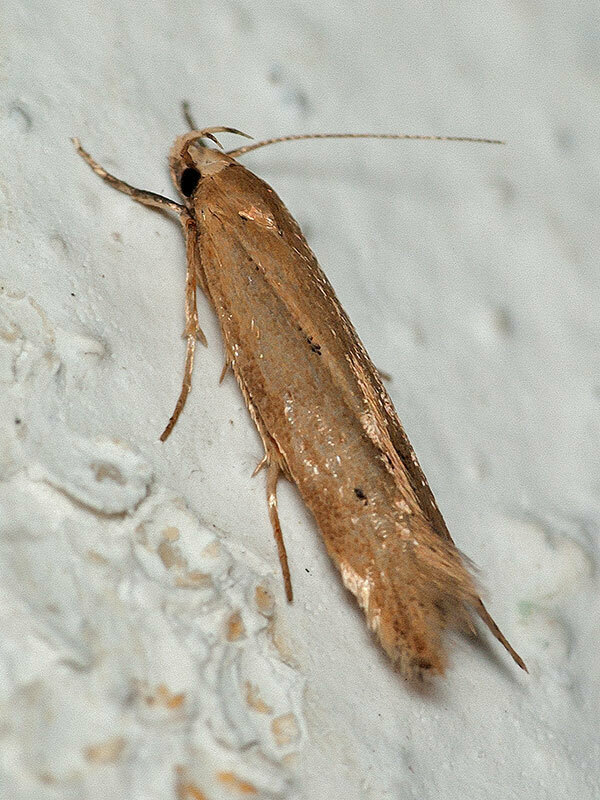
Angoumois Grain Moth
Sitotroga cerealella
The Angoumois grain moth (Sitotroga cerealella) is a species of the Gelechiidae moth family, commonly referred to as the "rice grain moth". It is most abundant in the temperate or tropical climates of India, China, South Africa, Indonesia, Malaysia, Japan, Egypt and Nigeria, with its location of origin being currently unknown. It is most commonly associated as a pest of field and stored cereal grains as they burrow within the kernel grains of crop plants, rendering them unusable for human consumption. By laying eggs between the grains themselves and hatching at a later time, often during the processing, transportation or storage stages, the moth can be transported to households or countries presently free of Angoumois grain moth infestations. Thus, constant protection against the Angoumois grain moth is required for grain up till the time of consumption.
From the article Angoumois grain moth on Wikipedia (CC BY-SA), quoted section by section
Description
The ovoid eggs are initially white when laid, but soon turn towards a shade of red and measure approximately 2 millimetres (3⁄32 in) long. Though rarely seen due to their growth stages taking place within a single grain, larvae of the Angoumois grain moth are yellowish-white with a small yellowish-brown head and 10–15 millimetres (3⁄8–9⁄16 in) in length. The average lifespan of the adult Angoumois grain moth is 15 days, with a maximum of 30 days if living under the optimal temperature. Adult Angoumois grain moths have a wingspan from 10–15 millimetres (13⁄32–19⁄32 in) and a body length of 5–10 millimetres (3⁄16–13⁄32 in). Like most moths, they have 4 wings, 6 legs and are brownish-grey, or pale brown in colour. They exhibit dark spots on their tapering forewings, about two-thirds from the base of their wings. Their uniquely curved hind wings give them a distinguishing characteristic from other moths, with hairs along the edge of the wings. The forewings are golden-yellow, with their light grey hind wings giving the whole moth an overall brown colour. Adult males are differentiated by a black thin and pointed abdomen whereas adult females express a colourless bulky and long abdomen.
Range & habitat
The Angoumois grain moth spread around the world with trade and it is now a cosmopolitan species. It is known to occur throughout Africa, Central and South America, Southeast and southern USA, the southern half of Eurasia (primarily below the 38th parallel north), Australia and New Zealand. The Angoumois grain moth is mostly found in warmer climates, but small populations have been documented in colder climates, such as Russia. There has been several recordings of its presence in imported products in the United Kingdom, but the moth has not established itself there. The optimal temperature at which it can survive is around 30 °C (86 °F), with a relatively high humidity of around 75% providing optimal conditions for hatching. Generally, the moth's habitat is predominantly situated within areas of agricultural development and agroecosystems.
Wikipedia: “Distribution and habitat”
What it does
The Angoumois grain moth's behavioural adaptations include the depositing of eggs on or close to a grain source, which the larvae then use as a food source as well as for protection. The adult moths, like all moth species, have an attraction to light (positive phototaxis) for competing reasons that are continuing to be debated. The moth in its larval stage creates an entrance hole within a grain, covering it after entry. After the process of pupation, an adult exit hole is created, from which it then emerges. These moths are typically known to be more active at low temperatures resulting in increased feeding activity in the winter months. Though typically a single larva will develop and feed on a single grain, cereal plants that produce kernel grains with high nutrient availability such as corn can provide for as many as three larvae. The moth can survive in both damaged grains and smaller grains such as millet, however, it has a preference for larger, nutrient-rich grains. Larvae burrow into the germ area of the grain where the thick bran acts as protection against predators whilst the germ itself provides a nutrient abundant food source. Larvae also exhibit the behaviour of producing silky tunnels between kernels in the storage of grains that have no external barrier, allowing for the larvae to travel freely between its food sources.
Wikipedia: “Behaviour”
Listen
Looking for field recordings…
Where it lives
Recorded sightings
—
geo-referenced records in GBIF, from museums, herbaria and field observers.
Drag the globe to turn it. Dots are where records exist, not a range map; darker means more records.
In the stacks
Searching the stacks…
Every page naming Sitotroga cerealella in the Biodiversity Heritage Library →
This page is assembled live from iNaturalist, GBIF, Wikipedia, the Source Library and the Internet Archive. It is not yet part of the hand-edited codex. iNaturalist taxon 231089.