- Animals
- ›Arthropods
- ›Hexapods
- ›Insects
- ›Winged and Once-winged Insects
- ›Butterflies and Moths
- ›Bagworms, Clothes Moths, and Allies
- ›Fungus Moths, Clothes Moths, & Allies
- ›Tineinae
- ›Tineola
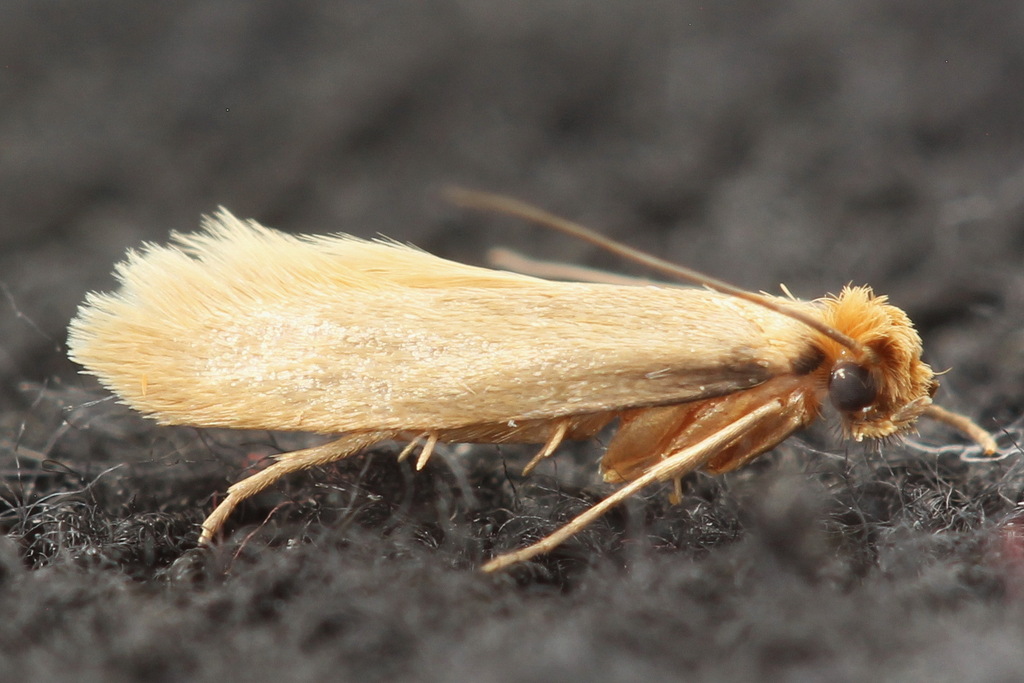
Webbing Clothes Moth
Tineola bisselliella
Tineola bisselliella, known as the common clothes moth, webbing clothes moth, or simply clothing moth, is a species of fungus moth (family Tineidae, subfamily Tineinae). It is the type species of its genus Tineola and was first described by the Swedish entomologist Arvid David Hummel in 1823. It and several closely related species are together known as the clothes moths due to their role as pests in human households. The specific name is commonly misspelled biselliella – for example, by G. A. W. Herrich-Schäffer, when he established Tineola in 1853.
The larvae (caterpillars) of this moth are considered a serious pest, as they can derive nourishment from clothing – in particular wool, but many other natural fibres – and also, like most related species, from stored foods, such as grains.
From the article Tineola bisselliella on Wikipedia (CC BY-SA), quoted section by section
Description
Tineola bisselliella is a small moth of 6–7 mm (0.24–0.28 in) body length and 9–16 mm (0.35–0.63 in) wingspan (most commonly 12–14 mm or 0.47–0.55 in). The head is light ferruginous ochreous, sometimes brownish-tinged.The antennae are thread-like and about four-fifths the length of the forewings. Forewings pale yellowish-ochreous; base of costa fuscous. Hindwings ochreous grey-whitish. (it is distinguished from similar species by its yellow-brown or ochreous colouring and red-orange tuft of hair on the head). The larva is white, eventually almost transparent, with a brown head. It lives in a silk tube.
Range & habitat
This moth's natural range is the western Palearctic, but it has been transported by human travelers to other localities. For example, it is nowadays found in Australia. The species' presence has not been recorded in France, Greece, Slovenia and Switzerland, though this probably reflects the lack of occurrence data rather than absence. This species is notorious for feeding on clothing and natural fibers; they have the ability to digest keratin protein in wool and silk. The moths prefer dirty fabric for oviposition and are particularly attracted to carpeting and clothing that contains human sweat or other organic liquids which have been spilled onto them; traces of dirt may provide essential nutrients for larval development. Larvae are attracted to these areas not only for the food but for traces of moisture; they do not require liquid water. The range of recorded foodstuffs includes linen, silk, and wool fabrics as well as furs. They will eat synthetic and cotton fibers if they are blended with wool and may use some cotton to build their cocoon. Furthermore, they have been found on shed feathers and hair, bran, semolina and flour (possibly preferring wheat flour), biscuits, casein, and insect specimens in museums. In one case, living T. bisselliella caterpillars were found in salt. …
Wikipedia: “Range and ecology”
What it does
Females lay eggs in clusters of between 30 and 200, which adhere to surfaces with a gelatin-like glue. These hatch between four and ten days later into near-microscopic white caterpillars, which immediately begin to feed. They will also spin mats under which to feed without being readily noticed and from which they will partially emerge at night or under dark conditions to acquire food. Development to the next stage takes place through between five and 45 instars typically over between one month and two years, until the pupal stage is reached. At this point, the caterpillars spin cocoons and spend another approximately 10–50 days developing into adults. After pupation is complete, the adult moths emerge and begin searching for mates. Females tend to move less than males, and both sexes prefer scuttling over surfaces to flying— some adults never fly at all. Adults can live for an additional 15–30 days, after which they die (otherwise death takes place shortly after mating for males and shortly after egg laying for females). …
Wikipedia: “Life cycle”
Listen
Looking for field recordings…
Where it lives
Recorded sightings
—
geo-referenced records in GBIF, from museums, herbaria and field observers.
Drag the globe to turn it. Dots are where records exist, not a range map; darker means more records.
In the stacks
Searching the stacks…
Every page naming Tineola bisselliella in the Biodiversity Heritage Library →
This page is assembled live from iNaturalist, GBIF, Wikipedia, the Source Library and the Internet Archive. It is not yet part of the hand-edited codex. iNaturalist taxon 232606.