- Animals
- ›Arthropods
- ›Hexapods
- ›Insects
- ›Winged and Once-winged Insects
- ›Ants, Bees, Wasps, and Sawflies
- ›Narrow-waisted Wasps, Ants, and Bees
- ›Ants, Bees, and Stinging Wasps
- ›Formicoidea
- ›Ants
- ›Odorous Ants
- ›Tapinomini
- ›Liometopum
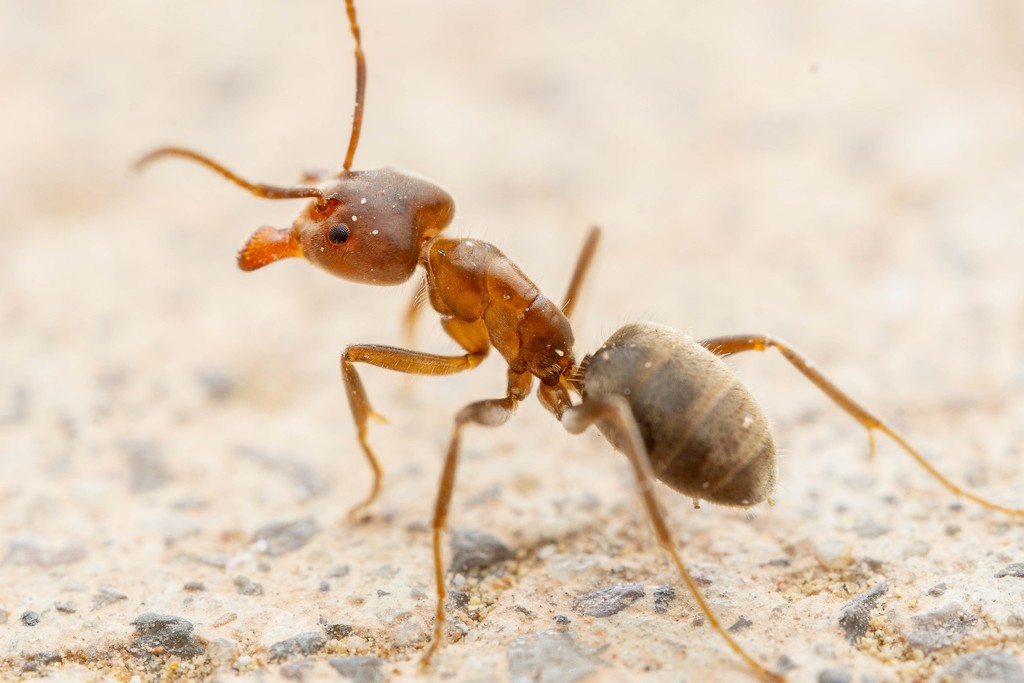
Escamolera Ant
Liometopum apiculatum
Liometopum apiculatum is a species of ant in the subfamily Dolichoderinae. Liometopum apiculatum ants are found in arid and semi-arid regions of southwestern United States and Mexico to Quintana Roo.
From the article Liometopum apiculatum on Wikipedia (CC BY-SA), quoted section by section
Range & habitat
Liometopum apiculatum ants are found in arid and semi-arid regions of southwestern United States and Mexico to Quintana Roo. They extend from Colorado through Texas, New Mexico, southeastern Arizona, and south into Mexico. They are usually found at elevations of 1,000–2,500 metres (3,300–8,200 ft), but their prime habitat is oak forests found around 2,000 m (6,600 ft). At higher elevations they are found in pinyon pine zones, up to the ponderosa pine and riparian zones; at lower elevations they inhabit creosote bush scrub and grasslands in microhabitats of clay, under rocks, boulders, and decaying logs. They have also been found in foothill meadows, deciduous canyon forests, pinyon-cedar woodlands, ponderosa pine-cedar-oak woodlands, and cottonwood–willow forests. At high elevations, their abundance decreases and they are replaced by L. luctuosum. Altitude may play an important role in the distribution of Liometopum. In regions of Mexico explored by Conconi et al. (1983b), L. luctuosum and L. apiculatum are only found between 2,000 and 3,000 m (6,600 and 9,800 ft). Although conditions below 1,800 m (5,900 ft) looked favorable, they are absent. In the U.S., L. apiculatum is found from 1,316 to 2,438 m (4,318 to 7,999 ft).
Wikipedia: “Habitat”
What it does
Liometopum apiculatum are opportunistic carnivores and granivores, and have also been observed foraging on dead insects, larger colonies being more predaceous. L. apiculatum also feeds on crustaceans, annelids, mollusks, dead vertebrates, animal droppings, and extrafloral nectar. These ants also obtain nectar or pollen from bear grass and substances from the outside of the ovaries of the flowers of century plants (Agave scabra and Agave chisosensis) and Spanish dagger (Yucca spp.). Workers have been attracted to various foods used as baits including apple sauce, sausage, vegetable soup, sugar water, and cookies. L. apiculatum have also been observed soliciting honeydew from insects including membracids (Vanduzea segmentata), aphids, and other ants (Pogonomyrmex barbatus, Camponotus sayi and Solenopsis xyloni). In some habitats the honeydew produced by hemipterans, Cinara spp., Dysmicoccus brevipes and Saissetia oleae, are the main energy sources. In other words, hemipteran exudates make up the bulk of the diet of L. apiculatum. Their role in disrupting biological control has not been determined.
Wikipedia: “Feeding”
Listen
Looking for field recordings…
Where it lives
Recorded sightings
—
geo-referenced records in GBIF, from museums, herbaria and field observers.
Drag the globe to turn it. Dots are where records exist, not a range map; darker means more records.
In the stacks
Searching the stacks…
Every page naming Liometopum apiculatum in the Biodiversity Heritage Library →
This page is assembled live from iNaturalist, GBIF, Wikipedia, the Source Library and the Internet Archive. It is not yet part of the hand-edited codex. iNaturalist taxon 244393.