- Animals
- ›Arthropods
- ›Chelicerates
- ›Arachnids
- ›Spiders
- ›Typical Spiders
- ›Entelegyne Spiders
- ›Orbweavers and Allies
- ›Leaf-curling Orbweavers
- ›Phonognatha
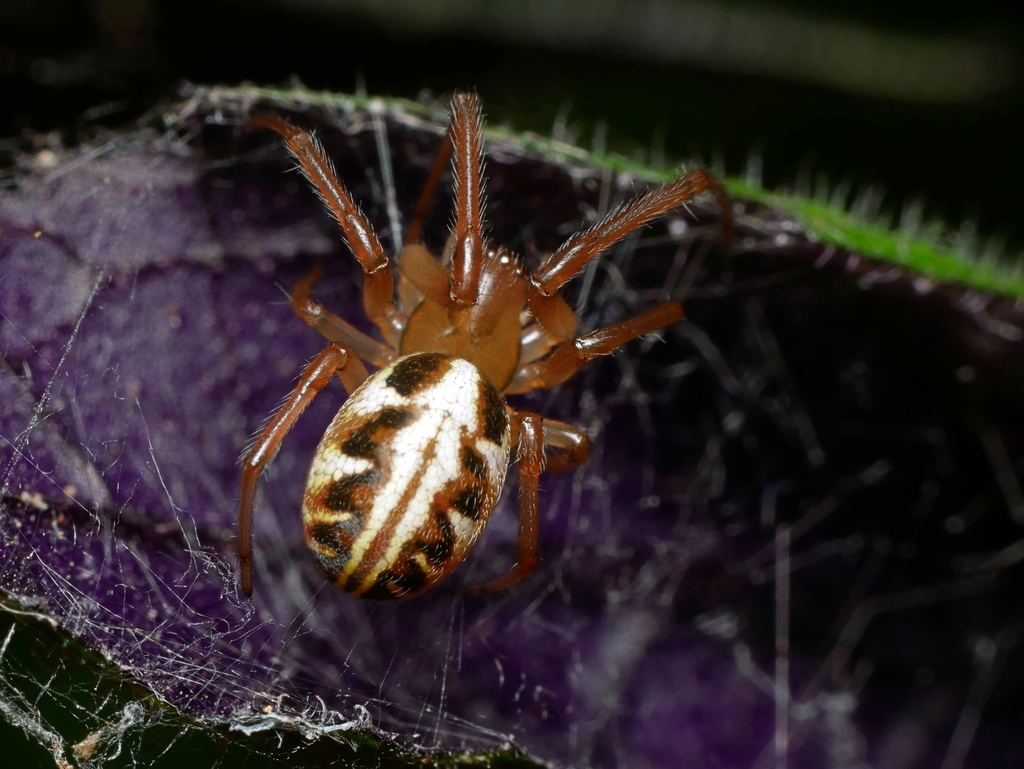
Leaf-curling Spider
Phonognatha graeffei
Phonognatha graeffei, referred to as the leaf curling spider, is a common Australian spider found in woodlands and urban areas in the northeastern, eastern and southern states. A member of the family Araneidae, the orb-weavers, it was previously placed in Tetragnathidae.
The spider is distinguished by having a curled leaf at the centre of its web, in which it shelters. The species form pairs living together in the same leaf, though at opposite ends of their shelter, even before mating at maturity. The female creates a separate curled leaf "nursery" hung in foliage nearby.
From the article Phonognatha graeffei on Wikipedia (CC BY-SA), quoted section by section
Description
The body length of the male is 5 to 6mm and female 8 to 12mm. Males and females look very similar with red-brown legs and body and a cream coloured pattern on their backs. Their bodies are fat and oval shaped with long tapered legs.
Wikipedia: “Appearance”
Range & habitat
The spider is commonly found in open woodland and forest habitats, as well as urban and suburban gardens in the northeastern, eastern and southern Australian states.
Wikipedia: “Distribution”
What it does
The leaf-curling spiders are day-active orb weavers, protecting themselves from predators by sitting inside their silk-seamed, curled leaf. In P. graeffei this leaf is suspended just above the centre of the web, but may be placed higher in other species. Such leaves may be already be partly curled, though many are not, and the spider pulls and silks its leaf into a retreat cylinder, silked shut at the top and open at the hub. Like other web-weaving spiders, their main food source is flying insects including insects larger than itself. They are noted for their sexual cohabitation and its function in mate-guarding behaviour. This means that the male and female live together in the same curled leaf, occupying opposite ends of the retreat, with the female at the open end.
Mating behaviour. The species is unusual among orb-weaving spiders because males cohabit in the leaf retreat with both immature and mature females, mating with the former shortly after the female moults. Male spiders may take up residence nearby, or in the same web as the (often immature) female. Mating takes place as soon as she has her final moult.
According to Babette F. Fahey, M. A. Elgar, cohabitation may be a form of mate-guarding, because resident males challenge rival males that venture onto the web. …
Wikipedia: “Behaviour”
Where it lives
Recorded sightings
—
geo-referenced records in GBIF, from museums, herbaria and field observers.
Drag the globe to turn it. Dots are where records exist, not a range map; darker means more records.
In the stacks
Searching the stacks…
Every page naming Phonognatha graeffei in the Biodiversity Heritage Library →
This page is assembled live from iNaturalist, GBIF, Wikipedia, the Source Library and the Internet Archive. It is not yet part of the hand-edited codex. iNaturalist taxon 244649.