- Animals
- ›Molluscs
- ›Cephalopods
- ›Octopuses, Squids, and Cuttlefishes
- ›Octopuses and Vampire Squids
- ›Octopuses
- ›Incirrate Octopuses
- ›Argonauts, Blanket Octopuses, and Allies
- ›Argonauts
- ›Argonauta
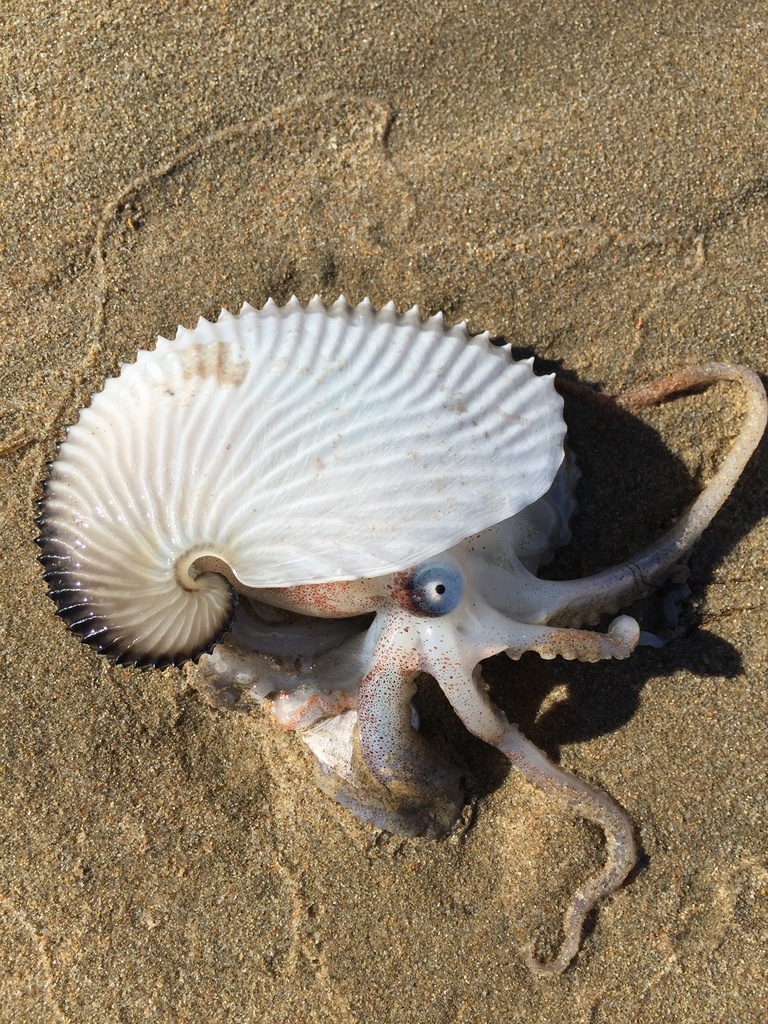
Greater Argonaut
Argonauta argo
Argonauta argo, also known as the greater argonaut, is a species of pelagic octopus belonging to the genus Argonauta. In some parts of Guangdong, China, this species is locally known as “白海马巢” While the name literally translates as "white sea-horse's nest", the term "sea-horse" in regional Sinitic languages actually refers to sand crabs (such as ghost crabs) rather than the animal commonly known as a seahorse, and bears no relation to horses. In Taizhou, local elderly speakers refer to its shell as "sea-horse shell", while the soft body is called "octopus".
A. argo was the first argonaut species to be described and is consequently the type species of the genus. The type specimen of A. argo was collected in the Mediterranean Sea and is deposited at the Linnean Society of London.
From the article Argonauta argo on Wikipedia (CC BY-SA), quoted section by section
Description
A. argo is the largest species in the genus and also produces the largest eggcase. Live animals have a characteristic blue sheen on the first arm pair and around the eyes. The eggcase is characterised by two rows of small, sharp tubercles running along a narrow keel, smooth ribs across the walls of the shell, and a thickening along the shell aperture, which forms distinct protrusions or 'horns' on either side. Argonauta cygnus Monterosato, 1889 was described based on a shell which lacked these protrusions, although it is now considered a junior synonym of A. argo. The greatest recorded size of an A. argo eggcase is 300 mm. A damaged beak of a female A. argo (ML = 40.0 mm; caught at 20°56′N 175°33′W), measuring 4.3 mm in hood length and 7.8 mm in crest length, is mentioned in A Handbook for the Identification of Cephalopod Beaks.
Range & habitat
A. argo is cosmopolitan, occurring in tropical and subtropical waters worldwide. A dwarf form exists in the Mediterranean Sea, which was described as Argonauta argo mediterranea Monterosato, 1914, although this taxon is now regarded as invalid.
Wikipedia: “Distribution and habitat”
In human culture
In Japanese, this species is called "Aoi-gai" (kanji: 葵貝, Katakana: アオイガイ), which means "Shell of Aoi" (not Malva but Asarum caulescens). Japanese have compared two eggcases of argonauts lapped each other to a leaf of Asarum caulescens. Another name is "Kaidako" (kanji: 貝蛸 or 貝鮹, Katakana: カイダコ), which means "Shell Octopus".
Wikipedia: “Culture”
Where it lives
Recorded sightings
—
geo-referenced records in GBIF, from museums, herbaria and field observers.
Drag the globe to turn it. Dots are where records exist, not a range map; darker means more records.
In the stacks
Searching the stacks…
Every page naming Argonauta argo in the Biodiversity Heritage Library →
This page is assembled live from iNaturalist, GBIF, Wikipedia, the Source Library and the Internet Archive. It is not yet part of the hand-edited codex. iNaturalist taxon 253674.