- Animals
- ›Arthropods
- ›Hexapods
- ›Insects
- ›Winged and Once-winged Insects
- ›Flies
- ›Nematoceran Flies
- ›Mosquitoes and Midges
- ›Culicoidea
- ›Mosquitoes
- ›Anopheline Mosquitoes
- ›Anopheles
- ›Nyssorhynchus
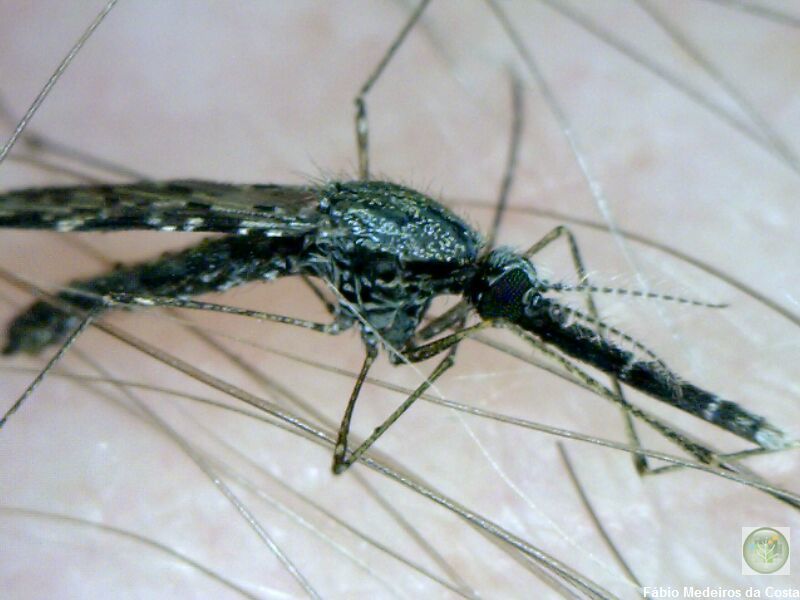
Anopheles darlingi
Anopheles () is a genus of mosquito first described by the German entomologist J. W. Meigen in 1818, and are known as nail mosquitoes and marsh mosquitoes. Many such mosquitoes are vectors of the parasite Plasmodium, a genus of protozoans that cause malaria in birds, reptiles, and mammals, including humans. The Anopheles gambiae mosquito is the best-known species of marsh mosquito that transmits the Plasmodium falciparum, which is a malarial parasite deadly to human beings; no other mosquito genus is a vector of human malaria.
The genus Anopheles diverged from other mosquitoes approximately 100 million years ago (mya), and, like other mosquitoes, the eggs, larvae, and pupae are aquatic. The Anopheles larva has no respiratory siphon through which to breathe, so it breathes and feeds with its body horizontal to the surface of the water. The adult mosquito hatches from the surface and feeds on the nectar of flowers; the female mosquito also feeds on blood, which animal diet allows them to carry and transmit parasites between hosts. The adult's feeding position is head-down, unlike the horizontal stance of the culicines. Anopheles are distributed almost worldwide, throughout the tropics, the subtropics, and the temperate regions of planet Earth. In hot weather, adult Anopheles aestivate, which is a state of dormancy that enables the mosquito to survive in hot dry regions, such as the Sahel.
From the article Anopheles on Wikipedia (CC BY-SA), quoted section by section
Range & habitat
Anopheles species live both in tropical areas known for malaria such as sub-Saharan Africa, and in colder latitudes. Malaria outbreaks have in the past occurred in colder climates, for example during the construction of the Rideau Canal in Canada during the 1820s. Anopheles species that can transmit malaria are not limited to malaria-endemic areas, so areas where they have been eliminated are constantly at risk of reintroduction of the disease.
Wikipedia: “Distribution”
What it does
Like all mosquitoes, anophelines go through four stages in their life cycles: egg, larva, pupa, and adult. The first three stages are aquatic and together last 5–14 days, depending on the species and the ambient temperature. The adult stage is when the female Anopheles acts as malaria vector. The adult females can live up to a month (or more in captivity), but most probably do not live more than two weeks in nature.
Eggs. Adult females lay 50–200 eggs per oviposition. The eggs are quite small (about 0.5 millimetres (0.02 in) × 0.2 millimetres (0.008 in)). Eggs are laid singly and directly on to water. They are unique in that they have floats on either side. Eggs are not resistant to drying and hatch within 2–3 days, although hatching may take up to 2–3 weeks in colder climates.
Larvae. The mosquito larva has a well-developed head with mouth brushes used for feeding, a large thorax and a nine-segment abdomen. It has no legs. In contrast to other mosquitoes, the Anopheles larva lacks a respiratory siphon, so it positions itself so that its body is parallel to the surface of the water. In contrast, the feeding larva of culicine mosquitoes attach themselves to the water surface with the posterior siphon, the body pointing downwards. Larvae breathe through spiracles located on the eighth abdominal segment and so must come to the surface frequently. …
Wikipedia: “Life cycle”
In human culture
Fossils of the genus Anopheles are rare; only two had been found by 2015. They are Anopheles (Nyssorhynchus) dominicanus Zavortink & Poinar in Dominican Republic amber from the Late Eocene (40.4 million years ago to 33.9 million years ago), and Anopheles rottensis Statz in German amber from the Late Oligocene (28.4 million years ago to 23 million years ago).
Wikipedia: “Fossil history”
Listen
Looking for field recordings…
Where it lives
Recorded sightings
—
geo-referenced records in GBIF, from museums, herbaria and field observers.
Drag the globe to turn it. Dots are where records exist, not a range map; darker means more records.
In the stacks
Searching the stacks…
Every page naming Anopheles darlingi in the Biodiversity Heritage Library →
This page is assembled live from iNaturalist, GBIF, Wikipedia, the Source Library and the Internet Archive. It is not yet part of the hand-edited codex. iNaturalist taxon 259058.