- Plants
- ›Vascular Plants
- ›flowering plants
- ›Dicots
- ›nightshades, bindweeds, gooseweeds, and allies
- ›nightshade family
- ›nightshades and allies
- ›nightshades and jaltomatas
- ›Solanum
- ›Leptostemonum
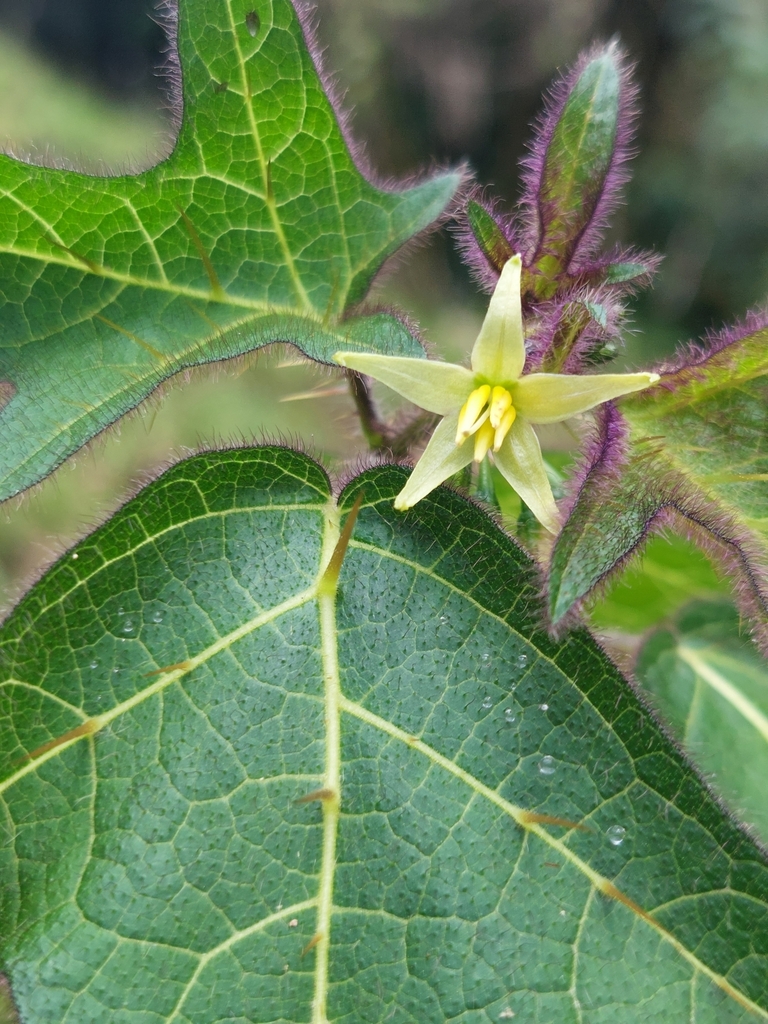
Solanum acerifolium
Solanum acerifolium is a species of small flowering shrub that belongs to the Solanaceae family, commonly known as the nightshade family. The species description was first published by a French botanist, Michel Félix Dunal in 1816.
From the article Solanum acerifolium on Wikipedia (CC BY-SA), quoted section by section
Description
Solanum acerifolium is a herbaceous plant that stands upright and is typically found reaching heights between 0.5 to 3 m (1 ft 8 in to 9 ft 10 in) in height, usually growing for a single stem but occasionally multiple coming from the base. Stems are pubescent with viscid-villous hairs and prickles that are straight and acicular. Acicular prickles appear densely armed along all parts of the stem. Prickles are usually 0.1 to 1.5 centimeters in length. Upper flowering branches usually carry fewer prickles and appear more glabrous except for the viscid-villous hairs.
Leaves. Leaves on S. acerifolium are around 5 to 18 cm (2.0 to 7.1 in) long and 4 to 15 cm (1.6 to 5.9 in) wide. Leaves can be single or in pairs. Leaves are broadly ovate or elliptic in shape and are usually 4-lobed with an acute apex. On both surfaces of the leaves are pubescent, and covered in viscid-villous hairs. Both surfaces of the leaves carry prickles along the major veins, similar in size to those found along the stems. The petioles of leaves measure 4 to 9 cm (1.6 to 3.5 in) and have a pubescence similar to that of stems.
Inflorescence. Inflorescence found on the S. aceriolium is extra-axillary and unbranched measuring 6 to 40 mm (0.24 to 1.57 in). The inflorescence is characterized as a subumbellate raceme. Typically holding 3 to 10 flowers that develop 1 to 8 fruit. …
Range & habitat
Solanum acerifolium is capable of populating many different habitats including forest clearings, pastures, roadsides, and ravines. S. acerifolium has also been correlated with growing close to and inside coffee plantations. It is possible that the commerce of coffee could be the reason for its success in distribution across countries in southern Mexico and South America. S. acerifolium is typically found at altitudes of 1200 to 2000 meters.
Wikipedia: “Habitat”
What it does
Many species in the Solanum genus including Solanum acerifolium are visited by buzzing bees and undergo buzz-pollination. Buzz-pollination is the mechanical shaking of the flowers' anthers, while in contact with the bodies of buzzing bees.
Wikipedia: “Pollination”
Where it lives
Recorded sightings
—
geo-referenced records in GBIF, from museums, herbaria and field observers.
Drag the globe to turn it. Dots are where records exist, not a range map; darker means more records.
In the stacks
Searching the stacks…
Every page naming Solanum acerifolium in the Biodiversity Heritage Library →
This page is assembled live from iNaturalist, GBIF, Wikipedia, the Source Library and the Internet Archive. It is not yet part of the hand-edited codex. iNaturalist taxon 280891.