- Plants
- ›Vascular Plants
- ›flowering plants
- ›Dicots
- ›nightshades, bindweeds, gooseweeds, and allies
- ›nightshade family
- ›nightshades and allies
- ›nightshades and jaltomatas
- ›Solanum
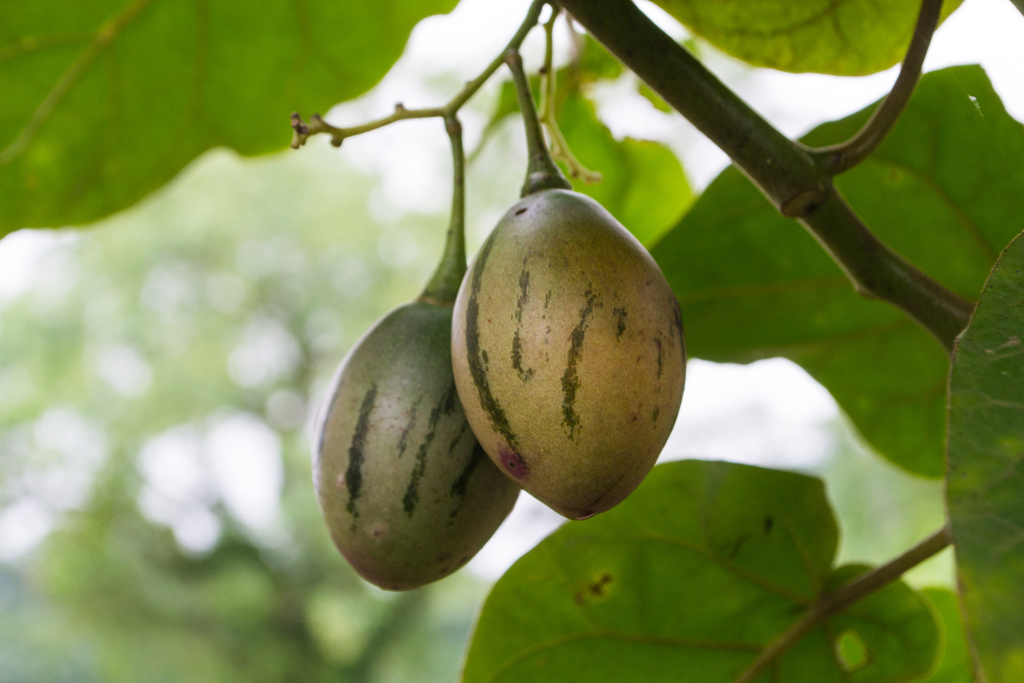
tamarillo
Solanum betaceum
The tamarillo (Solanum betaceum) is a tree or shrub in the flowering plant family Solanaceae (the nightshade family). It bears an egg-shaped edible fruit. It is common globally, especially in its native South America (as the Quechuan chilltu in Peru, Colombia, and Ecuador, or as tomate andino in other Andean countries), and has been introduced in New Zealand, Nepal, Rwanda, Burundi, the Democratic Republic of the Congo, Australia, Indonesia, Madeira and Bhutan.
From the article Tamarillo on Wikipedia (CC BY-SA), quoted section by section
Description
The plant is a fast-growing tree that grows up to 5 metres (16 ft). Peak production is reached after 4 years, and the life expectancy is about 5 to 12 years. The tree usually forms a single upright trunk with lateral branches. The flowers and fruits hang from the lateral branches. The leaves are large, simple and perennial, and have a strong pungent smell. The flowers are pink-white, and form clusters of 10 to 50 flowers. They produce 1 to 6 fruits per cluster. Plants can set fruit without cross-pollination, but the flowers are fragrant and attract insects. Cross-pollination seems to improve fruit set. The roots are shallow and not very pronounced, therefore the plant is not tolerant of drought stress and can be damaged by strong winds. Tamarillos will hybridize with many other solanaceae, though the hybrid fruits will be sterile, and unpalatable in some instances.
Fruit. The fruits are egg-shaped and about 4–10 centimetres (1+1⁄2–4 in) long. Their color varies from yellow and orange to red and almost purple. Sometimes they have dark, longitudinal stripes. Red fruits are more sour, yellow and orange fruits are sweeter. The flesh has a firm texture and contains more and larger seeds than a common tomato. The fruits are very high in vitamins and iron and low in calories (only about 40 calories per fruit).
Range & habitat
The tamarillo or chilltu is native to the Andes of Peru, Ecuador, Bolivia, Colombia, Argentina and Chile. Today it is still cultivated in gardens and small orchards for local production, and it is one of the most popular fruits in these regions. Other regions of cultivation are the subtropical areas throughout the world, such as Ethiopia, Burundi, Kenya, Rwanda, South Africa, Nepal, Hong Kong, China, Pakistan, the United States, Australia, Bhutan, New Zealand and Nagaland, Manipur, Darjeeling and Sikkim in India. It has also been seen in Cantabria, a province in Spain. Tamarillos were first introduced to New Zealand in 1891, from seeds originating from India (which in turn were likely sourced from Jamaica). The plant, then known as the tree tomato, was popularly grown in home gardens, and small-scale commercial production began by the 1910s. Production peaked in New Zealand in the mid-1960s, declining in the 1970s onwards due to disease-related problems. The tamarillo is a fruit harvested permanently in Colombia, the average annual production exceeds 150,000 tons. Antioquia has the largest number of hectares planted with La Meseta being the place where more than 900 hectares are located and from which the main cities of the country are supplied. In 1993, in New Zealand, about 2,000 tons were produced on 200 hectares of land and exported to the United States. …
Wikipedia: “Origin and distribution”
At the table
The fruit is eaten by scooping the flesh from a halved fruit. When lightly sugared and chilled, the flesh is used for a breakfast dish. Some people in New Zealand cut the fruit in half, scoop out the pulpy flesh and spread it on toast. Yellow-fruited cultivars have a sweeter flavor, occasionally compared to mango or apricot. The red-fruited variety, which is much more widely cultivated, is more tart, and the savory aftertaste is far more pronounced. In the Northern Hemisphere, tamarillos are most frequently available from July until November, and fruits early in the season tend to be sweeter and less astringent. In the highlands of Ecuador, yellow tamarillos are used in ceviche and condiments, and the red varieties for desserts. The hydroethanolic extract of the purple variety seeds has been found to be genotoxic, so macerations should only be done with the pulp. They can be made into compotes, or added to hollandaise, chutneys and curries. Desserts using this fruit include bavarois and, combined with apples, a strudel.
In Colombia, Ecuador, Panama, Venezuela, and parts of Indonesia (including Sumatra and Sulawesi), fresh tamarillos are frequently blended together with water and sugar to make a juice. It is also available as a commercially pasteurized purée. In Nepal, a version of the South American fruit is very popular. …
Wikipedia: “Culinary”
In human culture
Tamarillo is known as "Naga tree tomato" in Nagaland, and it is registered under the Geographical Indications (GI) of Nagaland by Government of India. It is locally called si binyano or khwüdi.
Wikipedia: “In culture”
Where it lives
Recorded sightings
—
geo-referenced records in GBIF, from museums, herbaria and field observers.
Drag the globe to turn it. Dots are where records exist, not a range map; darker means more records.
In the stacks
Searching the stacks…
Every page naming Solanum betaceum in the Biodiversity Heritage Library →
This page is assembled live from iNaturalist, GBIF, Wikipedia, the Source Library and the Internet Archive. It is not yet part of the hand-edited codex. iNaturalist taxon 280909.