- Animals
- ›Arthropods
- ›Chelicerates
- ›Arachnids
- ›Mites and Ticks
- ›Parasitiformes
- ›Ticks
- ›Hardbacked Ticks
- ›Ixodes
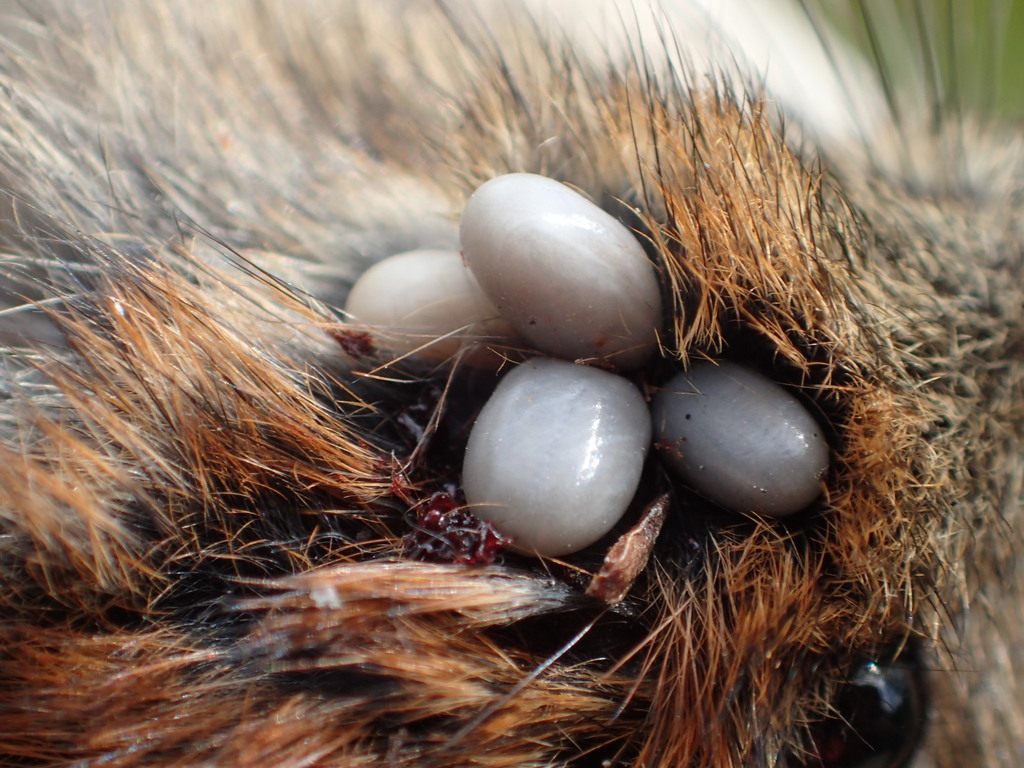
Ixodes angustus
Ixodes angustus is a species of parasitic tick, whose range encompasses the majority of Canada and the United States, along with parts of northern Mexico. I. angustus is a member of the Ixodidae (hard-bodied) family of ticks. It is most abundant in cool, moist biomes such as riparian, boreal or montane zones. I. angustus is a host generalist and has been discovered feeding on more than 90 different host species, including humans and domestic dogs. I. angustus has been identified as a potential vector for Lyme disease but is not considered a principal vector due to the relative rarity with which it feeds on humans.
From the article Ixodes angustus on Wikipedia (CC BY-SA), quoted section by section
Description
Adult females are approximately 2 mm unfed and can grow up to 7 mm when engorged with a blood meal. They possess a diamond shaped non-ornate dorsal plate (otherwise known as a shield) with rounded edges. Palps are long, with a half-diamond shape (straight outer edge and a rounded inner edge). Adult males grow to around 2 mm, and cannot become engorged with blood as their inflexible back plate extends to cover the entire dorsal side of the tick. Palps are much smaller, thicker, and more ovular than females.
Range & habitat
Ixodes angustus has a wide distribution in North America and has been recorded in all Canadian provinces except Saskatchewan (although it is suspected to occur there), the majority of continental US states, and the Mexican state of Coahuila. There have been several erroneous records of I. angustus in South and Central America, but thus far there are no Bona fide neotropical records of I.angustus. Within this extensive range, I. angustus is most prevalent in cool, damp habitats such as boreal, montane and riparian zones.
Wikipedia: “Distribution”
Where it lives
Recorded sightings
—
geo-referenced records in GBIF, from museums, herbaria and field observers.
Drag the globe to turn it. Dots are where records exist, not a range map; darker means more records.
In the stacks
Searching the stacks…
Every page naming Ixodes angustus in the Biodiversity Heritage Library →
This page is assembled live from iNaturalist, GBIF, Wikipedia, the Source Library and the Internet Archive. It is not yet part of the hand-edited codex. iNaturalist taxon 297829.