- Animals
- ›Arthropods
- ›Hexapods
- ›Insects
- ›Winged and Once-winged Insects
- ›Butterflies and Moths
- ›Curved-horn Moths
- ›Momphidae
- ›Momphinae
- ›Mompha
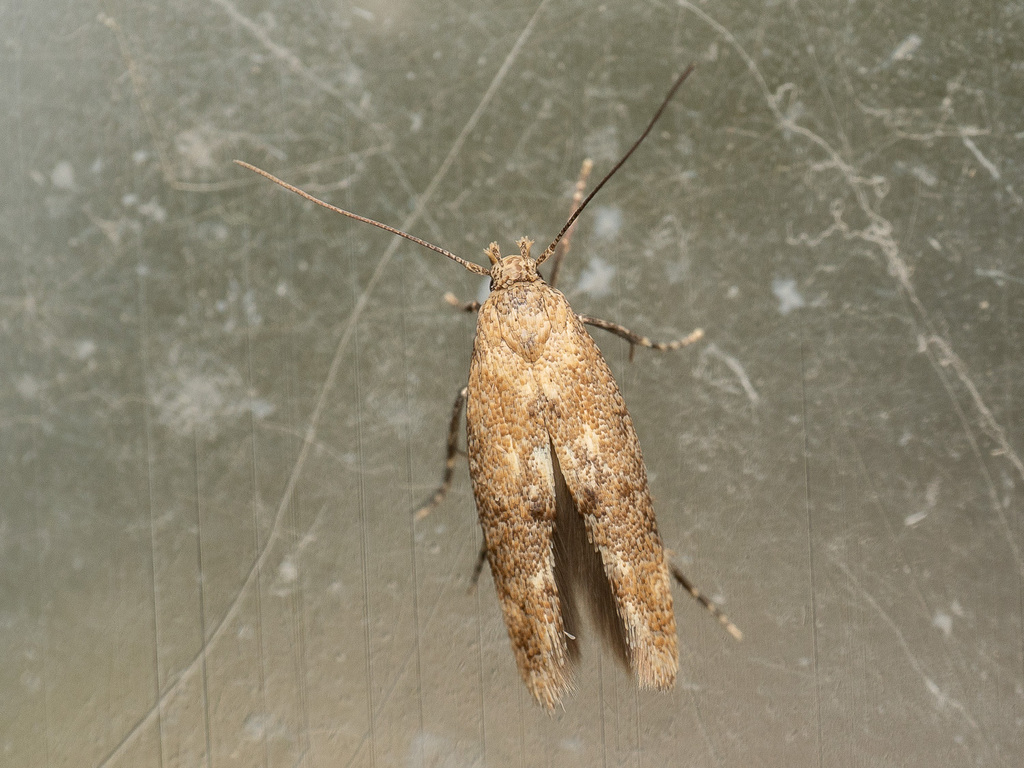
Common Cosmet
Mompha epilobiella
Mompha epilobiella is a moth in the Momphidae family. It has a Holarctic distribution, it is found in North America, including Ontario and all of Europe.
From the article Mompha epilobiella on Wikipedia (CC BY-SA), quoted section by section
Description
The wingspan is 10–13 mm. The head is yellowish white and brownish speckled. The thorax is ochre-coloured. The forewings are also ochre and greyish on the costal vein. An indistinct yellow spot is located on the costa at 3/4 of the length of the forewing, a similar spot is on the inner angle. Two small tufts of slightly protruding dark brown scales are located at 1/5 of the length of the forewing and in the middle of the inner edge of the wing. The hind wings shine grey. The males differ from the similar species Mompha subbistrigella by the following characteristics: The saccule is shortened and has a group of small teeth apically. The Aedeagus has a hook-shaped cornutus and several straight cornuti. In the females, the 8th tergite is rounded at the posterior end. The bursae duct has a narrow and short posterior part and an abruptly widened anterior part. Both parts have a conspicuous sclerotized plate with strongly sclerotized edges
Adults are on wing throughout the year, but are most common in July and August in Great Britain. The larvae have been recorded feeding on rosebay willowherb (Chamerion angustifolium), great willowherb (Epilobium hirsutum), broad-leaved willowherb (Epilobium montanum), marsh willowherb (Epilobium palustre) and evening primrose (Oenothera species), but great willowherb is the main food plant. The other listed plants might be misidentifications. …
Range & habitat
It has a Holarctic distribution, found in North America, including Ontario and all of Europe.
Wikipedia: “Distribution”
Listen
Looking for field recordings…
Where it lives
Recorded sightings
—
geo-referenced records in GBIF, from museums, herbaria and field observers.
Drag the globe to turn it. Dots are where records exist, not a range map; darker means more records.
In the stacks
Searching the stacks…
Every page naming Mompha epilobiella in the Biodiversity Heritage Library →
This page is assembled live from iNaturalist, GBIF, Wikipedia, the Source Library and the Internet Archive. It is not yet part of the hand-edited codex. iNaturalist taxon 320167.