- Animals
- ›Arthropods
- ›Hexapods
- ›Insects
- ›Winged and Once-winged Insects
- ›Butterflies and Moths
- ›Tortricid Leafroller Moths and Allies
- ›Tortricid Leafroller Moths
- ›Olethreutine Leafroller Moths
- ›Enarmoniini
- ›Enarmonia
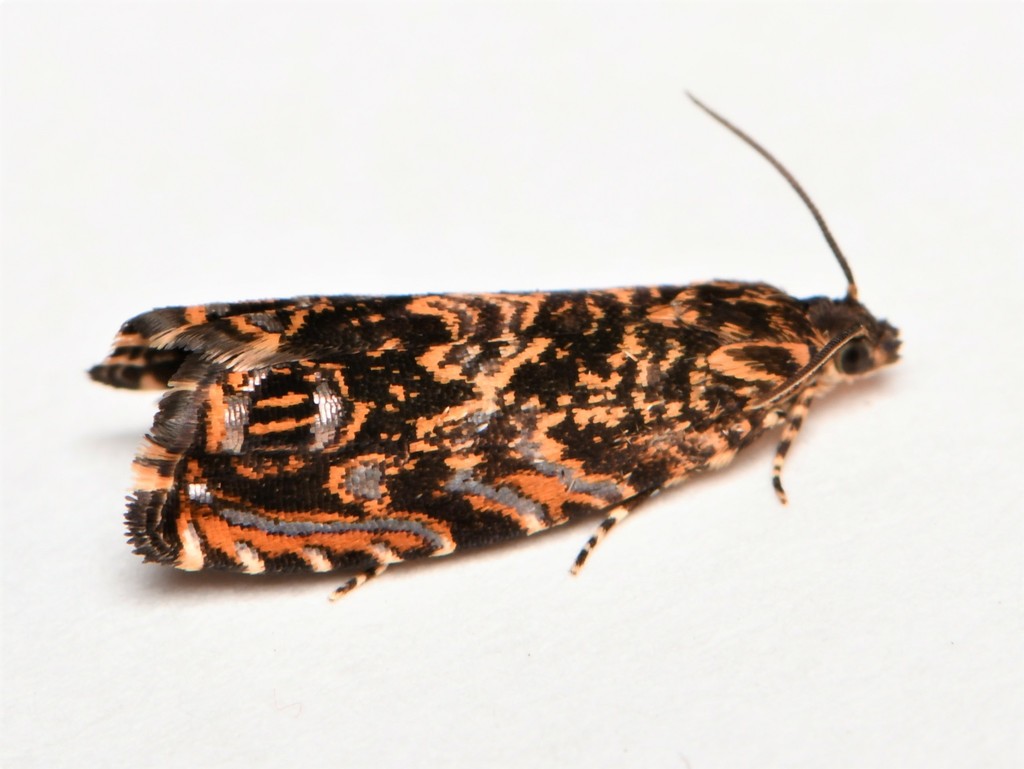
Cherry Bark Tortrix
Enarmonia formosana
Enarmonia formosana, the cherry-bark moth or cherry bark tortrix, is a small but colourful moth species in the family Tortricidae, native to Asia, Europe, and northern Africa, and introduced in North America. It was first described by the Italian physician and naturalist Giovanni Antonio Scopoli in 1763 and is the type species of its genus (Enarmonia), and by extension of the tribe Enarmoniini of subfamily Olethreutinae.
From the article Enarmonia formosana on Wikipedia (CC BY-SA), quoted section by section
Description
The wingspan is 15–19 mm. The forewings have a moderately arched costa. The ground colour is ferruginous-ochreous, with leaden metallic striae. The costa is blackish, posteriorly strigulated with white. The basal patch has the edge sharply angulated in the middle and indented near the dorsum. The central fascia is interrupted in the middle dark fuscous, marked with ferruginous-ochreous. The ocellus is black, edged with leaden-metallic and streaked with ferruginous, surmounted by a dark fuscous curved mark. The hindwings are rather dark fuscous. The larva is creamy white with an orange-brown head. The moths fly from May to October in the temperate parts of the range (e.g. Belgium and the Netherlands). The caterpillars feed on the bark of woody Rosaceae of subfamily Amygdaloideae, including hawthorns (Crataegus), apples (Malus), cherries and plums (Prunus), pears (Pyrus), and rowans (Sorbus). In particular, they have been noted to forage at canker lesions. They prefer mature trees and produce a reddish frass at the entrance to their tunnel. Signs of larval feeding can be seen at cracks in the bark, or at joints with branches. The larva pupates at the entrance to its tunnel, often enclosed by frass secured with silk.
Range & habitat
It is native to most of Europe, extending eastwards through Asia to Siberia and Kazakhstan and south to Maghreb in North Africa. Possibly and most likely introduced populations are found in Asia Minor and North America.
Wikipedia: “Distribution”
Listen
Looking for field recordings…
Where it lives
Recorded sightings
—
geo-referenced records in GBIF, from museums, herbaria and field observers.
Drag the globe to turn it. Dots are where records exist, not a range map; darker means more records.
In the stacks
Searching the stacks…
Every page naming Enarmonia formosana in the Biodiversity Heritage Library →
This page is assembled live from iNaturalist, GBIF, Wikipedia, the Source Library and the Internet Archive. It is not yet part of the hand-edited codex. iNaturalist taxon 320540.