- Plants
- ›Vascular Plants
- ›flowering plants
- ›monocots
- ›Agaves, Orchids, Irises, and Allies
- ›Orchids
- ›Orchidoid Orchids
- ›Cranichideae
- ›Pterostylidinae
- ›Pterostylis
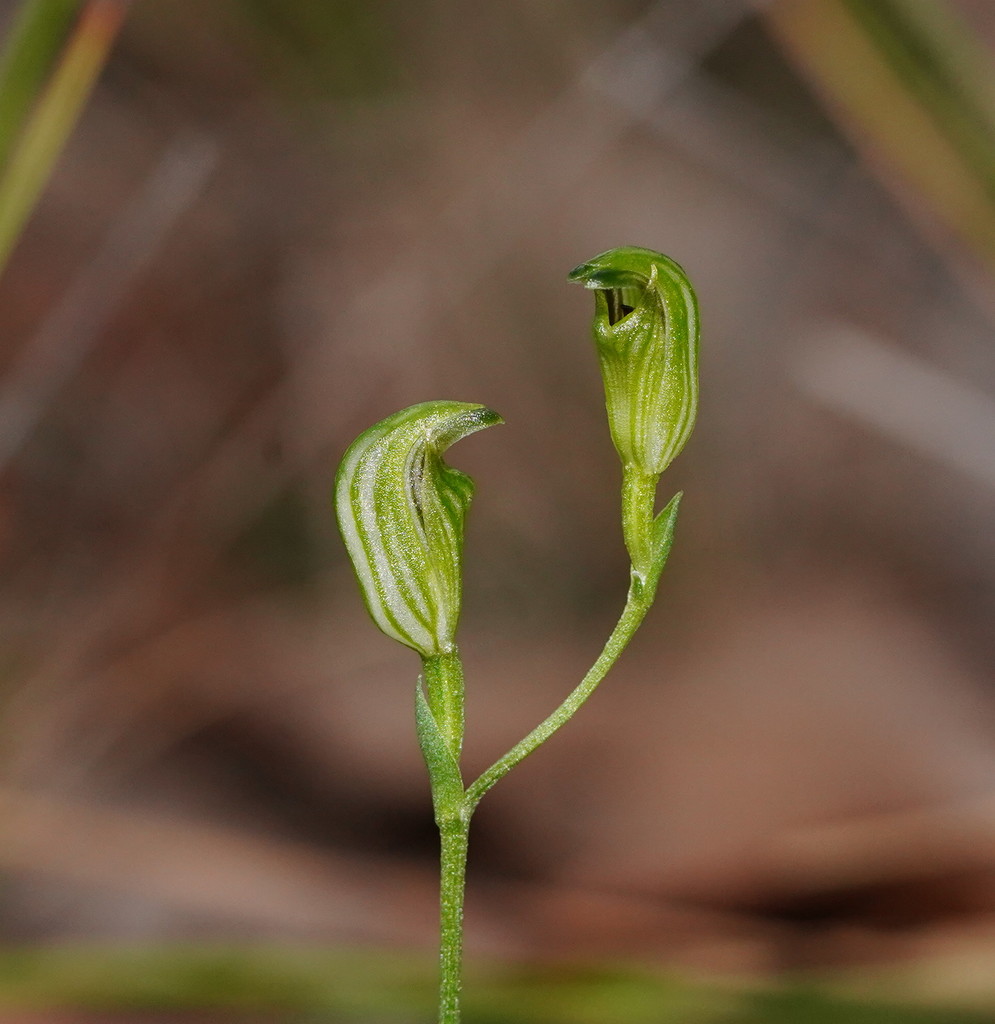
tiny greenhood
Pterostylis parviflora
Pterostylis parviflora, commonly known as the tiny greenhood, is a species of orchid endemic to south-eastern Australia. As with similar orchids, the flowering plants differ from those which are not flowering. The non-flowering plants have a rosette of leaves but the flowering plants lack a rosette at the base but have up to eight tiny green, white and brown flowers.
From the article Pterostylis parviflora on Wikipedia (CC BY-SA), quoted section by section
Description
Pterostylis parviflora is a terrestrial, perennial, deciduous, herb with an underground tuber and when not flowering, a rosette of three to eight egg-shaped to heart-shaped leaves which lie flat on the ground. Each leaf is 3–15 mm long and 3–7 mm wide. Flowering plants have up to eight well-spaced flowers 7–10 mm long and 3–4 mm wide borne on a thin, wiry spike 80–250 mm high. Up to three leaf rosettes are arranged on the side of the flowering spike. The flowers are green and white, sometimes brown on the petals. The dorsal sepal and petals are fused, forming a hood or "galea" over the column. The dorsal sepal curves forward and has a short point. The lateral sepals are erect, held closely against the galea with thread-like tips about 3mm long that do not project above the galea. The sinus between the bases of the lateral sepals bulges forward and has a small notch in the centre. The labellum is about 4 mm long, 1.5 mm wide and barely visible above the sinus. Flowering occurs from February to May.
Range & habitat
The tiny greenhood grows in a range of habitats from coastal heath to forest in moist, well-drained soils. It is widespread on the coast and ranges of New South Wales, the Australian Capital Territory, Tasmania and most of Victoria. It also occurs in Queensland but is rare in South Australia.
== References ==
Wikipedia: “Distribution and habitat”
Where it lives
Recorded sightings
—
geo-referenced records in GBIF, from museums, herbaria and field observers.
Drag the globe to turn it. Dots are where records exist, not a range map; darker means more records.
In the stacks
Searching the stacks…
Every page naming Pterostylis parviflora in the Biodiversity Heritage Library →
This page is assembled live from iNaturalist, GBIF, Wikipedia, the Source Library and the Internet Archive. It is not yet part of the hand-edited codex. iNaturalist taxon 323438.