- Animals
- ›Arthropods
- ›Chelicerates
- ›Arachnids
- ›Harvestmen
- ›Eupnoan Harvestmen
- ›Phalangioidea
- ›Phalangiid Harvestmen
- ›Oligolophinae
- ›Mitopus
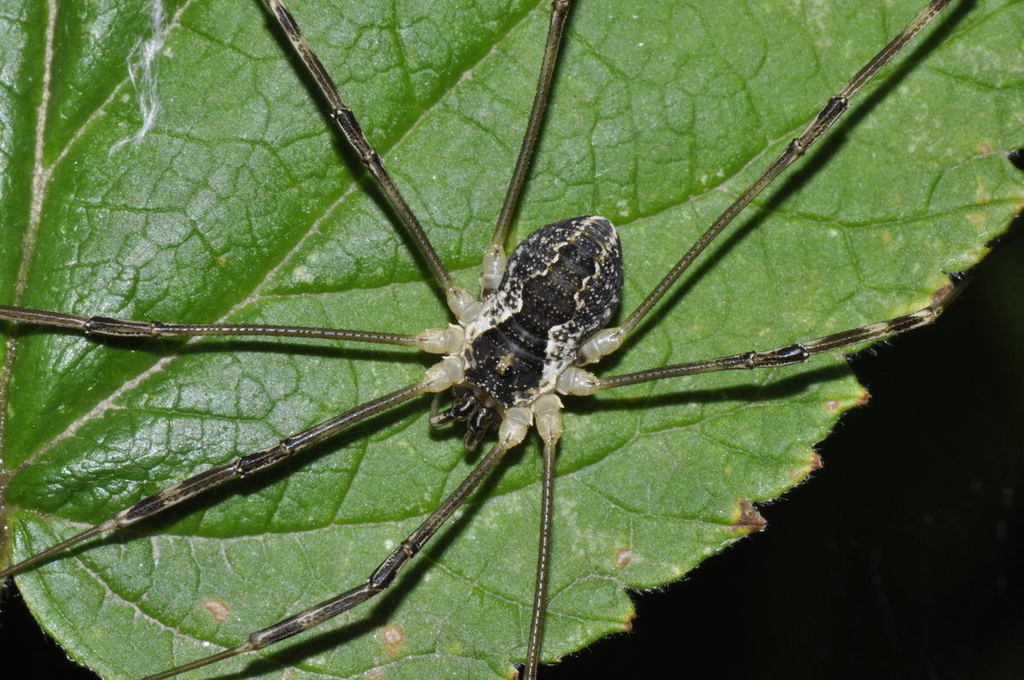
Saddleback Harvestman
Mitopus morio
Mitopus morio is a species of harvestman. It occurs in North America, Europe and Asia. It has been observed to walk using its first, third, and fourth sets of legs, using the unusually long second pair of legs to feel in front of it and probe its environment.
From the article Mitopus morio on Wikipedia (CC BY-SA), quoted section by section
Description
Mitopus morio can reach a body length of about 4–6 millimetres (0.16–0.24 in) in males, of about 4–8.5 millimetres (0.16–0.33 in) in females. However the body size is quite variable. The body is ovate, slightly narrower in the male. The head shows various tiny bumps. The eyes are small and narrow, longer than wider, with a varying number of small spikes around the eyebrow. Also color is rather variable, but males are usually brown-colored, where as females are darker. A dark irregular saddle-like area is always present on the back, sometimes with narrow white edges and a longitudinal pinkish stripe in the centre. The legs varies from yellowish-brown to dark brown and are thin and long. The length of the longest of the second pair of legs is 30–40 mm. Males have sharp, forward-pointing tooth under first segment of chelicera. This species is rather similar and may be confused with the females of Phalangium opilio.
Range & habitat
This very common species inhabits different biotopes, forests, heath and moorland, spruce forests, beech forests. meadows, human settlements and gardens, from the lowlands to the mountains.
Wikipedia: “Habitat”
Where it lives
Recorded sightings
—
geo-referenced records in GBIF, from museums, herbaria and field observers.
Drag the globe to turn it. Dots are where records exist, not a range map; darker means more records.
In the stacks
Searching the stacks…
Every page naming Mitopus morio in the Biodiversity Heritage Library →
This page is assembled live from iNaturalist, GBIF, Wikipedia, the Source Library and the Internet Archive. It is not yet part of the hand-edited codex. iNaturalist taxon 324310.