- Animals
- ›Arthropods
- ›Hexapods
- ›Insects
- ›Winged and Once-winged Insects
- ›Butterflies and Moths
- ›Pyralid and Crambid Snout Moths
- ›Pyralid Snout Moths
- ›Galleriinae
- ›Tirathabini
- ›Lamoria
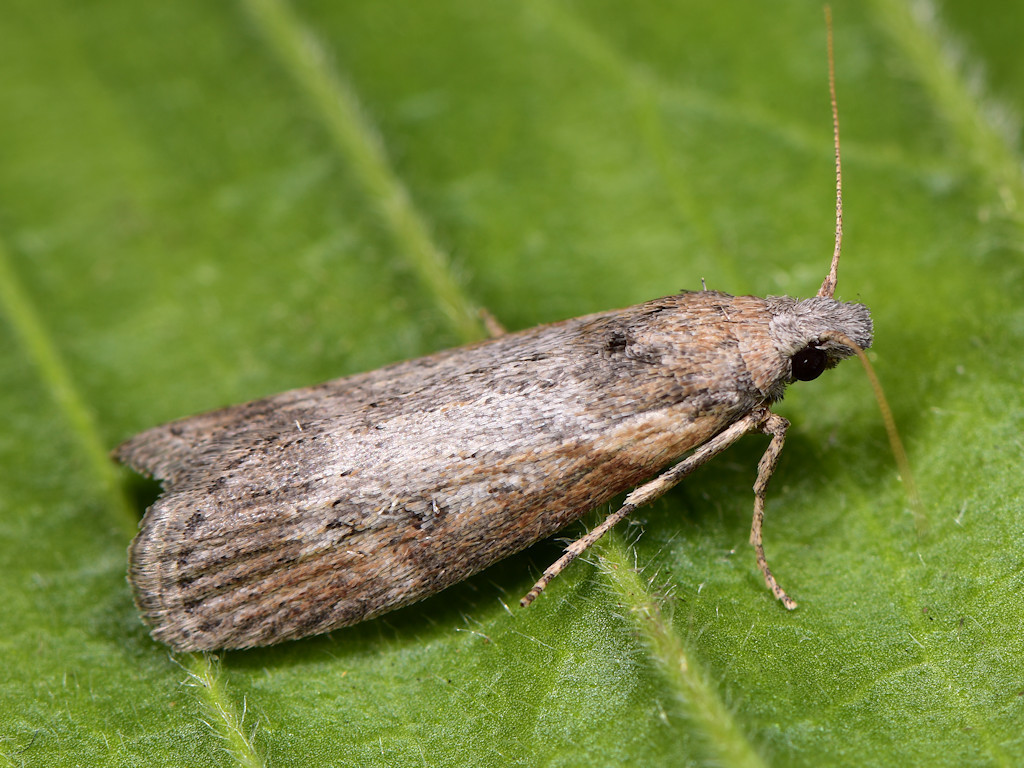
Theresian Moth
Lamoria anella
Lamoria anella is a species of snout moth described by Michael Denis and Ignaz Schiffermüller in 1775. It is found in most of Europe (except Ireland, Great Britain, Fennoscandia, Denmark, the Baltic region and Slovenia), the Canary Islands, as well as North Africa (including Tunisia, Morocco and Egypt), South Africa, India, Afghanistan, Sri Lanka and the United Arab Emirates.
From the article Lamoria anella on Wikipedia (CC BY-SA), quoted section by section
Description
The wingspan measures 18–28 mm for males and 30–40 mm for females. The head, thorax, and abdomen are greyish brown. The forewings are grey-brown, often entirely suffused with red or fuscous. There is an indistinct, highly dentate antemedial line. A more or less developed speck is present in the cell and the discocellular spot. A highly dentate postmedial line is sharply angled on vein 4 and often reduced to streaks on the veins. A marginal specks series is present. The hindwings are pale semi-hyaline, suffused with fuscous towards the margin.
Range & habitat
It is found in most of Europe (except Ireland, Great Britain, Fennoscandia, Denmark, the Baltic region and Slovenia), the Canary Islands, as well as North Africa (including Tunisia, Morocco and Egypt), South Africa, India, Afghanistan, Sri Lanka and the United Arab Emirates. The first confirmed British record was recorded in a garden at Hartford, Huntingdonshire on 5 October 2018, possibly as a migrant.
== References ==
Wikipedia: “Distribution”
Listen
Looking for field recordings…
Where it lives
Recorded sightings
—
geo-referenced records in GBIF, from museums, herbaria and field observers.
Drag the globe to turn it. Dots are where records exist, not a range map; darker means more records.
In the stacks
Searching the stacks…
Every page naming Lamoria anella in the Biodiversity Heritage Library →
This page is assembled live from iNaturalist, GBIF, Wikipedia, the Source Library and the Internet Archive. It is not yet part of the hand-edited codex. iNaturalist taxon 324518.