- Animals
- ›Arthropods
- ›Hexapods
- ›Insects
- ›Winged and Once-winged Insects
- ›True Bugs, Hoppers, Aphids, and allies
- ›True Hoppers
- ›Planthoppers
- ›Fulgoroidea
- ›Lanternflies
- ›Aphaeninae
- ›Aphaenini
- ›Lycorma
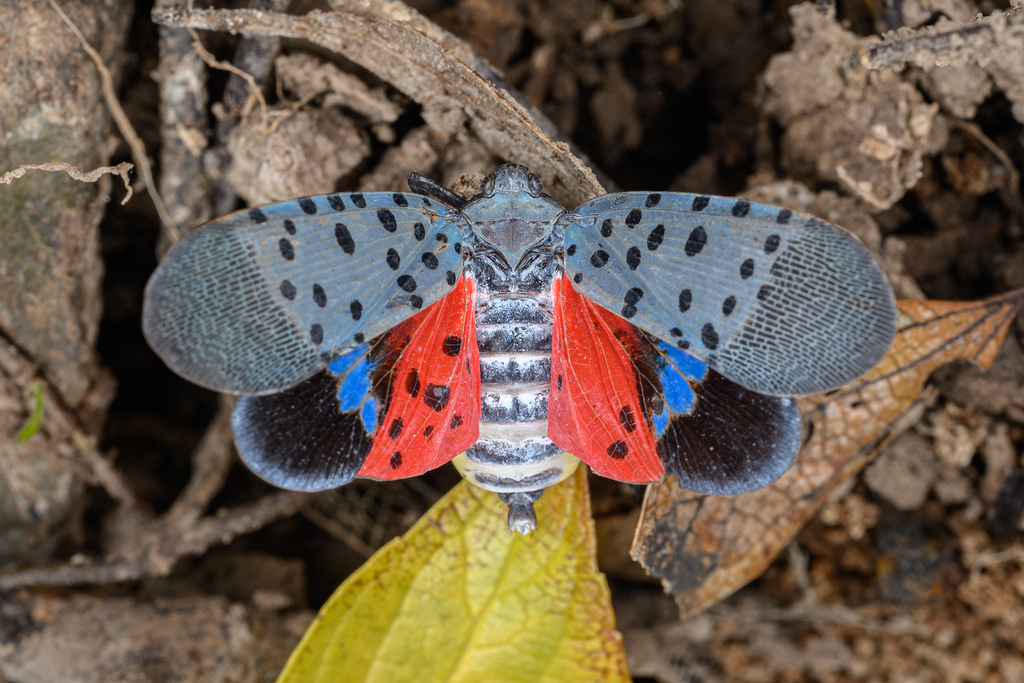
Spotted Lanternfly
Lycorma delicatula
The spotted lanternfly (Lycorma delicatula) is a species of planthopper indigenous to parts of China and Vietnam. It was accidentally introduced into South Korea and has spread invasively to Japan, 21 U.S. states, and Windsor, Ontario in Canada, (where it is often referred to by the acronym "SLF") and parts of Eastern Europe including Moldova. Its preferred host is the also invasive tree of heaven (Ailanthus altissima), but it also feeds on other trees, and on crops including soybean, grapes, stone fruits, and the Malus (apple) genus. In its native habitat, L. delicatula populations are regulated by parasitic wasps.
The spotted lanternfly's life cycle is often centered on its preferred host, Ailanthus altissima, but L. delicatula can associate with more than 173 plants. Early life stages (instars) of the spotted lanternfly are characterized by spotted black and white nymphs that develop a red pigmentation and wings as they mature. Early life instars have a large host range that narrows with maturation. Adult spotted lanternflies have a black head, grey fore wings, and red hind wings. Adults do not have any specialized feeding associations with herbaceous plants but cause extensive damage to crops and ornamental plants. The piercing wounds caused by their mouthparts and the honeydew waste they excrete are harmful to the health of host plants. They feed on the sap of host plants, including the tree of heaven, which is also invasive in the United States. The spotted lanternfly does not pose direct danger to humans through biting or stinging.
From the article Spotted lanternfly on Wikipedia (CC BY-SA), quoted section by section
Description
Adult L. delicatula measure about 25 millimetres (1 in) long and 12 millimetres (1⁄2 in) wide. Adult lanternflies have a black head and gray-brown forewings adorned with black spots. White's original account identified L. delicatula as having a minimum of 20 black spots, with six spots located on the anterior margin of the forewings.
When resting, the crimson hind wings are partially visible through the semi-translucent forewings, giving the lanternfly a red cast. Neatly spaced black rectangular markings color the tips of the forewings in a pattern sometimes likened to brick and mortar. In flight, the spotted lanternfly displays red hind wings with black spots on the proximal third, a white wedge in the middle of the wing, and a solid black wing tip. The abdomen is yellowish with black and white bands on the top and bottom. L. delicatula displays orange, bulbous antennae covered in needle-like tips. The spotted lanternfly is sexually dimorphic. Females have a set of red valvifers at the distal end of the abdomen, which males lack. When gravid (mated), the females' abdomens swell to the point where they have difficulty moving. Adult females, when measured from head to wing tip, have a body length of 20 to 27 millimetres (13⁄16 to 1+1⁄16 in) while males are a smaller size, between 21 and 22 millimetres (53⁄64 and 55⁄64 in). …
Range & habitat
The spotted lanternfly is native to China and subtropical regions of Southeast Asia. Fossil evidence indicates L. delicatula evolved between 55 and 51.6 myr, during the Ypresian Era. Phylogenomic analysis has shown that L. delicatula originally evolved in southwest China, eventually diverging into six phylogeographic lineages. One of these lineages then moved northward, following the Yangtze River during the late Pleistocene Era. In the 1930s, L. delicatula was known to inhabit the Northern Provinces of Shanxi, Shandong and Hebei. Since then, it has expanded its range to include Anhui, Beijing, Guangdong, Henan, Jiangsu, Sichuan, Yunnan and Zhejiang. In traditional Chinese medicine, the spotted lanternfly is believed to be poisonous, and has been used since the 1100s for topical relief from swelling. L. delicatula has also been reported in Taiwan, Vietnam, and India, but ongoing research has yet to conclude whether the species is native to these regions.
Wikipedia: “Native range”
What it does
Nymphs typically hatch from their egg cases starting in late April or early May, marking the beginning of the lanternfly's developmental stages. A nymph passes through several immature stages, all of which are wingless. In the first instar, it is black with white spots. Later instars have red patches in addition to the white spots. The final nymphal instar has red wing pads and a red upper body, before molting to the adult form, with a black head and grayish wings with black spots. Nymphs hop or crawl to search for plants on which to feed. Young nymphs (first through third instars) appear to have a wider host range early on, which narrows as they grow older. Though lanternflies have been recorded feeding on several herbaceous plants, this is most likely due to early-instar nymphs climbing or falling onto these plants; late-instar nymphs and adult lanternflies have no reliable association with herbaceous plants. As early as July, adults can be seen, and they mate and lay eggs from late September through the onset of winter. During mating periods, spotted lanternflies will perform migratory flights. During these migrations, adult L. delicatula will perform a brief courtship and copulation which will last for up to 4 hours. In their native Indomalayan habitat, they lay their eggs preferably on tree of heaven (A. altissima), which is a poisonous invasive species. …
Wikipedia: “Life cycle”
Listen
Looking for field recordings…
Where it lives
Recorded sightings
—
geo-referenced records in GBIF, from museums, herbaria and field observers.
Drag the globe to turn it. Dots are where records exist, not a range map; darker means more records.
In the stacks
Searching the stacks…
Every page naming Lycorma delicatula in the Biodiversity Heritage Library →
This page is assembled live from iNaturalist, GBIF, Wikipedia, the Source Library and the Internet Archive. It is not yet part of the hand-edited codex. iNaturalist taxon 324726.