- Animals
- ›Arthropods
- ›Hexapods
- ›Insects
- ›Winged and Once-winged Insects
- ›Butterflies and Moths
- ›Butterflies
- ›Brush-footed Butterflies
- ›Emperors
- ›Hestina
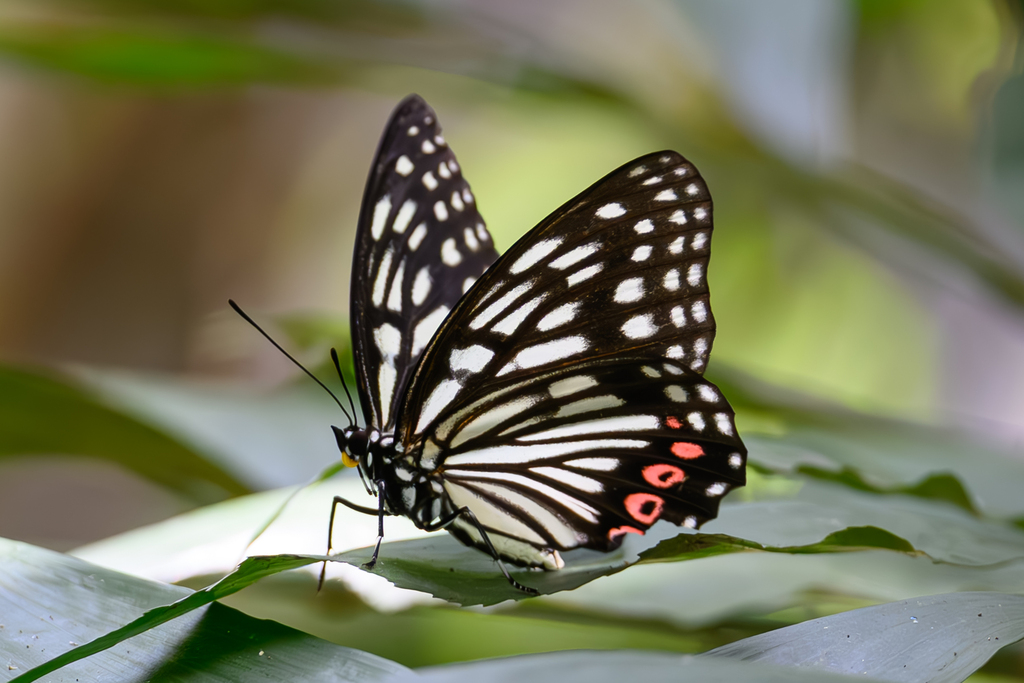
Red Ring Skirt
Hestina assimilis
Hestina assimilis, the red ring skirt, is a species of butterfly in the family Nymphalidae found in Asia. It is generally of large size, and is named for the row of red submarginal spots on the hindwing of summer-generation adults. The species is saprophagous, with adults feeding on tree sap, rotting fruit and dung rather than nectar.
The species is native to northern Vietnam, southern and eastern continental China, the Korean Peninsula and adjacent islands, and to the Amami Islands of Japan, where the endemic subspecies H. a. shirakii occurs. A separate population of the continental nominate subspecies became established in central Honshu in the late 1990s and is treated in Japan as an invasive alien species.
From the article Hestina assimilis on Wikipedia (CC BY-SA), quoted section by section
Description
Adults have a forewing length of 40–53 mm, and females lay on the order of 200 eggs.
Seasonal forms. H. assimilis is seasonally polyphenic. Summer-generation adults have red submarginal spots on the hindwing, while spring-generation adults lack the red spots and are substantially paler, with reduced black scaling — an appearance most pronounced in females. This pale phenotype corresponds to the form long known as nigrivena. Laboratory work on the Kanagawa population showed that the white morph is induced by both short photoperiod and relatively cool temperatures acting together: rearing at 15 °C produced white morphs, whereas 20 °C or 25 °C produced black-veined summer morphs. The temperature-sensitive period fell mainly in the third and fourth larval instars, particularly the fourth, and white morph production was closely associated with markedly delayed larval development. Cool temperature alone was sufficient to produce white morphs even without an intervening larval diapause.
Range & habitat
H. assimilis is found from eastern Tibet to most of China, in Hong Kong and in Korea. Its natural range comprises northern Vietnam, southern and eastern continental China, the Korean Peninsula and peripheral islands such as Jeju, together with the Amami Islands of Japan and Taiwan, where separate subspecies occur.
Wikipedia: “Range”
What it does
H. assimilis often uses its long proboscis to probe in muddy soil or gravel to get the moisture it needs. The male is strongly territorial, always staying in high positions to defend its territory.
Wikipedia: “Behaviour”
Listen
Looking for field recordings…
Where it lives
Recorded sightings
—
geo-referenced records in GBIF, from museums, herbaria and field observers.
Drag the globe to turn it. Dots are where records exist, not a range map; darker means more records.
In the stacks
Searching the stacks…
Every page naming Hestina assimilis in the Biodiversity Heritage Library →
This page is assembled live from iNaturalist, GBIF, Wikipedia, the Source Library and the Internet Archive. It is not yet part of the hand-edited codex. iNaturalist taxon 324771.