- Animals
- ›Arthropods
- ›Hexapods
- ›Insects
- ›Winged and Once-winged Insects
- ›Butterflies and Moths
- ›Tortricid Leafroller Moths and Allies
- ›Tortricid Leafroller Moths
- ›Olethreutine Leafroller Moths
- ›Grapholitini
- ›Cydia
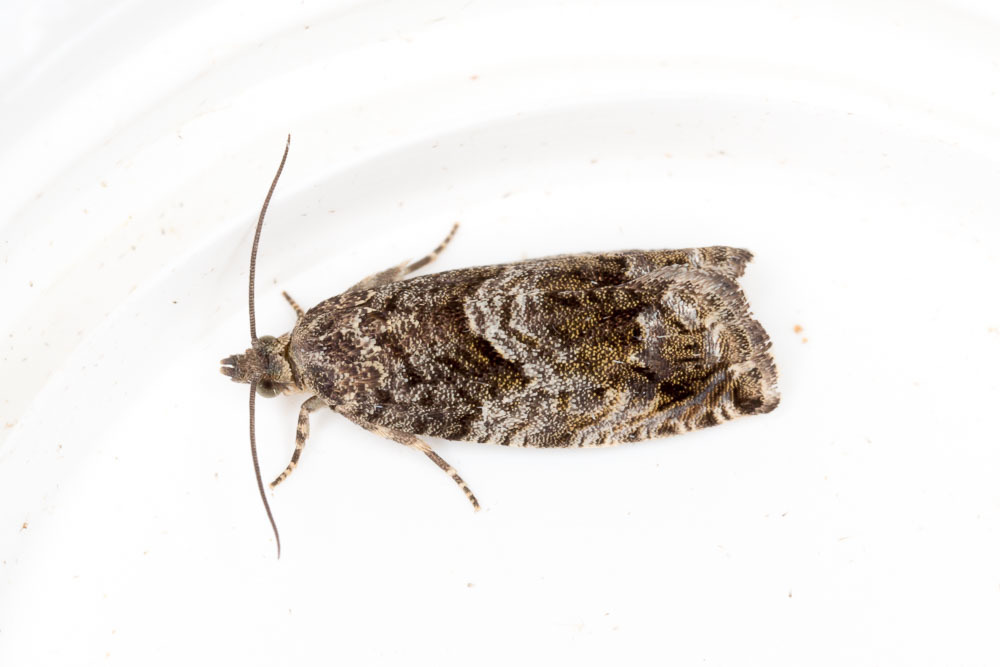
Large Beech Piercer
Cydia fagiglandana
Cydia fagiglandana, the beech moth, is a moth of the Tortricidae family. It is found in most of Europe.
From the article Cydia fagiglandana on Wikipedia (CC BY-SA), quoted section by section
Description
Cydia fagiglandana can reach a wingspan of 12–16 mm. The forewings are brown-black irrorated with whitish, crossed by pairs of fine dark brown stripes. The basal patch is slightly darker, the edge sharply angulated. There are two leaden-metallic streaks from costa posteriorly and a large darker coppery-tinged terminal patch hardly reaching costa. The ocellus within this patch is edged with leaden-metallic, enclosing some blackish marks. The hindwings are fuscous. The larvae are light yellowish or whitish, longitudinally clouded with orange; spots orange; head pale brownish; plate of 2 pale ochreous. This species is rather similar to Cydia splendana.
Range & habitat
This species is present in most of Europe. These moths mainly occur in beech woodland since it is a specialist with beech seeds as the major food of its larvae.
Wikipedia: “Distribution and habitat”
Listen
Looking for field recordings…
Where it lives
Recorded sightings
—
geo-referenced records in GBIF, from museums, herbaria and field observers.
Drag the globe to turn it. Dots are where records exist, not a range map; darker means more records.
In the stacks
Searching the stacks…
Every page naming Cydia fagiglandana in the Biodiversity Heritage Library →
This page is assembled live from iNaturalist, GBIF, Wikipedia, the Source Library and the Internet Archive. It is not yet part of the hand-edited codex. iNaturalist taxon 324869.