- Animals
- ›Arthropods
- ›Hexapods
- ›Insects
- ›Winged and Once-winged Insects
- ›Butterflies and Moths
- ›Geometrid and Swallowtail Moths
- ›Geometer Moths
- ›Carpet Moths
- ›Pug Moths & Allies
- ›Eupithecia
- ›Eupithecia centaureata
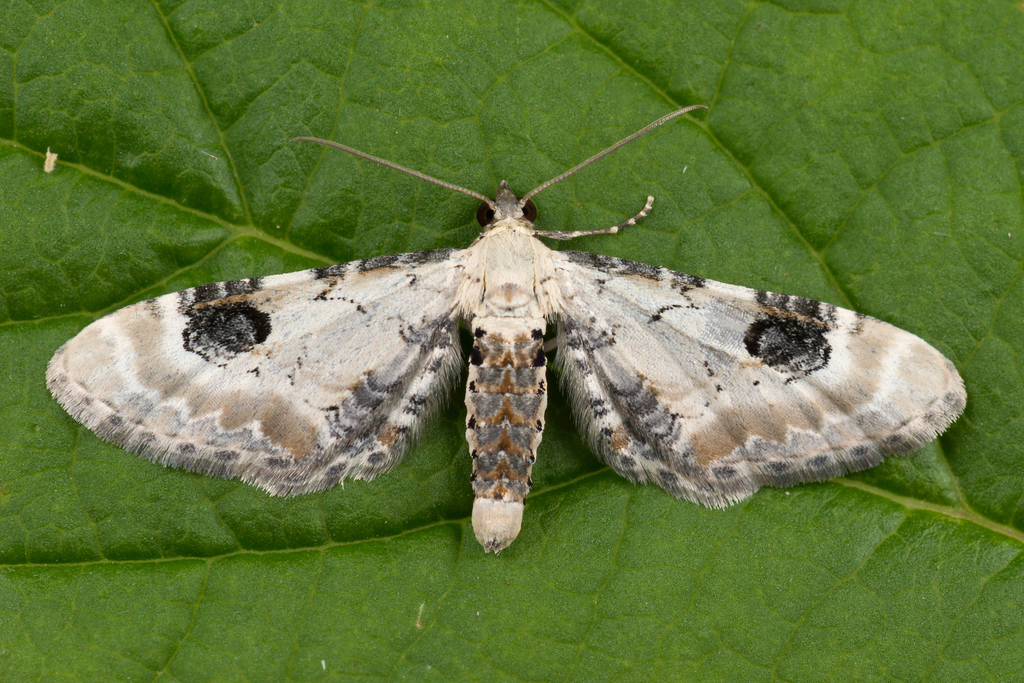
Lime-speck Pug
Eupithecia centaureata
The lime-speck pug (Eupithecia centaureata) is a moth of the family Geometridae. It is a common species throughout the Palearctic region (where it is found in Europe, Central Asia, Mongolia, southern Siberia, eastern China (Guangdong) and Taiwan), the Near East and North Africa.
From the article Lime-speck pug on Wikipedia (CC BY-SA), quoted section by section
Description
This is a distinctive species, all the wings being largely white except for a black blotch on the costa of the forewing. The wingspan is 20–24 mm. In the ab. obscura Dietze.(perhaps developed chiefly in Asia but also recorded from the Tyrol) the ground-colour of both wings has a smoky suffusion. In the ab. centralisata Stgr., chiefly from Palestine and Central Asia, the markings are weaker, sometimes (except the discal mark) almost entirely obsolete. The larva is long and thin, white-yellow with a red dorsal stripe and horseshoe-shaped red spots running down the sides.
Often two broods are produced each year and the adults can be seen at any time during the summer and autumn. The moths fly at night and are attracted to light and nectar-rich flowers. The larva is rather variable but is usually green or yellow, often with red markings. It feeds on the flowers of a variety of plants (see list below). The species overwinters as a pupa.
Listen
Looking for field recordings…
Where it lives
Recorded sightings
—
geo-referenced records in GBIF, from museums, herbaria and field observers.
Drag the globe to turn it. Dots are where records exist, not a range map; darker means more records.
In the stacks
Searching the stacks…
Every page naming Eupithecia centaureata in the Biodiversity Heritage Library →
This page is assembled live from iNaturalist, GBIF, Wikipedia, the Source Library and the Internet Archive. It is not yet part of the hand-edited codex. iNaturalist taxon 325476.