- Animals
- ›Arthropods
- ›Chelicerates
- ›Arachnids
- ›Spiders
- ›Typical Spiders
- ›Entelegyne Spiders
- ›RTA Clade Spiders
- ›Oval calamistrum clade spiders
- ›Wolf Spiders and Allies
- ›Wolf Spiders
- ›Pardosinae
- ›Pardosa
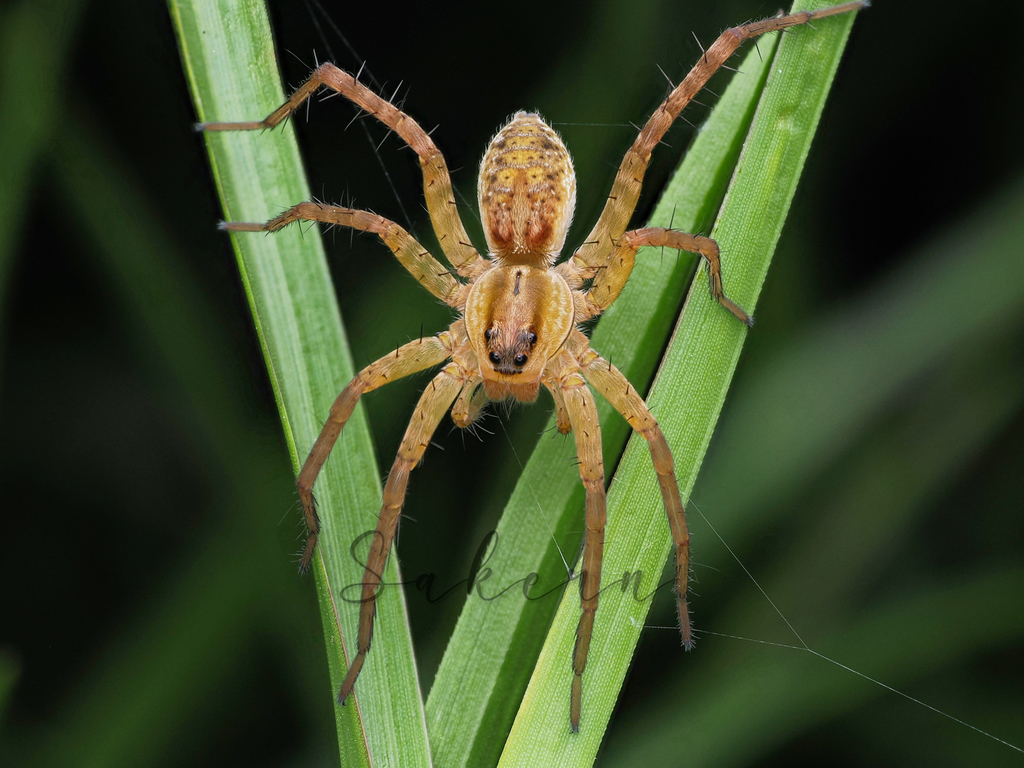
Pond Wolf Spider
Pardosa pseudoannulata
Pardosa pseudoannulata, a member of a group of species referred to as wolf-spiders, is a non-web-building spider belonging to the family Lycosidae. P. pseudoannulata are wandering spiders that track and ambush prey and display sexual cannibalism. They are commonly encountered in farmlands across China and other East Asian countries. Their venom has properties that helps it function as an effective insecticide, and it is, therefore, a crucial pesticide control agent.
From the article Pardosa pseudoannulata on Wikipedia (CC BY-SA), quoted section by section
Description
Pardosa pseudoannulata exhibits significant sexual dimorphism in terms of size. Females are, on average, 1.3 times larger than the males. This spider can be recognized by the ring markings on its legs and the dark bands on its carapace. The underside of these spiders is characterized by six black dots. Female P. pseudoannulata are easy to detect, as most will have an egg sac attached to their spinnerets. P. pseudoannulata have three rows of eyes with the front row having four eyes and the other rows having two eyes each.
Range & habitat
Pardosa pseudoannulata is widely spread across China, India, Korea, Japan and other countries in East Asia. It is most commonly found in farm fields throughout China. These spiders are commonly seen in rice fields and are the dominant predator.
Wikipedia: “Distribution”
What it does
Pardosa pseudoannulata commonly starve and have a hard time foraging for sufficient nutrients. Therefore, the occurrence of sexual cannibalism provides an adaptive strategy for female survival as well as reproductive benefits. Pre-copulation cannibalism in which the male spider is used solely as food is commonly observed in females who have already mated. The consumption of conspecifics makes up a quarter of the female's diet. Male spiders are an especially good source of nutrition because of their large size (females are 1.3 times larger) when compared to natural prey, which are insects that are several times smaller than the females. The natural prey of Pardosa pseudoannulata are rice field pests, with the rice brown planthopper, Nilaparvata lugens, as the most common. N. lugens are abundant in rice fields and detrimental to the growth of rice plants. Pardosa pseudoannulata prefers the rice brown planthopper over other pests, with the planthopper making up around 30% percent of an average spider's diet.
Abdomen size. Pardosa pseudoannulata’s abdomen width is an important indicator of its hunting abilities and starvation resistance. There is a trade-off between the hunting abilities and the period of time the spider can withstand hunger. …
Wikipedia: “Diet”
Where it lives
Recorded sightings
—
geo-referenced records in GBIF, from museums, herbaria and field observers.
Drag the globe to turn it. Dots are where records exist, not a range map; darker means more records.
In the stacks
Searching the stacks…
Every page naming Pardosa pseudoannulata in the Biodiversity Heritage Library →
This page is assembled live from iNaturalist, GBIF, Wikipedia, the Source Library and the Internet Archive. It is not yet part of the hand-edited codex. iNaturalist taxon 325487.