- Animals
- ›Arthropods
- ›Hexapods
- ›Insects
- ›Winged and Once-winged Insects
- ›Butterflies and Moths
- ›Owlet Moths and Allies
- ›Cutworm Moths and Allies
- ›Cutworms and Dart Moths
- ›Noctuini
- ›Noctuina
- ›Chersotis
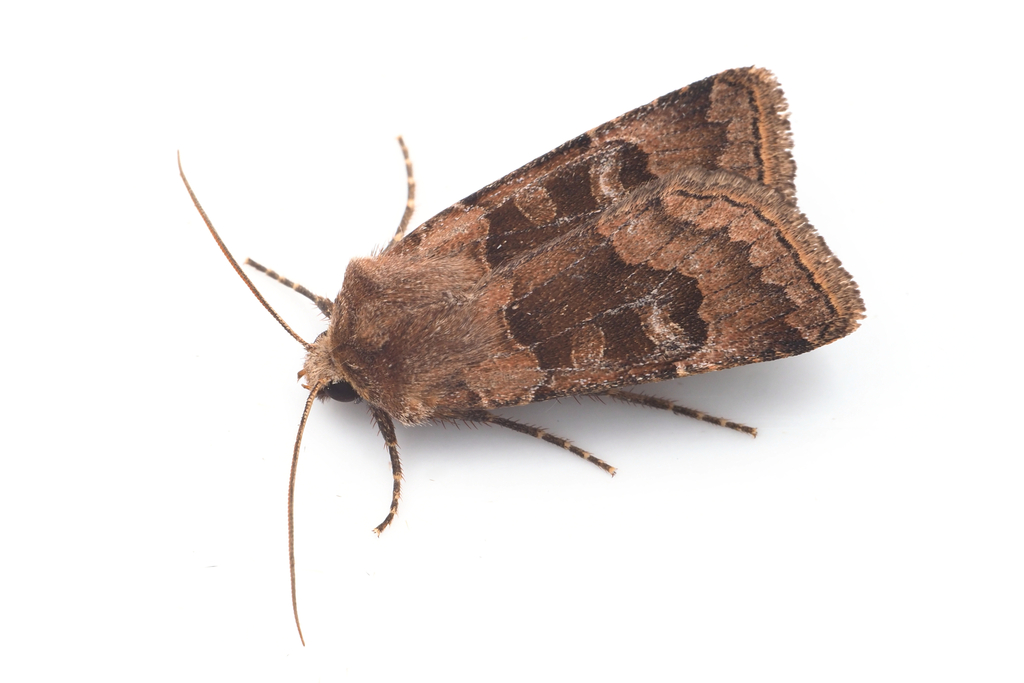
Chersotis cuprea
Chersotis cuprea is a moth of the Noctuidae family.
From the article Chersotis cuprea on Wikipedia (CC BY-SA), quoted section by section
Description
Adult males have a wingspan of 32–36 millimetres (1.3–1.4 in); adult females have a wingspan of 33–39 millimetres (1.3–1.5 in). This species shows a high variability in the basic colors. Usually, the upper side of the forewings is coppery reddish brown (hence the Latin name cuprea) with dark brown markings that have a thin whitish border. The underside of the forewing is dark gray-brown. The hind wings are monochrome gray-brown. Caterpillars are gray-brown, with dark dorsal markings and bright side stripes. Warren (1914) states R. cuprea Schiff. (= haematitedea Esp.) that the forewing is a dull brown; the median area below the subcostal vein is dark brown; the veins and edges of stigmata are very finely pale; the stigmata are a deep brown; the costa is dark with fine pale speckling and a dark shade before the submarginal line; the hindwing is gray-brown with a yellowish fringe. The species in found in Northern Europe (excluding Britain), Armenia, and Kamschatka. The larvae are dull brown, with 3 whitish dorsal lines, some oblique black subdorsal streaks, and a grey lateral line; The larvae live on various low plants.
Range & habitat
This species can be found in Northern Europe, the Pyrenees, Central Europe down to Greece and east through Ukraine, Siberia, Turkey, the Caucasus and Armenia, up to China and Japan.
Wikipedia: “Distribution”
Listen
Looking for field recordings…
Where it lives
Recorded sightings
—
geo-referenced records in GBIF, from museums, herbaria and field observers.
Drag the globe to turn it. Dots are where records exist, not a range map; darker means more records.
In the stacks
Searching the stacks…
Every page naming Chersotis cuprea in the Biodiversity Heritage Library →
This page is assembled live from iNaturalist, GBIF, Wikipedia, the Source Library and the Internet Archive. It is not yet part of the hand-edited codex. iNaturalist taxon 332688.