- Plants
- ›Vascular Plants
- ›flowering plants
- ›Dicots
- ›Nances, Willows, and Allies
- ›Passionfruit Family
- ›Passifloroideae
- ›Passifloreae
- ›Passiflora
- ›Passiflora
- ›Tiliifolia
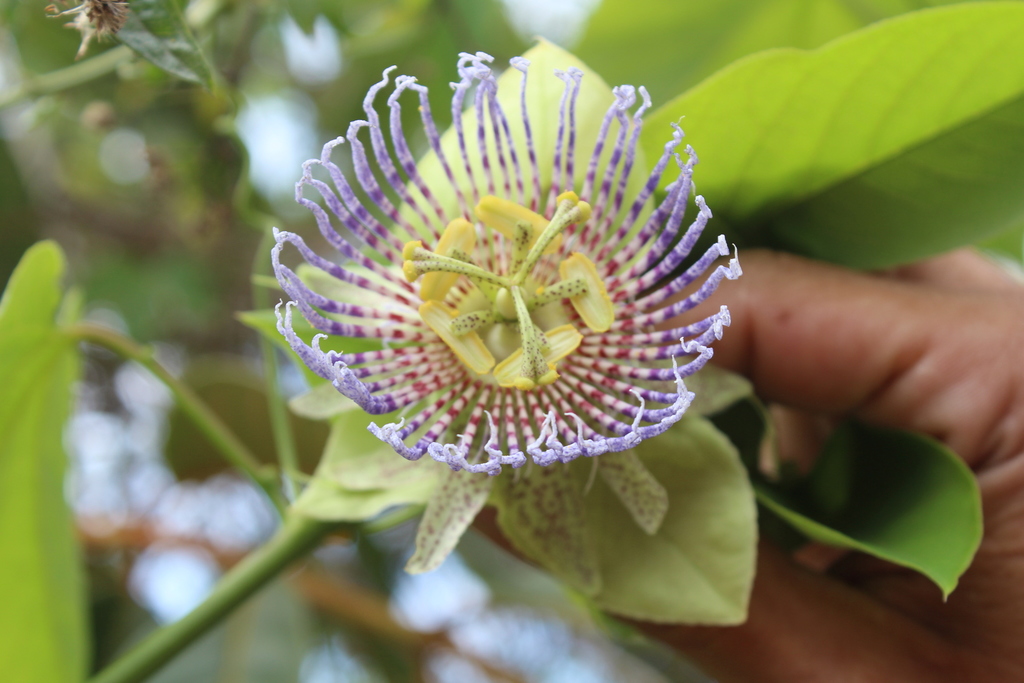
Passiflora platyloba
Passiflora platyloba is a species of flowering plant in the family Passifloraceae. It is a climbing plant with purple flowers. The species is native to Mexico central America, and Colombia, and was described in 1922.
From the article Passiflora platyloba on Wikipedia (CC BY-SA), quoted section by section
Description
Passiflora platyloba is a climbing plant. The stem is stout and cylindrical. The leaf stems are 6–7 centimetres (2.4–2.8 in) long. The leaves are suborbicular to ovate, 10–14 centimetres (3.9–5.5 in) long, and 12–18 centimetres (4.7–7.1 in) wide. The flower is enclosed by bracts, which are 5–6 centimetres (2.0–2.4 in) long, and 3–4 centimetres (1.2–1.6 in) wide. The flower stems are solitary, and 6–7 centimetres (2.4–2.8 in) long. The flower is purple, 4–5 centimetres (1.6–2.0 in) wide, and has a tube around 1 centimetre (0.39 in) long. The sepals are oblong-lanceolate, 1.8–2 centimetres (0.71–0.79 in) long, around 0.8 centimetres (0.31 in) wide, and slightly fleshy. The petals are linear-lanceolate, 1.5–1.7 centimetres (0.59–0.67 in) long, and around 0.5 centimetres (0.20 in) wide. The flower has coronas with several series of filaments. Passiflora platyloba resembles Passiflora seemannii, though the former has longer bracts.
Range & habitat
Passiflora platyloba is native to the wet tropical biome of Colombia, Costa Rica, El Salvador, Guatemala, Honduras, south-east Mexico, Nicaragua, and Panamá.
Wikipedia: “Distribution”
Where it lives
Recorded sightings
—
geo-referenced records in GBIF, from museums, herbaria and field observers.
Drag the globe to turn it. Dots are where records exist, not a range map; darker means more records.
In the stacks
Searching the stacks…
Every page naming Passiflora platyloba in the Biodiversity Heritage Library →
This page is assembled live from iNaturalist, GBIF, Wikipedia, the Source Library and the Internet Archive. It is not yet part of the hand-edited codex. iNaturalist taxon 332792.