- Animals
- ›Arthropods
- ›Hexapods
- ›Insects
- ›Winged and Once-winged Insects
- ›Butterflies and Moths
- ›Hawk, Sphinx, Silk, Emperor, and Allied Moths
- ›Emperor and Giant Silk Moths
- ›Emperor Moths
- ›Saturniini
- ›Cricula
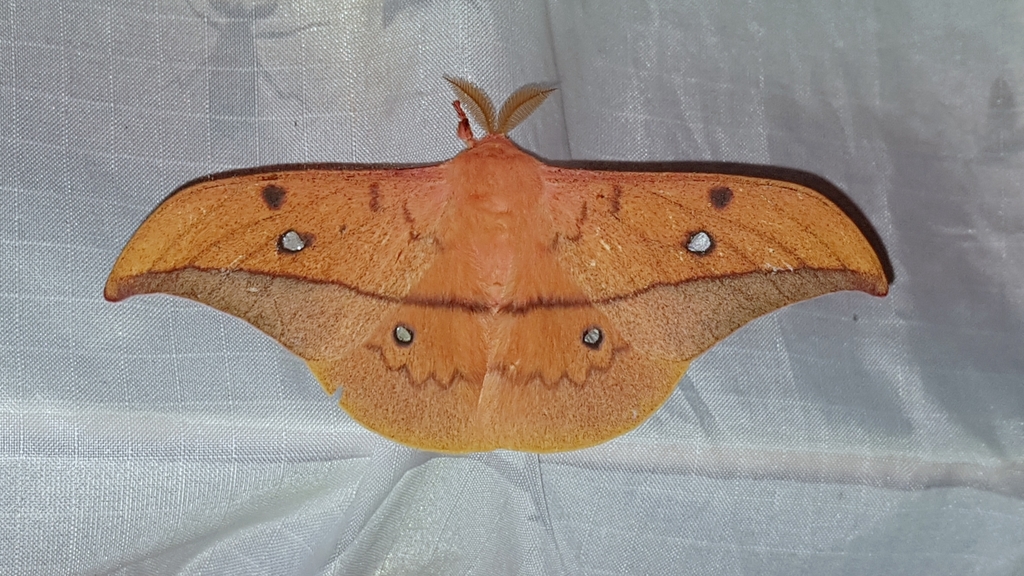
Cricula Silkmoth
Cricula andrei
Cricula trifenestrata, the cricula silkmoth, is a species of wild silk moth of the family Saturniidae. It is found from India to the Philippines, Sulawesi, Java, and Sri Lanka.
From the article Cricula trifenestrata on Wikipedia (CC BY-SA), quoted section by section
Description
The wingspan is 65–100 mm. Adults are on wing from May to June with a possible second brood from August to September. Male is brown, ochreous, yellowish to reddish. Forewings are consisted with a waved anti-medial dark line and a small hyaline spot beyond the end of the cell, with one or two others above it. The upper one is a dark spot. Hindwings with oblique line continued to the inner margin before the middle. There is a hyaline spot beyond the cell. Ventral side is much purple. Female is red. There are three large irregularly shaped hyaline spots beyond the cell of the forewing, often with one or two small sides inside them. Larva is blackish brown with red spots in color and hairy. There are six setiferous tubercles in each somite from 2nd to 11th. First somite and anal claspers are crimson colored. Legs and prolegs are brown colored. The larvae have been recorded on Anacardium, Mangifera, Spondias, Careya, Bischofia, Canarium, Quercus, Cinnamomum, Machilus, Persea, Acrocarpus, Ziziphus, Malus, Prunus, Pyrus, Salix and Schleichera species. Pupa At this phase, a tube that releases golden silk fibres replaces the mouth as they do not eat. After passing the last frass, each pupa will begin to spin golden cocoon between one or several leaves. Cocoon composed of bright golden yellow silk firmly united into a network. …
Listen
Looking for field recordings…
Where it lives
Recorded sightings
—
geo-referenced records in GBIF, from museums, herbaria and field observers.
Drag the globe to turn it. Dots are where records exist, not a range map; darker means more records.
In the stacks
Searching the stacks…
Every page naming Cricula andrei in the Biodiversity Heritage Library →
This page is assembled live from iNaturalist, GBIF, Wikipedia, the Source Library and the Internet Archive. It is not yet part of the hand-edited codex. iNaturalist taxon 333592.