- Animals
- ›Arthropods
- ›Hexapods
- ›Insects
- ›Winged and Once-winged Insects
- ›Butterflies and Moths
- ›Butterflies
- ›Gossamer-winged Butterflies
- ›Blues
- ›Typical Blues
- ›Polyommatina
- ›Polyommatus
- ›Agrodiaetus
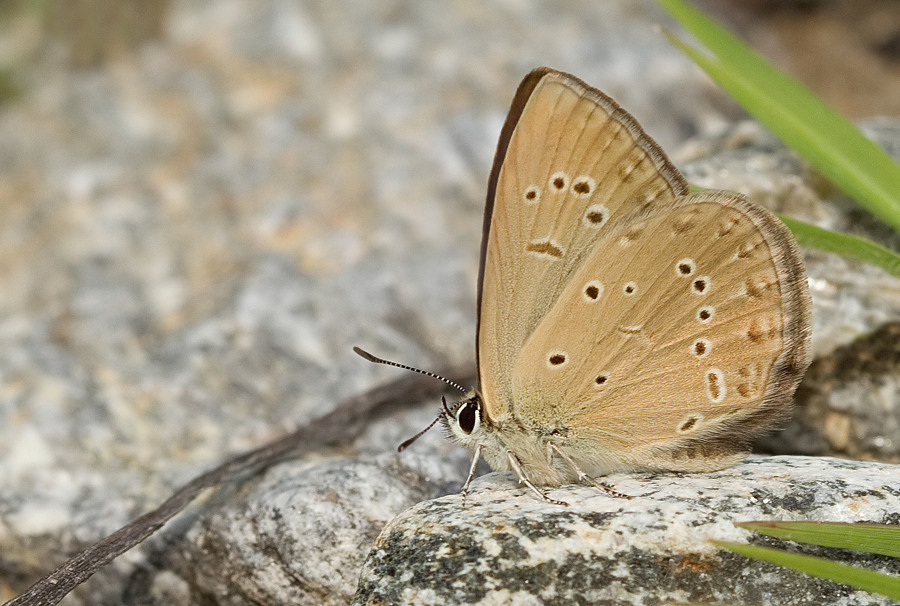
Anomalous Blue
Polyommatus admetus
Polyommatus admetus, the anomalous blue, is a butterfly of the family Lycaenidae. It was described by Eugenius Johann Christoph Esper in 1783. It is found in south-eastern Europe and Turkey.
The wingspan is 30–40 mm. Adults are on wing from June to August.
From the article Polyommatus admetus on Wikipedia (CC BY-SA), quoted section by section
Description
L. admetus Esp. (81 e). Male and female above dull dark brown, without metallic blue or aeneous gloss; the discocellular spot of the forewing and the black veins mostly distinctly contrasting. The hindwing, especially of the female, often bears obsolete reddish anal spots. The underside is somewhat paler brown than the upper, with distinct ocelli but no basal ocelli on the forewing. In South-East Europe, from Hungary and Galicia through the Balkan Peninsula and Asia Minor to Mesopotamia, and also in Spain. — ripartii Frr. (81 f), has a white mesial streak on the hindwing below, which extends from the base to the outer margin. More widely distributed than admetus, found in the Alps, South France, Eastern Europe, Asia Minor, Persia and Turkestan. — The egg is greenish at first, but later on, it is white. Larva on Onobrychis cristagalli. The butterflies are on the wing in June and July and fly on slopes with sparse vegetation, settling particularly on lavender. They are plentiful in most places where they occur.
Wikipedia: “Description from Seitz”
In human culture
Named in the Classical tradition. In Greek mythology, Admetus of Pherae was a friend of Hercules.
== References ==
Wikipedia: “Etymology”
Listen
Looking for field recordings…
Where it lives
Recorded sightings
—
geo-referenced records in GBIF, from museums, herbaria and field observers.
Drag the globe to turn it. Dots are where records exist, not a range map; darker means more records.
In the stacks
Searching the stacks…
Every page naming Polyommatus admetus in the Biodiversity Heritage Library →
This page is assembled live from iNaturalist, GBIF, Wikipedia, the Source Library and the Internet Archive. It is not yet part of the hand-edited codex. iNaturalist taxon 334405.