- Animals
- ›Arthropods
- ›Hexapods
- ›Insects
- ›Winged and Once-winged Insects
- ›Butterflies and Moths
- ›Butterflies
- ›Brush-footed Butterflies
- ›Fritillaries and Longwings
- ›Fritillaries
- ›Argynnis
- ›Fabriciana
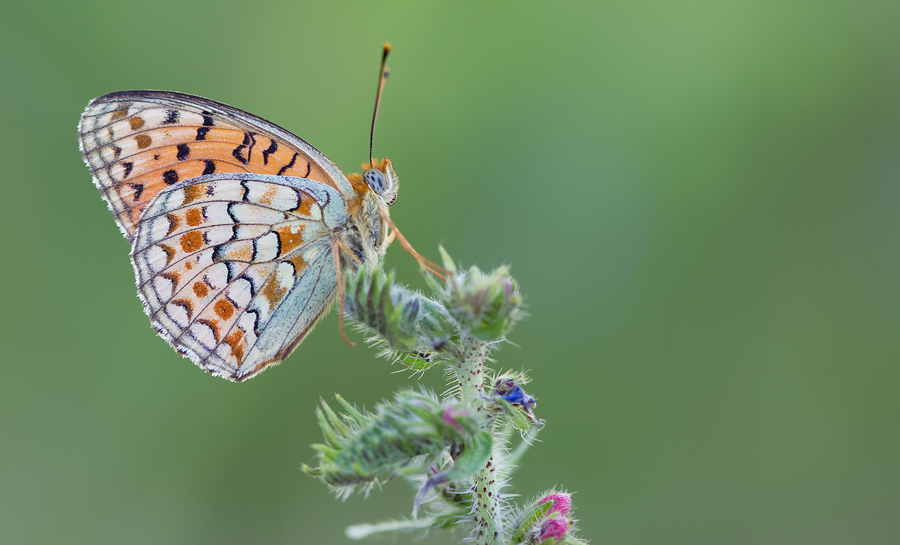
Niobe fritillary
Argynnis niobe
The Niobe fritillary (Fabriciana niobe) is a species of butterfly in the family Nymphalidae.
From the article Niobe fritillary on Wikipedia (CC BY-SA), quoted section by section
Description
Fabriciana niobe has a wingspan of 46–60 millimetres (1.8–2.4 in). The females are rather bigger and have more marked wings. These medium-sized butterflies have a bright brown-orange background with black dots and crossbands, and a line of submarginal triangular patches. The forewings margin shows a rounded shape. The underside of the hindwings usually has small whitish-silvery spots, a black pupilled yellow spot and black lined submarginal lunules and veins in the basal area. Caterpillars have a dark basic colour with small, white spots and white thorns. This species is rather similar to the dark-green fritillary (Speyeria aglaja) and high brown fritillary (Fabriciana adippe), but it is quite smaller, the silver centred brown spots are smaller and the postdiscal silver markings are not continuous. Seitz - A. niobe L. (69c). Above very similar to aglaja, at once recognized by the much more variegated under-side. The hindwing beneath is without the even verdigris shading in the basal half, the latter bearing distinct leathery-yellow patches, which are often centred, edged or shaded with brownish green. The nymotypical form has abundant silver-spots beneath, more than aglaja, as the distal band has no silver in aglaja, while it bears silvery centres in niobe.
Range & habitat
Fabriciana niobe is common throughout Europe, but absent from the United Kingdom and Northern Europe, and is also found in Siberia, Russia, Iran, China, and Korea These butterflies can be found in open grassy places, slopes, woodland and clearings at altitudes between sea level and 2,400 metres (7,900 ft).
Wikipedia: “Distribution and habitat”
In human culture
The Latin species name niobe refers to Niobe, daughter of Tantalus in Greek mythology.
Wikipedia: “Etymology”
Listen
Looking for field recordings…
Where it lives
Recorded sightings
—
geo-referenced records in GBIF, from museums, herbaria and field observers.
Drag the globe to turn it. Dots are where records exist, not a range map; darker means more records.
In the stacks
Searching the stacks…
Every page naming Argynnis niobe in the Biodiversity Heritage Library →
This page is assembled live from iNaturalist, GBIF, Wikipedia, the Source Library and the Internet Archive. It is not yet part of the hand-edited codex. iNaturalist taxon 335001.