- Animals
- ›Arthropods
- ›Hexapods
- ›Insects
- ›Winged and Once-winged Insects
- ›Butterflies and Moths
- ›Butterflies
- ›Skippers
- ›Coeliadinae
- ›Bibasis
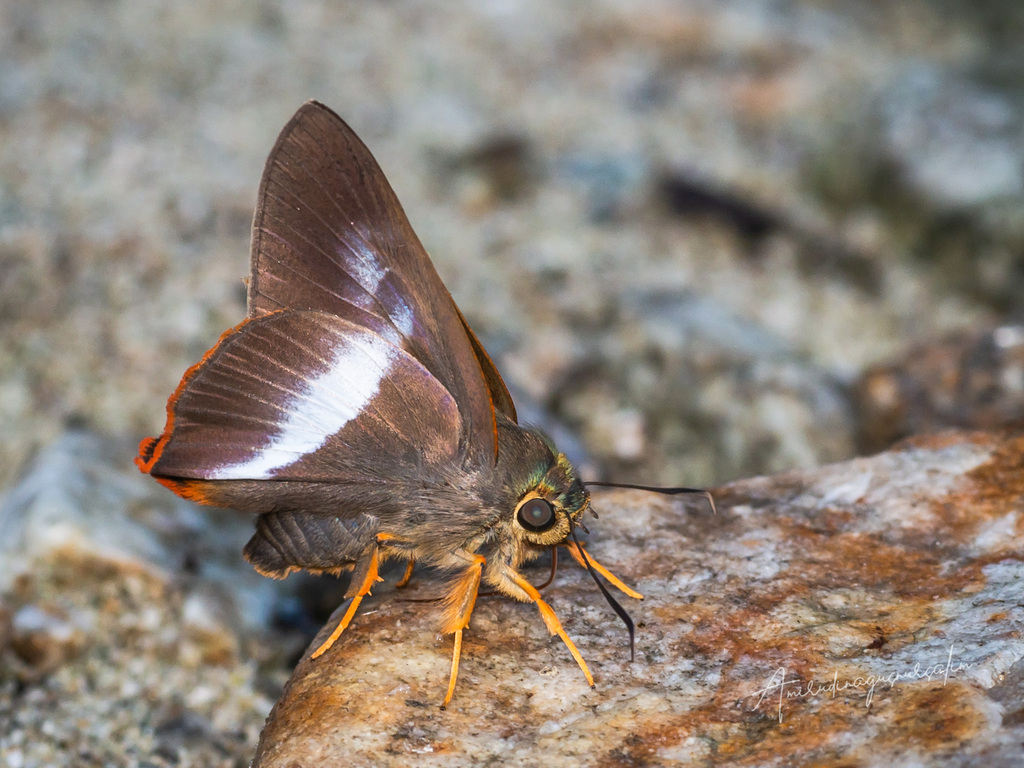
Orangetail Awlet
Bibasis sena
Bibasis sena, commonly known as the orange-tailed awlet, is a butterfly belonging to the family Hesperiidae, the skippers. It is also sometimes called the pale green awlet though that name can also refer to Burara gomata.
From the article Bibasis sena on Wikipedia (CC BY-SA), quoted section by section
Description
Both sexes: The butterfly has a wingspan of 45 to 50 mm. Above, both sexes are an unblemished dark brown. The hindwings have an orange fringe. The abdomen is orange towards the rear. Below, the wings have white patches; the forewings having a large white central patch, and the hindwings having a broad pure white discal band. The male has no brands.
Detailed description. Edward Yerbury Watson (1891) gives a detailed description as follows:
Male. Upperside dark chocolate brown. Cilia of hindwing carmine-red. Underside maroon brown; forewing with a large buff-white patch from the middle of posterior margin, bordered above with purple; hindwing with a broad transverse purple white band terminating before the anal angle, the inner border of which is sharply defined, the outer suffusing itself on the disk. Cilia carmine-red. Palpi and thorax in front, beneath and anal tuft dull yellow. Thorax beneath greyish brown.
The female is described by Mr. Moore in his "Lepidoptera of Ceylon" as not differing from the male.
Range & habitat
This skipper is found in Sri Lanka, India, China (Hainan), Myanmar, Cambodia, Thailand, Laos, Vietnam, Malaysia (Malay peninsula), Indonesian archipelago (including Borneo, Java, Kangean, Bali, Lombok, Bawean, Sumba, Sumbawa) and the Philippines. In India, this skipper is found in the Western Ghats including the Nilgiris, Kodagu, Kanara, and the Himalayas, from Shimla eastward to Northeast India and onto Myanmar (recorded in the Karens and Dawnas). Also found in Andaman and Nicobar Islands. The type locality for this species is the region of Bengal.
Wikipedia: “Distribution”
In human culture
The larva has been recorded on Combretum latifolium and Combretum extensum in Kanara. In the Andamans the larvae has been recorded on Hiptage benghalensis (Malpighiaceae).
Wikipedia: “Life history”
Listen
Looking for field recordings…
Where it lives
Recorded sightings
—
geo-referenced records in GBIF, from museums, herbaria and field observers.
Drag the globe to turn it. Dots are where records exist, not a range map; darker means more records.
In the stacks
Searching the stacks…
Every page naming Bibasis sena in the Biodiversity Heritage Library →
This page is assembled live from iNaturalist, GBIF, Wikipedia, the Source Library and the Internet Archive. It is not yet part of the hand-edited codex. iNaturalist taxon 335208.